How many electrons are transferred in the following net chemical reaction when the chemical equation is...
How many electrons are transferred in the following net chemical reaction when the chemical equation is balanced with lowest possible whole number coefficients. The reaction is written using line notation (also called cell notation): Cu (s) | Cu2+ (aq, 1 M) || H+ (aq, 1 M), MnO4 - (1 M), Mn2+ (1 M) | Pt
Homework Answers
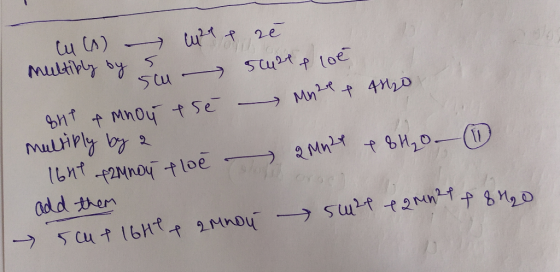
If you have any questions please comment
If you satisfied with the solution please rate it thanks
Add Answer to:
How many electrons are transferred in the following net chemical
reaction when the chemical equation is...
Question 4 1 pts How many electrons are transferred in the following reaction? Enter your answer as an integer. 4NO...
 Question 4 1 pts How many electrons are transferred in the following reaction? Enter your answer as an integer. 4NO3 +4H* +45b 4 NO+2H20 +Sb406 Question 5 1.5 pts Given the partial equation: VO2 + Mn2+ - VO2++ MnO4 , balance the reaction in acidic solution using the half-reaction method and fill in the coefficients. The missing blanks represent H2O, H. or OH, as required to balance the reaction. Enter the coefficients as integers, using the lowest whole numbers. If...
when the oxidation-reduction reaction shown here is balanced, how many electrons are transferred for each atom...
 when the oxidation-reduction reaction shown here is balanced, how
many electrons are transferred for each atom of copper that reacts?
When the oxidation-reduction reaction shown here is balanced, how many electrons are transferred for each atom of copper that reacts? Ag (aq) + Cu(s) → Ag(s) + Cu2(aq) a. 1 c. 3 e. 0 b. 2 d. 4
when the oxidation-reduction reaction shown here is balanced, how
many electrons are transferred for each atom of copper that reacts?
When the oxidation-reduction reaction shown here is balanced, how many electrons are transferred for each atom of copper that reacts? Ag (aq) + Cu(s) → Ag(s) + Cu2(aq) a. 1 c. 3 e. 0 b. 2 d. 4
Given the following line notation for an electrochemical cell, write the balanced net equation: Zn(s) |...
Given the following line notation for an electrochemical cell, write the balanced net equation: Zn(s) | Zn2+ (aq, 1 M) || H+ (aq, 1 M), MnO4 - (1 M), Mn2+ (1 M) | Pt
Consider the unbalanced half reaction shown below: (MnO4)-(aq) → MnO2(s) When this half reaction is balanced...
Consider the unbalanced half reaction shown below: (MnO4)-(aq) → MnO2(s) When this half reaction is balanced with the lowest possible whole number coefficients how many electrons will there be in the balanced half reaction?
What is the net redox reaction that occurs when Ag comes into contact with acidic K2Cr2O7?
Students should always be careful of the chemical reaction between jewelry and laboratory reagents. The table below shows the reduction reactions and potentials for some common lab reagents and metals.Ox + ne1-RedEo(V)Ni2+(aq) + 2e1-↔ Ni(s)-0.23SO42-(aq) + 4H1+(aq) + 2e1-↔H2SO3(aq) + H2O+0.20Cu2+(aq) + 2e1-↔ Cu(s)+0.34Ag1+(aq) + e1-↔ Ag(s)+0.80Pt2+(aq) + 2e1-↔ Pt(s)+1.19Cr2O72-(aq) + 14H1+(aq) + 6e1-↔ 2Cr3+(aq) + 7H2O+1.33Au3+(aq) + 3e1-↔ Au(s)+1.50MnO41-(aq) + 8H1+(aq) + 5e1-↔ Mn2+(aq) + 4H2O+1.51(a) What is the net redox reaction that occurs when Au comes into contact...
How many electrons are transferred in the following redox reaction when it is properly balanced with...
 How many electrons are transferred in the following redox reaction when it is properly balanced with the smallest possible integer coefficients? Ag2O(s) + Mo(s) → MoO3(s) + Ag(s) 4 a 3 O 1 2
Enter electrons as e A voltaic cell is constructed in which the anode is a Mn...
 Enter electrons as e A voltaic cell is constructed in which the anode is a Mn Mn+ half cell and the cathode is a Ag Agt half cell. The half-cell compartments are connected by a salt bridge. (Use the lowest possible coefficients. Use the pull-down boxes to specify states such as (aq) or (s). If a box is not needed, leave it blank.) The anode reaction is: The cathode reaction is: The net cell reaction is: In the external circuit,...
When the following equation is balanced properly under acidic conditions, what are the coefficients of the...
When the following equation is balanced properly under acidic conditions, what are the coefficients of the species shown? Pb2+ + Mg2+------> PbO2 + Mg Water appears in the balanced equation as a______ (reactant, product, neither) with a coefficient of _____ (Enter 0 for neither.) How many electrons are transferred in this reaction? _____ When the following equation is balanced properly under acidic conditions, what are the coefficients of the species shown? Cr3+ + Mn2+-------->Cr2+ + MnO4- Water appears in the...
The following chemical reaction occurs in a basic solution. Mg2+(aq) + MnO2(aq) + OH−(aq) → Mg(s)...
The following chemical reaction occurs in a basic solution. Mg2+(aq) + MnO2(aq) + OH−(aq) → Mg(s) + MnO4−(aq) + H2O(l) How many moles of electrons are transferred when the equation is balancedusing the smallest whole-number coefficients?
1. Balance the reaction between Mg and NO3- to form Mg2+ and HNO2 in acidic solution....
 1. Balance the reaction between Mg and
NO3- to form
Mg2+ and
HNO2 in acidic solution.
When you have balanced the equation using the smallest integers
possible, enter the coefficients of the species shown. Enter "1" if
the coefficient is "1."
Mg + NO3Mg2+
+ HNO2
Water appears in the balanced equation as a (reactant,
product, neither) with a coefficient of ______. (Enter 0 for
neither.)
How many electrons are transferred in this reaction? _______
.
.
2. Balance the following...
1. Balance the reaction between Mg and
NO3- to form
Mg2+ and
HNO2 in acidic solution.
When you have balanced the equation using the smallest integers
possible, enter the coefficients of the species shown. Enter "1" if
the coefficient is "1."
Mg + NO3Mg2+
+ HNO2
Water appears in the balanced equation as a (reactant,
product, neither) with a coefficient of ______. (Enter 0 for
neither.)
How many electrons are transferred in this reaction? _______
.
.
2. Balance the following...
 Question 4 1 pts How many electrons are transferred in the following reaction? Enter your answer as an integer. 4NO3 +4H* +45b 4 NO+2H20 +Sb406 Question 5 1.5 pts Given the partial equation: VO2 + Mn2+ - VO2++ MnO4 , balance the reaction in acidic solution using the half-reaction method and fill in the coefficients. The missing blanks represent H2O, H. or OH, as required to balance the reaction. Enter the coefficients as integers, using the lowest whole numbers. If...
 when the oxidation-reduction reaction shown here is balanced, how
many electrons are transferred for each atom of copper that reacts?
When the oxidation-reduction reaction shown here is balanced, how many electrons are transferred for each atom of copper that reacts? Ag (aq) + Cu(s) → Ag(s) + Cu2(aq) a. 1 c. 3 e. 0 b. 2 d. 4
when the oxidation-reduction reaction shown here is balanced, how
many electrons are transferred for each atom of copper that reacts?
When the oxidation-reduction reaction shown here is balanced, how many electrons are transferred for each atom of copper that reacts? Ag (aq) + Cu(s) → Ag(s) + Cu2(aq) a. 1 c. 3 e. 0 b. 2 d. 4
 How many electrons are transferred in the following redox reaction when it is properly balanced with the smallest possible integer coefficients? Ag2O(s) + Mo(s) → MoO3(s) + Ag(s) 4 a 3 O 1 2
 Enter electrons as e A voltaic cell is constructed in which the anode is a Mn Mn+ half cell and the cathode is a Ag Agt half cell. The half-cell compartments are connected by a salt bridge. (Use the lowest possible coefficients. Use the pull-down boxes to specify states such as (aq) or (s). If a box is not needed, leave it blank.) The anode reaction is: The cathode reaction is: The net cell reaction is: In the external circuit,...
 1. Balance the reaction between Mg and
NO3- to form
Mg2+ and
HNO2 in acidic solution.
When you have balanced the equation using the smallest integers
possible, enter the coefficients of the species shown. Enter "1" if
the coefficient is "1."
Mg + NO3Mg2+
+ HNO2
Water appears in the balanced equation as a (reactant,
product, neither) with a coefficient of ______. (Enter 0 for
neither.)
How many electrons are transferred in this reaction? _______
.
.
2. Balance the following...
1. Balance the reaction between Mg and
NO3- to form
Mg2+ and
HNO2 in acidic solution.
When you have balanced the equation using the smallest integers
possible, enter the coefficients of the species shown. Enter "1" if
the coefficient is "1."
Mg + NO3Mg2+
+ HNO2
Water appears in the balanced equation as a (reactant,
product, neither) with a coefficient of ______. (Enter 0 for
neither.)
How many electrons are transferred in this reaction? _______
.
.
2. Balance the following...
Most questions answered within 3 hours.
-
Where is the error in this code sequence?
String s1 = "Hello";
String s2 = "ello";...
asked 10 months ago -
Financial data for Joel de Paris, Inc., for last year
follow:
Joel de Paris, Inc.
Balance...
asked 10 months ago -
Consider this reaction:
Al2(SO4)3 (aq)+ BaCl3
(aq) Al2Cl6 (aq)- +
3BaSO4(s) . What is the...
asked 10 months ago -
Suppose that Savneet is considering increasing her
recent random sample from 20 car rentals to 40...
asked 10 months ago -
Trucks arrive at an unloading terminal at an average rate of 120
per hour.
Trucks arrive...
asked 10 months ago -
Why are methanol and ethanol completely soluble in water while
octanol is not very little soluble....
asked 10 months ago -
A facilities manager at a university reads in a research report
that the mean amount of...
asked 10 months ago -
When the CuSO4 is rehydrated by adding water to the anhydrous
compound, is this an endothermic...
asked 10 months ago -
A ray of sunlight is passing from diamond into crown glass; the
angle of incidence is...
asked 10 months ago -
A block of mass 0.249 kg is placed on top of a light, vertical
spring of...
asked 10 months ago -
how do the kidneys compensate in the presences of acidosis
a) trigger hyperventilate
b) reserve acid...
asked 10 months ago -
Question 501 pts
The rental rate of capital to the firm increases. Which of the
following...
asked 10 months ago