


Homework Answers

Add Answer to:
A student is attempting to determine the order of reactivity for 4 different substrates. The student...
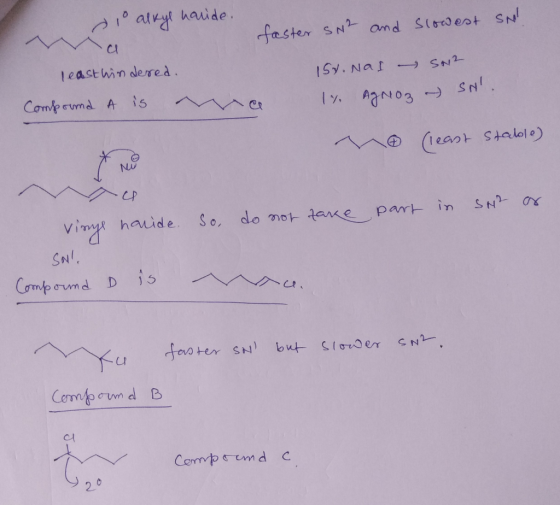
1. arrange the halides in order of reactivity under the two sets of conditions Part 2:...
 1. arrange the halides in order of reactivity under the two
sets of conditions
Part 2: A Comparison of the Reactivity of Alkyl Halides 2% ethanolic silver nitrate 15 Nal in acetone 1. n-butyl chloride Clear Milky precipitate 2. sec-butyl chloride After heating, some precipitation 3. t-butyl chloride White precipitate After heating, precipitate Clear No precipitate Milk precipitate 4. n-butyl bromide Clear 5. allyl chloride White precipitate Brown color precipitate 6. chlorobenzene Clear Clear 1. Arrange the halides in order...
1. arrange the halides in order of reactivity under the two
sets of conditions
Part 2: A Comparison of the Reactivity of Alkyl Halides 2% ethanolic silver nitrate 15 Nal in acetone 1. n-butyl chloride Clear Milky precipitate 2. sec-butyl chloride After heating, some precipitation 3. t-butyl chloride White precipitate After heating, precipitate Clear No precipitate Milk precipitate 4. n-butyl bromide Clear 5. allyl chloride White precipitate Brown color precipitate 6. chlorobenzene Clear Clear 1. Arrange the halides in order...
Part A: Structural effects of SUBSTRATE on Srl and SN2 reactivity. RECORD YOUR OBSERVATIONS. Compound Butyl...
 Part A: Structural effects of SUBSTRATE on Srl and SN2 reactivity. RECORD YOUR OBSERVATIONS. Compound Butyl bromide 15 % Nal - acetone crystallization in 55 seconds 1% ethanolic silver nitrate did not crystallize in over 30 minutes Butyl chloride crystallization in 85 seconds Sec-butyl chloride crystallization in 5 minutes 25 seconds did not crystallize in over 30 minutes crystallization in 10 minutes 45 seconds crystallization in 2 minutes 20 seconds Tert-butyl chloride did not crystallize in over 30 minutes Crotyl...
Draw the strcture of all substrates you will be using in this reaction and classify them...
 Draw the strcture of all substrates you will be using in this
reaction and classify them as( primary, Secondary, and tertiary)
aryl bezylic or some combination of these (such as primary
bezylic). Identify the nucleophile, substrate, and leaving group in
general equations for reactions 1 and 2
ORRAS sminilah you dimensions (R) or (S), and show their stereochemistry clearly. If your instructor reguests, obtain another set of atoms and connectors and use it to prepare isomers as well. R eal...
Draw the strcture of all substrates you will be using in this
reaction and classify them as( primary, Secondary, and tertiary)
aryl bezylic or some combination of these (such as primary
bezylic). Identify the nucleophile, substrate, and leaving group in
general equations for reactions 1 and 2
ORRAS sminilah you dimensions (R) or (S), and show their stereochemistry clearly. If your instructor reguests, obtain another set of atoms and connectors and use it to prepare isomers as well. R eal...
(If you need any more information just let me know) Determine the limiting reagent for the...
(If you need any more information just let me know) Determine the limiting reagent for the preparation of 2-bromo-2-methylbutane and calculate the theoretical yield of product. 1 CHEM-2223 Organic Chemistry Laboratory I Exp. 7: Synthesis of 2-chloro-2-methylbutane In this reaction a tertiary alcohol, 2-methyl-2-butanol, is converted to a tertiary halide, 2-chloro- 2-methylbutane through a SN1 reaction. 1) Chemicals 2-Methyl-2-butanol Hydrochloric acid, HCl (12 M) Saturated sodium bicarbonate Saturated sodium chloride (380 g/L) Anhydrous sodium sulfate...
sn1: write the reactions for each of the secondary, tertiary, and aryl substrates Chemicals and Solvents,...
 sn1: write the reactions for each of the secondary, tertiary, and
aryl substrates
Chemicals and Solvents, Chemical Abstract Service (CAS): (1) 1-chlorobutane, (109-69-3] (2) 1-bromobutane, (109-65-9) (3) 2-chlorobutane, (78-86-4) (4) 2-bromobutane, (78-76-2] (5) 2-chloro-2-methylpropane, (507-20-0) (6) bromobenzene, (108-86-1) (7) 2-bromo-2-methylpropane, (507-19-7) (8) ethanol, [64-17-5) 2. Sn1 Reaction. For the Sn1 reaction, the nucleophile is ethanol, introduced into the solution as the solvent in a silver nitrate-ethanol solution. If the reaction occurs, silver chloride or silver bromide will form a precipitate...
sn1: write the reactions for each of the secondary, tertiary, and
aryl substrates
Chemicals and Solvents, Chemical Abstract Service (CAS): (1) 1-chlorobutane, (109-69-3] (2) 1-bromobutane, (109-65-9) (3) 2-chlorobutane, (78-86-4) (4) 2-bromobutane, (78-76-2] (5) 2-chloro-2-methylpropane, (507-20-0) (6) bromobenzene, (108-86-1) (7) 2-bromo-2-methylpropane, (507-19-7) (8) ethanol, [64-17-5) 2. Sn1 Reaction. For the Sn1 reaction, the nucleophile is ethanol, introduced into the solution as the solvent in a silver nitrate-ethanol solution. If the reaction occurs, silver chloride or silver bromide will form a precipitate...
can all parts of question A be answered and labeled please. there is no data for...
 can all parts of question A be answered and labeled please.
there is no data for precipitation of Nal in acetone.
NUCLEOPHILIC SUBSTITUTION A. Structural Effects on Sa1 and Sa2 Reactivity A1. In the following table, record the results of your group's experiments with the five alkyl halides and the two reagents, sodium iodide in acetone and alcoholic silver nitrate. Note the elapsed time required for turbidity to appear and for a precipitate to form. If you heated any of...
can all parts of question A be answered and labeled please.
there is no data for precipitation of Nal in acetone.
NUCLEOPHILIC SUBSTITUTION A. Structural Effects on Sa1 and Sa2 Reactivity A1. In the following table, record the results of your group's experiments with the five alkyl halides and the two reagents, sodium iodide in acetone and alcoholic silver nitrate. Note the elapsed time required for turbidity to appear and for a precipitate to form. If you heated any of...
2) Predict the order of reactivity (1=least, 4=most) of primary, secondary, tertiary, and aryl halides toward...
 2) Predict the order of reactivity (1=least, 4=most) of
primary, secondary, tertiary, and aryl halides toward nucleophilic
displacement by an SN1 reaction mechanism. Explain
3) Give a detailed summary of the chemistry in both reactions
SN2 and SN1 in details please for both reactions. include any
general statements about the experiments.
LAB)o Organic Chemistry I Lab CHEM 3512 Nueleophilic Substitution Reactions: Sl vs S2 To review Sul, S2, El and E2 reactions and mechanisms and compare and contrast the effect...
2) Predict the order of reactivity (1=least, 4=most) of
primary, secondary, tertiary, and aryl halides toward nucleophilic
displacement by an SN1 reaction mechanism. Explain
3) Give a detailed summary of the chemistry in both reactions
SN2 and SN1 in details please for both reactions. include any
general statements about the experiments.
LAB)o Organic Chemistry I Lab CHEM 3512 Nueleophilic Substitution Reactions: Sl vs S2 To review Sul, S2, El and E2 reactions and mechanisms and compare and contrast the effect...
Follow-up Questions 1. The Nal al/acetone test gives a precipitate with 1-chlorobutane and 1-bromobutane, but not...
 Follow-up Questions 1. The Nal al/acetone test gives a precipitate with 1-chlorobutane and 1-bromobutane, but not l-iodobutane. Why? 2. Why is it important to use a polar solvent such as ethanol in the silver nitrate test? 3. A student decides to repeat the experiment using organochlorides (R-Cl) instead of organobromides. In the Nal test, would organochlorides react faster, slower or at the same rate as the corresponding organobromides? Explain. Would the order of reactivity change? Explain. b. In the AgNO,...
PLEASE PLEASE answer all :) Name: CEII2L Spring 2020 Pre-Lab Questions WinQual 2 1. Forcach reaction...
 PLEASE PLEASE answer all :)
Name: CEII2L Spring 2020 Pre-Lab Questions WinQual 2 1. Forcach reaction described below, write the chemical equation a) Lead(II) nitrate and sodium sulfate solutions are mixed together b) Silver nitrate and sodium chloride solutions are mixed together c) Silver nitrate and sodium hydroxide solutions are mixed together 2. Write the balanced precipitation reactions for the following reactions. Use the solubility rules to determine if a precipitate happened. 11.51 Nal + AgNO, Na SO4 + AgNO3-...
PLEASE PLEASE answer all :)
Name: CEII2L Spring 2020 Pre-Lab Questions WinQual 2 1. Forcach reaction described below, write the chemical equation a) Lead(II) nitrate and sodium sulfate solutions are mixed together b) Silver nitrate and sodium chloride solutions are mixed together c) Silver nitrate and sodium hydroxide solutions are mixed together 2. Write the balanced precipitation reactions for the following reactions. Use the solubility rules to determine if a precipitate happened. 11.51 Nal + AgNO, Na SO4 + AgNO3-...
In our experiment we will use three different substrates: 1°, n-butyl chloride; 2°, sec-butyl chloride; and...
 In our experiment we will use three different substrates: 1°,
n-butyl chloride; 2°, sec-butyl chloride; and 3°, tert- butyl
chloride, and we will evaluate their reactivity and the rate of the
reaction in an SN1 reaction. We will use an acid-base indicator to
monitor the completion of the reaction and a salt, silver nitrate,
to obtain a precipitate. The success of the reaction is evidenced
by the change in color of the indicator (from orange to red) due to
the...
In our experiment we will use three different substrates: 1°,
n-butyl chloride; 2°, sec-butyl chloride; and 3°, tert- butyl
chloride, and we will evaluate their reactivity and the rate of the
reaction in an SN1 reaction. We will use an acid-base indicator to
monitor the completion of the reaction and a salt, silver nitrate,
to obtain a precipitate. The success of the reaction is evidenced
by the change in color of the indicator (from orange to red) due to
the...
 1. arrange the halides in order of reactivity under the two
sets of conditions
Part 2: A Comparison of the Reactivity of Alkyl Halides 2% ethanolic silver nitrate 15 Nal in acetone 1. n-butyl chloride Clear Milky precipitate 2. sec-butyl chloride After heating, some precipitation 3. t-butyl chloride White precipitate After heating, precipitate Clear No precipitate Milk precipitate 4. n-butyl bromide Clear 5. allyl chloride White precipitate Brown color precipitate 6. chlorobenzene Clear Clear 1. Arrange the halides in order...
1. arrange the halides in order of reactivity under the two
sets of conditions
Part 2: A Comparison of the Reactivity of Alkyl Halides 2% ethanolic silver nitrate 15 Nal in acetone 1. n-butyl chloride Clear Milky precipitate 2. sec-butyl chloride After heating, some precipitation 3. t-butyl chloride White precipitate After heating, precipitate Clear No precipitate Milk precipitate 4. n-butyl bromide Clear 5. allyl chloride White precipitate Brown color precipitate 6. chlorobenzene Clear Clear 1. Arrange the halides in order...
 Part A: Structural effects of SUBSTRATE on Srl and SN2 reactivity. RECORD YOUR OBSERVATIONS. Compound Butyl bromide 15 % Nal - acetone crystallization in 55 seconds 1% ethanolic silver nitrate did not crystallize in over 30 minutes Butyl chloride crystallization in 85 seconds Sec-butyl chloride crystallization in 5 minutes 25 seconds did not crystallize in over 30 minutes crystallization in 10 minutes 45 seconds crystallization in 2 minutes 20 seconds Tert-butyl chloride did not crystallize in over 30 minutes Crotyl...
 Draw the strcture of all substrates you will be using in this
reaction and classify them as( primary, Secondary, and tertiary)
aryl bezylic or some combination of these (such as primary
bezylic). Identify the nucleophile, substrate, and leaving group in
general equations for reactions 1 and 2
ORRAS sminilah you dimensions (R) or (S), and show their stereochemistry clearly. If your instructor reguests, obtain another set of atoms and connectors and use it to prepare isomers as well. R eal...
Draw the strcture of all substrates you will be using in this
reaction and classify them as( primary, Secondary, and tertiary)
aryl bezylic or some combination of these (such as primary
bezylic). Identify the nucleophile, substrate, and leaving group in
general equations for reactions 1 and 2
ORRAS sminilah you dimensions (R) or (S), and show their stereochemistry clearly. If your instructor reguests, obtain another set of atoms and connectors and use it to prepare isomers as well. R eal...
 sn1: write the reactions for each of the secondary, tertiary, and
aryl substrates
Chemicals and Solvents, Chemical Abstract Service (CAS): (1) 1-chlorobutane, (109-69-3] (2) 1-bromobutane, (109-65-9) (3) 2-chlorobutane, (78-86-4) (4) 2-bromobutane, (78-76-2] (5) 2-chloro-2-methylpropane, (507-20-0) (6) bromobenzene, (108-86-1) (7) 2-bromo-2-methylpropane, (507-19-7) (8) ethanol, [64-17-5) 2. Sn1 Reaction. For the Sn1 reaction, the nucleophile is ethanol, introduced into the solution as the solvent in a silver nitrate-ethanol solution. If the reaction occurs, silver chloride or silver bromide will form a precipitate...
sn1: write the reactions for each of the secondary, tertiary, and
aryl substrates
Chemicals and Solvents, Chemical Abstract Service (CAS): (1) 1-chlorobutane, (109-69-3] (2) 1-bromobutane, (109-65-9) (3) 2-chlorobutane, (78-86-4) (4) 2-bromobutane, (78-76-2] (5) 2-chloro-2-methylpropane, (507-20-0) (6) bromobenzene, (108-86-1) (7) 2-bromo-2-methylpropane, (507-19-7) (8) ethanol, [64-17-5) 2. Sn1 Reaction. For the Sn1 reaction, the nucleophile is ethanol, introduced into the solution as the solvent in a silver nitrate-ethanol solution. If the reaction occurs, silver chloride or silver bromide will form a precipitate...
 can all parts of question A be answered and labeled please.
there is no data for precipitation of Nal in acetone.
NUCLEOPHILIC SUBSTITUTION A. Structural Effects on Sa1 and Sa2 Reactivity A1. In the following table, record the results of your group's experiments with the five alkyl halides and the two reagents, sodium iodide in acetone and alcoholic silver nitrate. Note the elapsed time required for turbidity to appear and for a precipitate to form. If you heated any of...
can all parts of question A be answered and labeled please.
there is no data for precipitation of Nal in acetone.
NUCLEOPHILIC SUBSTITUTION A. Structural Effects on Sa1 and Sa2 Reactivity A1. In the following table, record the results of your group's experiments with the five alkyl halides and the two reagents, sodium iodide in acetone and alcoholic silver nitrate. Note the elapsed time required for turbidity to appear and for a precipitate to form. If you heated any of...
 2) Predict the order of reactivity (1=least, 4=most) of
primary, secondary, tertiary, and aryl halides toward nucleophilic
displacement by an SN1 reaction mechanism. Explain
3) Give a detailed summary of the chemistry in both reactions
SN2 and SN1 in details please for both reactions. include any
general statements about the experiments.
LAB)o Organic Chemistry I Lab CHEM 3512 Nueleophilic Substitution Reactions: Sl vs S2 To review Sul, S2, El and E2 reactions and mechanisms and compare and contrast the effect...
2) Predict the order of reactivity (1=least, 4=most) of
primary, secondary, tertiary, and aryl halides toward nucleophilic
displacement by an SN1 reaction mechanism. Explain
3) Give a detailed summary of the chemistry in both reactions
SN2 and SN1 in details please for both reactions. include any
general statements about the experiments.
LAB)o Organic Chemistry I Lab CHEM 3512 Nueleophilic Substitution Reactions: Sl vs S2 To review Sul, S2, El and E2 reactions and mechanisms and compare and contrast the effect...
 Follow-up Questions 1. The Nal al/acetone test gives a precipitate with 1-chlorobutane and 1-bromobutane, but not l-iodobutane. Why? 2. Why is it important to use a polar solvent such as ethanol in the silver nitrate test? 3. A student decides to repeat the experiment using organochlorides (R-Cl) instead of organobromides. In the Nal test, would organochlorides react faster, slower or at the same rate as the corresponding organobromides? Explain. Would the order of reactivity change? Explain. b. In the AgNO,...
 PLEASE PLEASE answer all :)
Name: CEII2L Spring 2020 Pre-Lab Questions WinQual 2 1. Forcach reaction described below, write the chemical equation a) Lead(II) nitrate and sodium sulfate solutions are mixed together b) Silver nitrate and sodium chloride solutions are mixed together c) Silver nitrate and sodium hydroxide solutions are mixed together 2. Write the balanced precipitation reactions for the following reactions. Use the solubility rules to determine if a precipitate happened. 11.51 Nal + AgNO, Na SO4 + AgNO3-...
PLEASE PLEASE answer all :)
Name: CEII2L Spring 2020 Pre-Lab Questions WinQual 2 1. Forcach reaction described below, write the chemical equation a) Lead(II) nitrate and sodium sulfate solutions are mixed together b) Silver nitrate and sodium chloride solutions are mixed together c) Silver nitrate and sodium hydroxide solutions are mixed together 2. Write the balanced precipitation reactions for the following reactions. Use the solubility rules to determine if a precipitate happened. 11.51 Nal + AgNO, Na SO4 + AgNO3-...
 In our experiment we will use three different substrates: 1°,
n-butyl chloride; 2°, sec-butyl chloride; and 3°, tert- butyl
chloride, and we will evaluate their reactivity and the rate of the
reaction in an SN1 reaction. We will use an acid-base indicator to
monitor the completion of the reaction and a salt, silver nitrate,
to obtain a precipitate. The success of the reaction is evidenced
by the change in color of the indicator (from orange to red) due to
the...
In our experiment we will use three different substrates: 1°,
n-butyl chloride; 2°, sec-butyl chloride; and 3°, tert- butyl
chloride, and we will evaluate their reactivity and the rate of the
reaction in an SN1 reaction. We will use an acid-base indicator to
monitor the completion of the reaction and a salt, silver nitrate,
to obtain a precipitate. The success of the reaction is evidenced
by the change in color of the indicator (from orange to red) due to
the...
Most questions answered within 3 hours.
-
Where is the error in this code sequence?
String s1 = "Hello";
String s2 = "ello";...
asked 11 months ago -
Financial data for Joel de Paris, Inc., for last year
follow:
Joel de Paris, Inc.
Balance...
asked 11 months ago -
Consider this reaction:
Al2(SO4)3 (aq)+ BaCl3
(aq) Al2Cl6 (aq)- +
3BaSO4(s) . What is the...
asked 11 months ago -
Suppose that Savneet is considering increasing her
recent random sample from 20 car rentals to 40...
asked 11 months ago -
Trucks arrive at an unloading terminal at an average rate of 120
per hour.
Trucks arrive...
asked 11 months ago -
Why are methanol and ethanol completely soluble in water while
octanol is not very little soluble....
asked 11 months ago -
A facilities manager at a university reads in a research report
that the mean amount of...
asked 11 months ago -
When the CuSO4 is rehydrated by adding water to the anhydrous
compound, is this an endothermic...
asked 11 months ago -
A ray of sunlight is passing from diamond into crown glass; the
angle of incidence is...
asked 11 months ago -
A block of mass 0.249 kg is placed on top of a light, vertical
spring of...
asked 11 months ago -
how do the kidneys compensate in the presences of acidosis
a) trigger hyperventilate
b) reserve acid...
asked 11 months ago -
Question 501 pts
The rental rate of capital to the firm increases. Which of the
following...
asked 11 months ago