A proton transfer under acidic conditions from the carboxyl group to the carbonyl oxygen forms what...
A proton transfer under acidic conditions from the carboxyl group to the carbonyl oxygen forms what type of product? Decarboxylation of 3-oxobutanoic acid results in the formation of what product? View Available Hint(s)
Homework Answers
Decarboxylation of 3-oxobutanoic acid gives acetone and carbon dioxide.
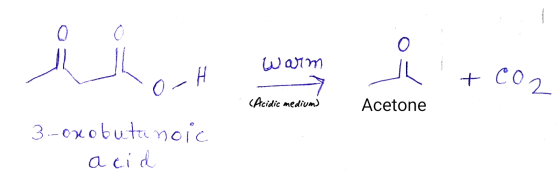
Reaction undergoes via six memebered cyclic transition state.

Add Answer to:
A proton transfer under acidic conditions from the carboxyl
group to the carbonyl oxygen forms what...
A proton transfer reaction can occur when a carbonyl compound is placed in an aqueous acidic...
 A proton transfer reaction can occur when a carbonyl compound is placed in an aqueous acidic solution. Water and a charged conjugate acid produced. The resulting organic compound is resonance stabilized. Draw the curved arrows for the proton transfer and draw both resonance-stabilized organic products in the appropriate boxes. Be sure to incle lone pairs and nonzero formal charges. Do not draw the water product. 3rd attempt ad See Periodic Tabl water Draw the resonance structure with the charge on...
Formation of an imine needs to occur under mildly acidic conditions, yet no acid is started...
 Formation of an imine needs to occur under mildly acidic conditions, yet no acid is started at the start of the reaction. How does imine synthesis succeed? O A No acid is needed when solventless conditions are employed O B The proton transfer is intramolecular, so no additional acid is needed o C The proton transfer is intermolecular, so no additional acid is needed O Glacial acetic acid is added in a subsequent step, which protonates the ion that was...
Question (1 point) See page 313 A proton transfer reaction can occur when a carbonyl compound...
 Question (1 point) See page 313 A proton transfer reaction can occur when a carbonyl compound is placed in an aqueous acidic solution. Water and a charged conjugate acid are produced. The resulting organic compound is resonance stabilized, Draw the curved arrows for the proton transfer and draw both resonance-stabilized organic products in the appropriate boxes. Be sure to include all lone pairs and nonzero formal charges. Do not draw the water product. 11th attempt See Periodic Table Draw the...
Help 1. Under acidic conditions, if Z CH3 in Compound 2, Compound 1 forms. он он...
 Help
1. Under acidic conditions, if Z CH3 in Compound 2, Compound 1 forms. он он о 2 3 a. If ZCompound 3 forms Identify Z and determine reaction condition A. b. Use curved arrows to show how Compound 3 forms from Compound 2 using your Z and reaction condition A from Question 1a c. How does Z determine the product that forms? 2. Ambien is a prescription sedative. Draw the structures of the metabolic (hydrolysis under acid conditions) products...
Help
1. Under acidic conditions, if Z CH3 in Compound 2, Compound 1 forms. он он о 2 3 a. If ZCompound 3 forms Identify Z and determine reaction condition A. b. Use curved arrows to show how Compound 3 forms from Compound 2 using your Z and reaction condition A from Question 1a c. How does Z determine the product that forms? 2. Ambien is a prescription sedative. Draw the structures of the metabolic (hydrolysis under acid conditions) products...
Ethers can be formed under acidic or basic conditions. What are the limitation of forming an...
 Ethers can be formed under acidic or basic conditions. What are the limitation of forming an ether from an alcohol under acidic conditions? I. Asymmetrical ethers cannot be formed exclusively under acidic conditions II. Rearrangement in the carbon skeletal backbone is possible under acidic conditions, III. Ethers in which the carbon bound to oxygen is 3° are not possible. IV. Intramolecular cyclization reactions are not possible under acidic conditions.
please help The dehydration of alcohols Under acidic conditions, alcohols will undergo a dehydration reaction, producing...
 please help
The dehydration of alcohols Under acidic conditions, alcohols will undergo a dehydration reaction, producing an alkene and water. During the reaction, the hydroxyl group of the alcohol and a hydrogen atom from an adjacent carbon atom are lost. The reaction takes place in three steps, as shown in the diagram. (Figure 1) In the first step, a hydrogen lon bonds to the hydroxyl group of the alcohol. In the second step, the protonated hydroxl group leaves the compound,...
please help
The dehydration of alcohols Under acidic conditions, alcohols will undergo a dehydration reaction, producing an alkene and water. During the reaction, the hydroxyl group of the alcohol and a hydrogen atom from an adjacent carbon atom are lost. The reaction takes place in three steps, as shown in the diagram. (Figure 1) In the first step, a hydrogen lon bonds to the hydroxyl group of the alcohol. In the second step, the protonated hydroxl group leaves the compound,...
a. Caffeine can be protonated under acidic conditions to form an imidazolium-like species. Draw the structure...
a. Caffeine can be protonated under acidic conditions to form an imidazolium-like species. Draw the structure for this protonated form, then find and report a pKa value for the most acidic proton. b. Draw a reaction scheme between caffeine and water. Which side of the equilibrium is favored for this acid/base reaction? Hint: Use the pKa value from part a. c. Find and report a pKa value for phenol. Draw a reaction scheme between phenol and water. Which side of...
When the following equation is balanced properly under acidic conditions, what are the coefficients of the...
 When the following equation is balanced properly under acidic conditions, what are the coefficients of the species shown? Agt+ cut Ag+C cu2+ Water appears in the balanced equation as a (reactant, product, neither) with a coefficient of (Enter 0 for neither.) Which element is oxidized? Submit Answer Retry Entire Group 9 more group attempts remaining When the following equation is balanced properly under acidic conditions, what are the coefficients of the species shown? cu++ D C103— Cu2+ + C102 Water...
take When the following skeletal equation is balanced under acidic conditions, what are the coefficients of...
 take When the following skeletal equation is balanced under acidic conditions, what are the coefficients of the species shown? Cut + Sb205 Cu2+ sbot Water appears in the balanced equation as a coefficient of (Enter 0 for neither.) (reactant, product, neither) with a Which species is the oxidizing agent? 3 Submit Answer Retry Entire Group 6 more group attempts remaining When the following skeletal equation is balanced under acidic conditions, what are the coefficients of the species shown? 0₂+ Pb2+...
QUESTION 1 Any reaction involving a carbonyl group and a strong acid begins with the same...
QUESTION 1 Any reaction involving a carbonyl group and a strong acid begins with the same first step, which is __________________ of the carbonyl oxygen. QUESTION 2 Using condensed molecular formulas (C#H#X#Y#) for your answers, predict the products of the reactions of C6H5CH2CHO (phenylacetaldehyde) with these reagents, and identify the functional group produced in the product. Note that the Tx symbol above allows you to do a subscript. a. NaBH4 / CH3OH b. 1. CH3MgBr; 2. H2O c. Ph3P=CHCH3 d....
 A proton transfer reaction can occur when a carbonyl compound is placed in an aqueous acidic solution. Water and a charged conjugate acid produced. The resulting organic compound is resonance stabilized. Draw the curved arrows for the proton transfer and draw both resonance-stabilized organic products in the appropriate boxes. Be sure to incle lone pairs and nonzero formal charges. Do not draw the water product. 3rd attempt ad See Periodic Tabl water Draw the resonance structure with the charge on...
 Formation of an imine needs to occur under mildly acidic conditions, yet no acid is started at the start of the reaction. How does imine synthesis succeed? O A No acid is needed when solventless conditions are employed O B The proton transfer is intramolecular, so no additional acid is needed o C The proton transfer is intermolecular, so no additional acid is needed O Glacial acetic acid is added in a subsequent step, which protonates the ion that was...
 Question (1 point) See page 313 A proton transfer reaction can occur when a carbonyl compound is placed in an aqueous acidic solution. Water and a charged conjugate acid are produced. The resulting organic compound is resonance stabilized, Draw the curved arrows for the proton transfer and draw both resonance-stabilized organic products in the appropriate boxes. Be sure to include all lone pairs and nonzero formal charges. Do not draw the water product. 11th attempt See Periodic Table Draw the...
 Help
1. Under acidic conditions, if Z CH3 in Compound 2, Compound 1 forms. он он о 2 3 a. If ZCompound 3 forms Identify Z and determine reaction condition A. b. Use curved arrows to show how Compound 3 forms from Compound 2 using your Z and reaction condition A from Question 1a c. How does Z determine the product that forms? 2. Ambien is a prescription sedative. Draw the structures of the metabolic (hydrolysis under acid conditions) products...
Help
1. Under acidic conditions, if Z CH3 in Compound 2, Compound 1 forms. он он о 2 3 a. If ZCompound 3 forms Identify Z and determine reaction condition A. b. Use curved arrows to show how Compound 3 forms from Compound 2 using your Z and reaction condition A from Question 1a c. How does Z determine the product that forms? 2. Ambien is a prescription sedative. Draw the structures of the metabolic (hydrolysis under acid conditions) products...
 Ethers can be formed under acidic or basic conditions. What are the limitation of forming an ether from an alcohol under acidic conditions? I. Asymmetrical ethers cannot be formed exclusively under acidic conditions II. Rearrangement in the carbon skeletal backbone is possible under acidic conditions, III. Ethers in which the carbon bound to oxygen is 3° are not possible. IV. Intramolecular cyclization reactions are not possible under acidic conditions.
 please help
The dehydration of alcohols Under acidic conditions, alcohols will undergo a dehydration reaction, producing an alkene and water. During the reaction, the hydroxyl group of the alcohol and a hydrogen atom from an adjacent carbon atom are lost. The reaction takes place in three steps, as shown in the diagram. (Figure 1) In the first step, a hydrogen lon bonds to the hydroxyl group of the alcohol. In the second step, the protonated hydroxl group leaves the compound,...
please help
The dehydration of alcohols Under acidic conditions, alcohols will undergo a dehydration reaction, producing an alkene and water. During the reaction, the hydroxyl group of the alcohol and a hydrogen atom from an adjacent carbon atom are lost. The reaction takes place in three steps, as shown in the diagram. (Figure 1) In the first step, a hydrogen lon bonds to the hydroxyl group of the alcohol. In the second step, the protonated hydroxl group leaves the compound,...
 When the following equation is balanced properly under acidic conditions, what are the coefficients of the species shown? Agt+ cut Ag+C cu2+ Water appears in the balanced equation as a (reactant, product, neither) with a coefficient of (Enter 0 for neither.) Which element is oxidized? Submit Answer Retry Entire Group 9 more group attempts remaining When the following equation is balanced properly under acidic conditions, what are the coefficients of the species shown? cu++ D C103— Cu2+ + C102 Water...
 take When the following skeletal equation is balanced under acidic conditions, what are the coefficients of the species shown? Cut + Sb205 Cu2+ sbot Water appears in the balanced equation as a coefficient of (Enter 0 for neither.) (reactant, product, neither) with a Which species is the oxidizing agent? 3 Submit Answer Retry Entire Group 6 more group attempts remaining When the following skeletal equation is balanced under acidic conditions, what are the coefficients of the species shown? 0₂+ Pb2+...
Most questions answered within 3 hours.
-
Where is the error in this code sequence?
String s1 = "Hello";
String s2 = "ello";...
asked 10 months ago -
Financial data for Joel de Paris, Inc., for last year
follow:
Joel de Paris, Inc.
Balance...
asked 10 months ago -
Consider this reaction:
Al2(SO4)3 (aq)+ BaCl3
(aq) Al2Cl6 (aq)- +
3BaSO4(s) . What is the...
asked 10 months ago -
Suppose that Savneet is considering increasing her
recent random sample from 20 car rentals to 40...
asked 10 months ago -
Trucks arrive at an unloading terminal at an average rate of 120
per hour.
Trucks arrive...
asked 10 months ago -
Why are methanol and ethanol completely soluble in water while
octanol is not very little soluble....
asked 10 months ago -
A facilities manager at a university reads in a research report
that the mean amount of...
asked 10 months ago -
When the CuSO4 is rehydrated by adding water to the anhydrous
compound, is this an endothermic...
asked 10 months ago -
A ray of sunlight is passing from diamond into crown glass; the
angle of incidence is...
asked 10 months ago -
A block of mass 0.249 kg is placed on top of a light, vertical
spring of...
asked 10 months ago -
how do the kidneys compensate in the presences of acidosis
a) trigger hyperventilate
b) reserve acid...
asked 10 months ago -
Question 501 pts
The rental rate of capital to the firm increases. Which of the
following...
asked 10 months ago