

![15. Consider the following equilibrium: H2(g) + 12(g) + 2 HI(g) If the initial [H2] = 0.200 M, [12] = 0.200 M and Keq = 55.6](http://img.homeworklib.com/questions/800df4c0-6f39-11ea-8562-0745594cedca.png?x-oss-process=image/resize,w_560)
Homework Answers
Here is the solution of your question. If you have any doubt or need any clarification please comment in comment box and will definitely resolve your query. If you find useful please upvote it. Thanks in advance.
![13. Given [502] = 0.60 mole = 0.60M IL Initial 102]: 0.6omole - 0060 MT TL al equilibrium S03) = 0.250M +234 21 25 0215) + O2](http://img.homeworklib.com/questions/80a20440-6f39-11ea-b131-7d11a7a89077.png?x-oss-process=image/resize,w_560)
![15. Given [2] = 0.20 m [[2]=0.20m keq = 55.6 a ²2HI1g I(M) C(A) H₂co, + I2(8) 0.20 0.20 -- - +27 ECM) 0.20-7 0.20-X 22 1 by k](http://img.homeworklib.com/questions/814d99d0-6f39-11ea-b5b6-3368c13ee4f8.png?x-oss-process=image/resize,w_560)
Add Answer to:
13. Consider the following When 0.600 moles of SO and allowed to reach equi Keq value....
1) The Keq for the reaction below at 1530oC is 1.2 X 10⁻⁴. Determine the equilibrium...
1) The Keq for the reaction below at 1530oC is 1.2 X 10⁻⁴. Determine the equilibrium concentrations of all species when 1 mol/L of nitrogen and oxygen is placed in the vessel and allowed to reach equilibrium. Write out the ICE table to help guide your calculations. N2 (g) + O2 (g) ---> 2 NO (g)
Please answer all six thanks 1) The equilibrium constant for the following reaction is 2.90×10⁻² at...
Please answer all six thanks 1) The equilibrium constant for the following reaction is 2.90×10⁻² at 1.15×10³K. 2SO3(g) ------------------->2SO2(g) + O2(g) If an equilibrium mixture of the three gases in a 17.3 L container at 1.15×10³K contains 0.437 mol of SO3(g) and 0.422 mol of SO2, the equilibrium concentration of O2 is M. 2) A student ran the following reaction in the laboratory at 1100 K: 2SO3(g) -------------------->2SO2(g) + O2(g) When she introduced 7.74×10⁻² moles of SO3(g) into a 1.00 liter...
Consider the following equilibrium reaction : Heat + 2 SO2 (g) + O2(g) ↔ 2 SO3(g) Assume the above...
Consider the following equilibrium reaction : Heat + 2 SO2 (g) + O2(g) ↔ 2 SO3(g) Assume the above reaction is allowed to reach equilibrium prior to the following changes. Answer the following questions by writing increase, decrease or remain the same on the line. **please also explain why** If the reaction mixture is heated up , the value of the equilibrium constant will _______________________ If SO2 (g) is added to the reaction vessel the concentration of O2(g) will____________________________. If SO3 (g) is...
Use the References to access important values if needed for this question. Dinitrogen tetraoxide is a...
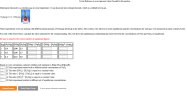 Use the References to access important values if needed for this question. Dinitrogen tetraoxide is a colorless gas at room temperature. It can dissociate into nitrogen dioxide, which is a reddish brown gas. N204()22 NO2(g) Three experiments were run starting with different initial amounts of N204(g) ([N204]o in the table). The systems were allowed to reach equilibrium and concentrations for each gas were measured (in units of moles/Liter). For each of the boxes below, calculate the ratios indicated by the...
Dinitrogen tetraoxide is a colorless gas at room temperature. It can dissociate into nitrogen dioxide, which...
 Dinitrogen tetraoxide is a colorless gas at room temperature. It can dissociate into nitrogen dioxide, which is a reddish brown gas. N204(0) 22 NO2(g) Three experiments were run starting with different initial amounts of N204(9) ([N204]o in the table). The systems were allowed to reach equilibrium and the concentrations for each gas were measured (in units of moles/Liter). For each of the boxes below, calculate the ratios indicated by the column heading. This will show the mathematical relationship that exists...
Dinitrogen tetraoxide is a colorless gas at room temperature. It can dissociate into nitrogen dioxide, which...
 Dinitrogen tetraoxide is a colorless gas at room temperature. It can dissociate into nitrogen dioxide, which is a reddish brown gas. N204(9) 2 NO2(g) Three experiments were run starting with different initial amounts of N204(g) ([N2040 in the table). The systems were allowed to reach equilibrium and the concentrations for each gas were measured (in units of moles/Liter). For each of the boxes below, calculate the ratios indicated by the column heading. This will show the mathematical relationship that exists...
Dinitrogen tetraoxide is a colorless gas at room temperature. It can dissociate into nitrogen dioxide, which...
 Dinitrogen tetraoxide is a colorless gas at room temperature. It can dissociate into nitrogen dioxide, which is a reddish brown gas. N2。4(g) 2 NO2(g) Three experiments were run starting with different initial amounts of N204(g) (IN204]o in the table). The systems were allowed to reach equilibrium and the concentrations for each gas were measured (in units of moles/Liter). For each of the boxes below, calculate the ratios indicated by the column heading. This will show the mathematical relationship that exists...
Dinitrogen trioxide decomposes according to the following equation with K = 0.128: N2O3 (g) <-> NO2...
Dinitrogen trioxide decomposes according to the following equation with K = 0.128: N2O3 (g) <-> NO2 (g) + NO (g) 2.00 moles of the reactant are placed into a 1.00 liter chamber and allowed to come to equilibrium. Set up the ICE table and the equilibrium expression. Apply the 5 % rule and you will see that x cannot be neglected. Solve the quadratic equation and determine the equilibrium concentrations of the species present.
QUESTION 5 3 poi Consider the equilibrium: 2 SO2(g) + O2(g) = 2 SO3(g) A student...
 QUESTION 5 3 poi Consider the equilibrium: 2 SO2(g) + O2(g) = 2 SO3(g) A student places 2.00 moles Soz in a 1.00 L flask. When equilibrium is reached (O) = 0.10 M at 130 °C. Calculate the kc. Hint: use the detectivee method and construct an ICE table. Record your answer as a standard number to 2 significant figures. For example, if the answer is 2.75 x 100 M then you should enter 0.00275 as the answer.
0.200 moles N2O4 were placed in a 2.00-L container, and at certain temperature the equilibrium set...
0.200 moles N2O4 were placed in a 2.00-L container, and at certain temperature the equilibrium set up with N2O4 measured at 0.0090 M: N2O4(g) 2 NO2(g) (a) Calculate the amount (in grams) of NO2 at equilibrium. (b) Calculate the percent of the initial N2O4 dissociated into nitrogen dioxide. (c) Determine Kc for the above rxn at that temperature. (Use ICE table) d) If after the equilibrium set up, the system was compressed to one half of its initial volume,...
 Use the References to access important values if needed for this question. Dinitrogen tetraoxide is a colorless gas at room temperature. It can dissociate into nitrogen dioxide, which is a reddish brown gas. N204()22 NO2(g) Three experiments were run starting with different initial amounts of N204(g) ([N204]o in the table). The systems were allowed to reach equilibrium and concentrations for each gas were measured (in units of moles/Liter). For each of the boxes below, calculate the ratios indicated by the...
 Dinitrogen tetraoxide is a colorless gas at room temperature. It can dissociate into nitrogen dioxide, which is a reddish brown gas. N204(0) 22 NO2(g) Three experiments were run starting with different initial amounts of N204(9) ([N204]o in the table). The systems were allowed to reach equilibrium and the concentrations for each gas were measured (in units of moles/Liter). For each of the boxes below, calculate the ratios indicated by the column heading. This will show the mathematical relationship that exists...
 Dinitrogen tetraoxide is a colorless gas at room temperature. It can dissociate into nitrogen dioxide, which is a reddish brown gas. N204(9) 2 NO2(g) Three experiments were run starting with different initial amounts of N204(g) ([N2040 in the table). The systems were allowed to reach equilibrium and the concentrations for each gas were measured (in units of moles/Liter). For each of the boxes below, calculate the ratios indicated by the column heading. This will show the mathematical relationship that exists...
 Dinitrogen tetraoxide is a colorless gas at room temperature. It can dissociate into nitrogen dioxide, which is a reddish brown gas. N2。4(g) 2 NO2(g) Three experiments were run starting with different initial amounts of N204(g) (IN204]o in the table). The systems were allowed to reach equilibrium and the concentrations for each gas were measured (in units of moles/Liter). For each of the boxes below, calculate the ratios indicated by the column heading. This will show the mathematical relationship that exists...
 QUESTION 5 3 poi Consider the equilibrium: 2 SO2(g) + O2(g) = 2 SO3(g) A student places 2.00 moles Soz in a 1.00 L flask. When equilibrium is reached (O) = 0.10 M at 130 °C. Calculate the kc. Hint: use the detectivee method and construct an ICE table. Record your answer as a standard number to 2 significant figures. For example, if the answer is 2.75 x 100 M then you should enter 0.00275 as the answer.
Most questions answered within 3 hours.
-
Where is the error in this code sequence?
String s1 = "Hello";
String s2 = "ello";...
asked 11 months ago -
Financial data for Joel de Paris, Inc., for last year
follow:
Joel de Paris, Inc.
Balance...
asked 11 months ago -
Consider this reaction:
Al2(SO4)3 (aq)+ BaCl3
(aq) Al2Cl6 (aq)- +
3BaSO4(s) . What is the...
asked 11 months ago -
Suppose that Savneet is considering increasing her
recent random sample from 20 car rentals to 40...
asked 11 months ago -
Trucks arrive at an unloading terminal at an average rate of 120
per hour.
Trucks arrive...
asked 11 months ago -
Why are methanol and ethanol completely soluble in water while
octanol is not very little soluble....
asked 11 months ago -
A facilities manager at a university reads in a research report
that the mean amount of...
asked 11 months ago -
When the CuSO4 is rehydrated by adding water to the anhydrous
compound, is this an endothermic...
asked 11 months ago -
A ray of sunlight is passing from diamond into crown glass; the
angle of incidence is...
asked 11 months ago -
A block of mass 0.249 kg is placed on top of a light, vertical
spring of...
asked 11 months ago -
how do the kidneys compensate in the presences of acidosis
a) trigger hyperventilate
b) reserve acid...
asked 11 months ago -
Question 501 pts
The rental rate of capital to the firm increases. Which of the
following...
asked 11 months ago