which mechanism is involved in innate immunity?
which mechanism is involved in innate immunity?
Homework Answers
Innate immunity is the strength to fight against any disease by birth. The mechanism involved in innate immunity is the cellular and biochemical defense components present even before the infection is poised to respond rapidly to infections. The mechanisms are:
* physical and chemical barriers released at surface of epithelial * presence of phagocytic cells
* blood proteins including the membranes of the complementary system
QUESTION 17 Skin and mucous membranes are mostly involved in adaptive immunity. autoimmunity. irregular immunity innate...
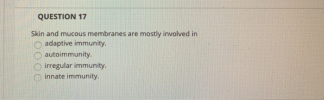 QUESTION 17 Skin and mucous membranes are mostly involved in adaptive immunity. autoimmunity. irregular immunity innate immunity QUESTION 18 Interferons, complement, lysozyme, and lactoferrin are all examples of specific antimicrobial factors. immune enzymes. nonspecific antimicrobial factors. cytokines. QUESTION 19 Proteins that react specifically with the chemical structures in the antigen that induced them are called determinants. antibodies. proteases. macroproteins. QUESTION 20 Which of the following can lead to constriction of smooth muscles? Prostaglandins Bradykinin Leukotriene Histamine
Which type of Immunity is the one that would be associate with Anti-Rabies Vaccine? Innate immunity...
Which type of Immunity is the one that would be associate with Anti-Rabies Vaccine? Innate immunity Naturally acquired active immunity Naturally acquired passive immunity Artificially acquired active immunity Artificially acquired passive immunity
Indicate whether each item identifies an adaptive or innate immunity Adaptive Immunity Innate Immunity Histamine Pyrogens...
 Indicate whether each item identifies an adaptive or innate immunity Adaptive Immunity Innate Immunity Histamine Pyrogens Lysozyme Heparin Hyaluronic acid Defensins Hydrogen peroxide Tumor necrosis factor Reset < Prev 11 of 48 Next >
Innate immunity Complete the following statements to describe examples of innate immunity. Not all choices will...
 Innate immunity Complete the following statements to describe examples of innate immunity. Not all choices will be used. serve as mechanisms of innate Several physical and chemical immunity active sites Innate immune mechanisms include several types of barriers to pathogen entry. Mechanical barriers include skin and the mucous lining the respiratory, digestive, and urinary tracts. mucus membranes The excretions of _ and sweat glands in the skin contain chemicals that kill certain bacteria on the skin. PIPOOD antibodies pH, which...
Distinguish between innate-acquired immunity and humoral-cell mediated immunity.
Distinguish between innate-acquired immunity and humoral-cell mediated immunity.
what are the 7 major categories of innate defenses of immunity? how do innate defenses contribute...
what are the 7 major categories of innate defenses of immunity? how do innate defenses contribute to the immunity response in our body?
15. Differences between innate and adaptive immunity. Name and have basic idea about the various components...
15. Differences between innate and adaptive immunity. Name and have basic idea about the various components involved in these two types of immunities. 16. Process of Phagocytosis in detail, various steps. Meaning of opsonization and complement involved in opsonization. 17. Fever and Inflammation in detail. Complements and Interleukins involved.
49. Which of these is least likely to be considered part of innate immunity? a. skin...
 49. Which of these is least likely to be considered part of innate immunity? a. skin b. teeth c. bathing d. macrophage e. tears 50. What would not be found in the blood? a. hormones b. osmotic proteins C. red blood cells d. clotting factor e. All are found in the blood
please I need help 5. Contrast innate immunity with acquired immunity. For each type of immunity...
 please I need help
5. Contrast innate immunity with acquired immunity. For each type of immunity indicate: Whether it attacks a specific antigen. Whether it needs to first be exposed to a pathogen to attack it. • Whether it can respond to intracellular threats, extracellular threats, or both. Which types of cells play a major role. • Which groups of molecules play a major role. (Hint: see page 756-757 under the heading "THE IMMUNE RESPONSE" for a definition and then...
please I need help
5. Contrast innate immunity with acquired immunity. For each type of immunity indicate: Whether it attacks a specific antigen. Whether it needs to first be exposed to a pathogen to attack it. • Whether it can respond to intracellular threats, extracellular threats, or both. Which types of cells play a major role. • Which groups of molecules play a major role. (Hint: see page 756-757 under the heading "THE IMMUNE RESPONSE" for a definition and then...
Name two microbes that have specialized mechanisms for evading innate immunity
Name two microbes that have specialized mechanisms for evading innate immunity
 QUESTION 17 Skin and mucous membranes are mostly involved in adaptive immunity. autoimmunity. irregular immunity innate immunity QUESTION 18 Interferons, complement, lysozyme, and lactoferrin are all examples of specific antimicrobial factors. immune enzymes. nonspecific antimicrobial factors. cytokines. QUESTION 19 Proteins that react specifically with the chemical structures in the antigen that induced them are called determinants. antibodies. proteases. macroproteins. QUESTION 20 Which of the following can lead to constriction of smooth muscles? Prostaglandins Bradykinin Leukotriene Histamine
 Indicate whether each item identifies an adaptive or innate immunity Adaptive Immunity Innate Immunity Histamine Pyrogens Lysozyme Heparin Hyaluronic acid Defensins Hydrogen peroxide Tumor necrosis factor Reset < Prev 11 of 48 Next >
 Innate immunity Complete the following statements to describe examples of innate immunity. Not all choices will be used. serve as mechanisms of innate Several physical and chemical immunity active sites Innate immune mechanisms include several types of barriers to pathogen entry. Mechanical barriers include skin and the mucous lining the respiratory, digestive, and urinary tracts. mucus membranes The excretions of _ and sweat glands in the skin contain chemicals that kill certain bacteria on the skin. PIPOOD antibodies pH, which...
 49. Which of these is least likely to be considered part of innate immunity? a. skin b. teeth c. bathing d. macrophage e. tears 50. What would not be found in the blood? a. hormones b. osmotic proteins C. red blood cells d. clotting factor e. All are found in the blood
 please I need help
5. Contrast innate immunity with acquired immunity. For each type of immunity indicate: Whether it attacks a specific antigen. Whether it needs to first be exposed to a pathogen to attack it. • Whether it can respond to intracellular threats, extracellular threats, or both. Which types of cells play a major role. • Which groups of molecules play a major role. (Hint: see page 756-757 under the heading "THE IMMUNE RESPONSE" for a definition and then...
please I need help
5. Contrast innate immunity with acquired immunity. For each type of immunity indicate: Whether it attacks a specific antigen. Whether it needs to first be exposed to a pathogen to attack it. • Whether it can respond to intracellular threats, extracellular threats, or both. Which types of cells play a major role. • Which groups of molecules play a major role. (Hint: see page 756-757 under the heading "THE IMMUNE RESPONSE" for a definition and then...
Most questions answered within 3 hours.
-
Where is the error in this code sequence?
String s1 = "Hello";
String s2 = "ello";...
asked 10 months ago -
Financial data for Joel de Paris, Inc., for last year
follow:
Joel de Paris, Inc.
Balance...
asked 10 months ago -
Consider this reaction:
Al2(SO4)3 (aq)+ BaCl3
(aq) Al2Cl6 (aq)- +
3BaSO4(s) . What is the...
asked 10 months ago -
Suppose that Savneet is considering increasing her
recent random sample from 20 car rentals to 40...
asked 10 months ago -
Trucks arrive at an unloading terminal at an average rate of 120
per hour.
Trucks arrive...
asked 10 months ago -
Why are methanol and ethanol completely soluble in water while
octanol is not very little soluble....
asked 10 months ago -
A facilities manager at a university reads in a research report
that the mean amount of...
asked 10 months ago -
When the CuSO4 is rehydrated by adding water to the anhydrous
compound, is this an endothermic...
asked 10 months ago -
A ray of sunlight is passing from diamond into crown glass; the
angle of incidence is...
asked 10 months ago -
A block of mass 0.249 kg is placed on top of a light, vertical
spring of...
asked 10 months ago -
how do the kidneys compensate in the presences of acidosis
a) trigger hyperventilate
b) reserve acid...
asked 10 months ago -
Question 501 pts
The rental rate of capital to the firm increases. Which of the
following...
asked 10 months ago