
Homework Answers
Add Answer to:
6. The production function of a firm is y = LIR. Labour is paid a wage,...
6. The production function of a firm is y = LIKt. Labour is paid a wage,...
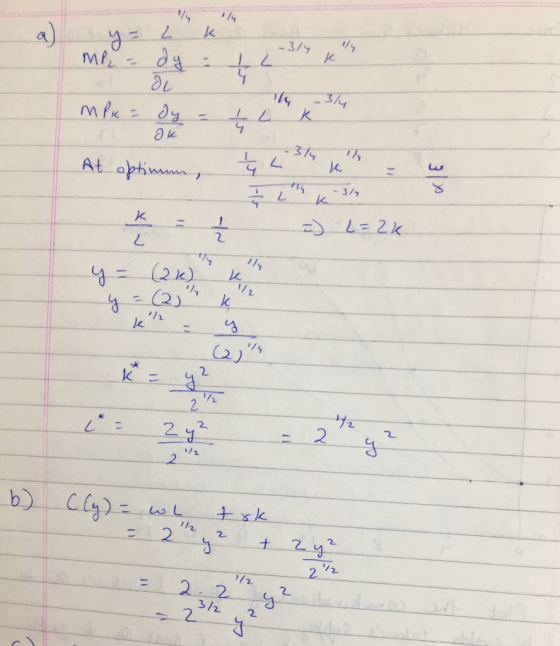
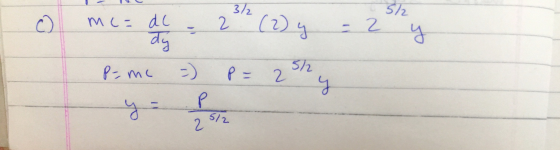
 6. The production function of a firm is y = LIKt. Labour is paid a wage, w = 1 and capital earns a rental rate, r = 2. (a) Derive the long-run conditional factor demands for L and K. (b) Derive the long-run cost function C(y). (c) If the firm operates in a competitive industry, p = mc. Derive the long-run supply curve for the firm, y(p).
A firm has a production function Y 2 K05L05. Use w to denote the wage rate...
 A firm has a production function Y 2 K05L05. Use w to denote the wage rate and r to denote the capital rental price Let us first consider the short run situation, where the firm has K = 25 and In order to produce 10 units of output, how many units of labour does the firm need to hire? What is the average cost of the firm? Let us first consider the short run situation, where the firm has K-25....
A firm has a production function Y = 2 Ko5L05 use w to denote the wage...
 A firm has a production function Y = 2 Ko5L05 use w to denote the wage rate and r to denote the capital rental price. Let us first consider the short run situation, where the firm has K = 25 and r = 2. In order to produce 10 units of output, how many units of labour does the firm need to hire? What is the average cost of the firm? a. b. Let us first consider the short run...
5. Let the firm's production function be given by y = + x2. Note that the...
 5. Let the firm's production function be given by y = + x2. Note that the inputs 2 and 2 are perfect substitutes in this production process. Suppose w = 2 and we = 1. (a) Derive the conditional factor/input demands and use them to find the long-run cost function for this firm. (b) For these factor prices, derive the firm's long-run supply curve. (c) For these factor prices graph the firm's long-run supply curve. (d) Suppose the price of...
5. Let the firm's production function be given by y = x1 + x2. Note that the inputs 21 and 2 are perfect substitu...
 5. Let the firm's production function be given by y = x1 + x2. Note that the inputs 21 and 2 are perfect substitutes in this production process. Suppose w = 2 and w2 = 1. (a) Derive the conditional factor/input demands and use them to find the long-run cost function for this firm. (b) For these factor prices, derive the firm's long-run supply curve. (c) For these factor prices graph the firm's long-run supply curve. (d) Suppose the price...
5. Let the firm's production function be given by y 1+2. Note that the inputs r1...
 5. Let the firm's production function be given by y 1+2. Note that the inputs r1 and 2 are perfect substitutes in this production process. Suppose wi 2 and w2 1 (a) Derive the conditional factor/input demands and use them to find the long-run cost function for this firm. (b) For these factor prices, derive the firm's long-run supply curve. (c) For these factor prices graph the firm's long-run supply curve. (d) Suppose the price of the second input, w2,...
4. A firm produces computers with two factors of production: labor L and capital K. It's pro- duction function is ....
 4. A firm produces computers with two factors of production: labor L and capital K. It's pro- duction function is . Suppose the factor prices are wl = 10 and wK = 100. (a) Graph the isoquants for y equal to 1.2, and 3. Does this technology show increasing, constant, or decreasing returns to scale? Why? (b) Derive the conditional factor demands. (c) Derive the long-run cost function C(y). (d) If the firm wants to produce one computer, how many...
NEED ALL ANSWERS PLEASE Problem 3 [24 marks] A competitive firm uses two inputs, capital (k) and labour (), to produce...
 NEED ALL ANSWERS PLEASE
Problem 3 [24 marks] A competitive firm uses two inputs, capital (k) and labour (), to produce one output, (y). The price of capital, W, is S1 per unit and the price of labor, wi, is SI per unit. The firm operates in competitive markets for outputs and inputs, so takes the prices as given. The production function is f(k,l) 3k025/025. The maximum amount of output produced for a givern amount of inputs is y(k, l)...
NEED ALL ANSWERS PLEASE
Problem 3 [24 marks] A competitive firm uses two inputs, capital (k) and labour (), to produce one output, (y). The price of capital, W, is S1 per unit and the price of labor, wi, is SI per unit. The firm operates in competitive markets for outputs and inputs, so takes the prices as given. The production function is f(k,l) 3k025/025. The maximum amount of output produced for a givern amount of inputs is y(k, l)...
4. A firm produces computers with two factors of production: labor L and capital K. It's...
 4. A firm produces computers with two factors of production: labor L and capital K. It's pro- duction function is y 10 . Suppose the factor prices are wL = 10 and wk = 100. (a) Graph the isoquants for y equal to 1,2, and 3. Does this technology show increasing, constant, or decreasing returns to scale? Why? (b) Derive the conditional factor demands. (c) Derive the long-run cost function C(y). (d) If the firm wants to produce one computer,...
3. Consider the linear production function y a Br2 where aE1 and with prices w, and...
 3. Consider the linear production function y a Br2 where aE1 and with prices w, and w respectively are inputs (a) Derive the conditional factor demands for and . (b) Derive the cost function (c) Derive the short-run cost function when input 2 is fixed at (d) Derive both short- and long-run average cost functions.
 6. The production function of a firm is y = LIKt. Labour is paid a wage, w = 1 and capital earns a rental rate, r = 2. (a) Derive the long-run conditional factor demands for L and K. (b) Derive the long-run cost function C(y). (c) If the firm operates in a competitive industry, p = mc. Derive the long-run supply curve for the firm, y(p).
 A firm has a production function Y 2 K05L05. Use w to denote the wage rate and r to denote the capital rental price Let us first consider the short run situation, where the firm has K = 25 and In order to produce 10 units of output, how many units of labour does the firm need to hire? What is the average cost of the firm? Let us first consider the short run situation, where the firm has K-25....
 A firm has a production function Y = 2 Ko5L05 use w to denote the wage rate and r to denote the capital rental price. Let us first consider the short run situation, where the firm has K = 25 and r = 2. In order to produce 10 units of output, how many units of labour does the firm need to hire? What is the average cost of the firm? a. b. Let us first consider the short run...
 5. Let the firm's production function be given by y = + x2. Note that the inputs 2 and 2 are perfect substitutes in this production process. Suppose w = 2 and we = 1. (a) Derive the conditional factor/input demands and use them to find the long-run cost function for this firm. (b) For these factor prices, derive the firm's long-run supply curve. (c) For these factor prices graph the firm's long-run supply curve. (d) Suppose the price of...
 5. Let the firm's production function be given by y = x1 + x2. Note that the inputs 21 and 2 are perfect substitutes in this production process. Suppose w = 2 and w2 = 1. (a) Derive the conditional factor/input demands and use them to find the long-run cost function for this firm. (b) For these factor prices, derive the firm's long-run supply curve. (c) For these factor prices graph the firm's long-run supply curve. (d) Suppose the price...
 5. Let the firm's production function be given by y 1+2. Note that the inputs r1 and 2 are perfect substitutes in this production process. Suppose wi 2 and w2 1 (a) Derive the conditional factor/input demands and use them to find the long-run cost function for this firm. (b) For these factor prices, derive the firm's long-run supply curve. (c) For these factor prices graph the firm's long-run supply curve. (d) Suppose the price of the second input, w2,...
 4. A firm produces computers with two factors of production: labor L and capital K. It's pro- duction function is . Suppose the factor prices are wl = 10 and wK = 100. (a) Graph the isoquants for y equal to 1.2, and 3. Does this technology show increasing, constant, or decreasing returns to scale? Why? (b) Derive the conditional factor demands. (c) Derive the long-run cost function C(y). (d) If the firm wants to produce one computer, how many...
 NEED ALL ANSWERS PLEASE
Problem 3 [24 marks] A competitive firm uses two inputs, capital (k) and labour (), to produce one output, (y). The price of capital, W, is S1 per unit and the price of labor, wi, is SI per unit. The firm operates in competitive markets for outputs and inputs, so takes the prices as given. The production function is f(k,l) 3k025/025. The maximum amount of output produced for a givern amount of inputs is y(k, l)...
NEED ALL ANSWERS PLEASE
Problem 3 [24 marks] A competitive firm uses two inputs, capital (k) and labour (), to produce one output, (y). The price of capital, W, is S1 per unit and the price of labor, wi, is SI per unit. The firm operates in competitive markets for outputs and inputs, so takes the prices as given. The production function is f(k,l) 3k025/025. The maximum amount of output produced for a givern amount of inputs is y(k, l)...
 4. A firm produces computers with two factors of production: labor L and capital K. It's pro- duction function is y 10 . Suppose the factor prices are wL = 10 and wk = 100. (a) Graph the isoquants for y equal to 1,2, and 3. Does this technology show increasing, constant, or decreasing returns to scale? Why? (b) Derive the conditional factor demands. (c) Derive the long-run cost function C(y). (d) If the firm wants to produce one computer,...
 3. Consider the linear production function y a Br2 where aE1 and with prices w, and w respectively are inputs (a) Derive the conditional factor demands for and . (b) Derive the cost function (c) Derive the short-run cost function when input 2 is fixed at (d) Derive both short- and long-run average cost functions.
Most questions answered within 3 hours.
-
Where is the error in this code sequence?
String s1 = "Hello";
String s2 = "ello";...
asked 11 months ago -
Financial data for Joel de Paris, Inc., for last year
follow:
Joel de Paris, Inc.
Balance...
asked 11 months ago -
Consider this reaction:
Al2(SO4)3 (aq)+ BaCl3
(aq) Al2Cl6 (aq)- +
3BaSO4(s) . What is the...
asked 11 months ago -
Suppose that Savneet is considering increasing her
recent random sample from 20 car rentals to 40...
asked 11 months ago -
Trucks arrive at an unloading terminal at an average rate of 120
per hour.
Trucks arrive...
asked 11 months ago -
Why are methanol and ethanol completely soluble in water while
octanol is not very little soluble....
asked 11 months ago -
A facilities manager at a university reads in a research report
that the mean amount of...
asked 11 months ago -
When the CuSO4 is rehydrated by adding water to the anhydrous
compound, is this an endothermic...
asked 11 months ago -
A ray of sunlight is passing from diamond into crown glass; the
angle of incidence is...
asked 11 months ago -
A block of mass 0.249 kg is placed on top of a light, vertical
spring of...
asked 11 months ago -
how do the kidneys compensate in the presences of acidosis
a) trigger hyperventilate
b) reserve acid...
asked 11 months ago -
Question 501 pts
The rental rate of capital to the firm increases. Which of the
following...
asked 11 months ago