
Homework Answers
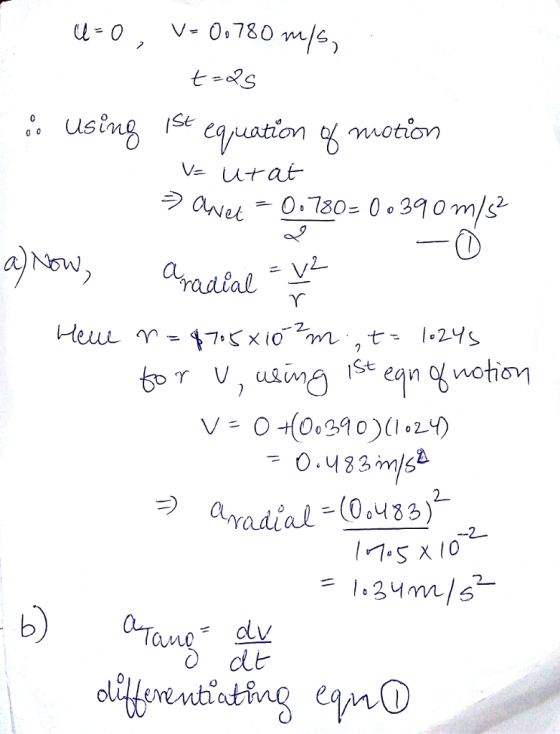
Step 1 - In order to find the acceleration, we firstly apply first equation of motion and then calculate the acceleration (equation 1)
Step 2- For part a) radial acceleration for a mass = v2/r, where r is the radius.
Since, we know t=1.24s and a =0.39 m/s 2 from equation 1. We put these values in first equation of motion and find v and hence find radial acceleration.
Step 3- For part b) tangential acceleration is given by = dv/dt.
From first equation of motion, v=u+at , therefore, dv/dt =a = 0.39 m/s 2
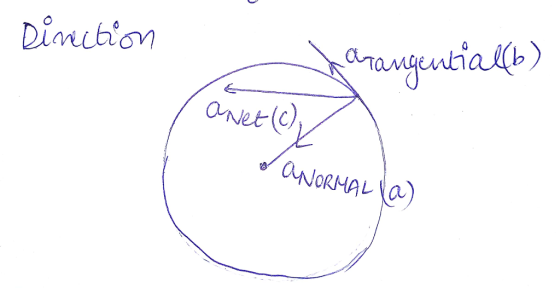
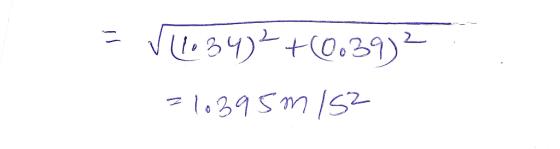
Step 4- For part c) netacceleration is √(a radial)2 + (a tangential)2
further elaboration can be seen in the given pictures

Add Answer to:
A point on a rotating turntable 17.5 cm from the center accelerates from rest to a...
A point on a rotating turntable 18.5 cm from the center accelerates from rest to a...
A point on a rotating turntable 18.5 cm from the center accelerates from rest to a final speed of 0.710 m/s in 1.75 s. At t = 1.21 s, find the magnitude and direction of each of the following. (a) the radial acceleration m/s2 toward the center away from the center in the direction of the rotation in a direction opposite to the rotation (b) the tangential acceleration m/s2 toward the center away from the center in the direction of...
A point on a rotating turntable 19.0 cm from the center accelerates from rest to a...
A point on a rotating turntable 19.0 cm from the center accelerates from rest to a final speed of 0.620 m/s in 1.70 s. At t = 1.22 s, find the magnitude and direction of each of the following. (a) the radial acceleration m/s2 toward the center away from the center in the direction of the rotation in a direction opposite to the rotation (b) the tangential acceleration m/s2 toward the center away from the center in the direction of...
Looking for some Physics help please.. Would you please clearly define what formulas used in answer?...
 Looking for some Physics help
please.. Would you please clearly define what formulas used in
answer? Having some real trouble with questions like these. Thank
you very much for your time. Sincerely,
Struggling physics student
A point on a rotating turntable 22.0 cm from the center accelerates from rest to a final speed of 0.660 m/s in 1.65 s. At t = 1.24 s, find the magnitude and direction of each of the following. (a) the radial acceleration 1.12 m/s...
Looking for some Physics help
please.. Would you please clearly define what formulas used in
answer? Having some real trouble with questions like these. Thank
you very much for your time. Sincerely,
Struggling physics student
A point on a rotating turntable 22.0 cm from the center accelerates from rest to a final speed of 0.660 m/s in 1.65 s. At t = 1.24 s, find the magnitude and direction of each of the following. (a) the radial acceleration 1.12 m/s...
An ultracentrifuge accelerates from rest to 100,000 rpm in 2.00 min. (a) What is its angular...
 An ultracentrifuge accelerates from rest to 100,000 rpm in 2.00 min. (a) What is its angular acceleration in rad/s2, rad/s2 (b) What is the tangential acceleration (in m/s2) of a point 9.00 cm from the axis of rotation? m/s2 (c) What is the radial acceleration in m/s2 and multiples of g of this point at full rpm? a in m/s m/s2 a as a multiple of g 9
An ultracentrifuge accelerates from rest to 100,000 rpm in 1.80 min. (a) What is its angular...
 An ultracentrifuge accelerates from rest to 100,000 rpm in 1.80 min. (a) What is its angular acceleration in rad/s2? rad/s² (b) What is the tangential acceleration, in m/s, of a point 10.55 cm from the axis of rotation? O m/s2 (c) What is the radial acceleration, in m/s2, of this point at full rpm? m/s2 (d) Express this radial acceleration as a multiple of g.
1, A 0.30 m radius automobile tire accelerates from rest at a constant angular acceleration of...
1, A 0.30 m radius automobile tire accelerates from rest at a constant angular acceleration of 0.758 rad/s2 for 2.23 s. What is its final angular speed in rad/s? 2. A turntable has a moment of inertia of 3.00 x 10⁻² kg-m2 and spins freely on a frictionless bearing at 46 rev/min. A 1.11 kg ball of putty is dropped vertically onto the turntable and sticks at a point 0.100m from the center. What is the new rate of rotation...
A coin is placed 34 cm from the center of a horizontal turntable, initially at rest....
A coin is placed 34 cm from the center of a horizontal turntable, initially at rest. The turntable then begins to rotate. When the speed of the coin is 120 cm/s (rotating at a constant rate), the coin just begins to slip. The acceleration of gravity is 980 cm/s^2. What is the coefficient of static friction between the coin and the turntable?
A coin placed 29.0 cm from the center of a rotating, horizontal turntable slips when its...
A coin placed 29.0 cm from the center of a rotating, horizontal turntable slips when its speed is 50.2 cm/s. (a) What force causes the centripetal acceleration when the coin is stationary relative to the turntable? static frictioninertia kinetic frictioncentrifugal force (b) What is the coefficient of static friction between coin and turntable?
Consider a bug which is crawling on the surface of a turntable rotating with constant angular...
 Consider a bug which is crawling on the surface of a turntable rotating with constant angular velocity wo. List all the forces acting on it in a system of coordinates painted on the turntable (z is perpendicular to the turntable and the rotation is around the z-axis) and the direction of each of those forces, in each of the following cases: a) when the bug is moving out from the center of the turntable along a radius at constant speed...
Starting from rest, the boy runs outward in the radial direction from the center of the...
 Starting from rest, the boy runs outward in the radial direction from the center of the platform with a constant acceleration of 0.5 m/s2. If the platform is rotating at a constant rate theta = 0.2 rad/s, determine the radial and transverse components of the velocity and acceleration of the boy when t = 3 s. Neglect his size.
 Looking for some Physics help
please.. Would you please clearly define what formulas used in
answer? Having some real trouble with questions like these. Thank
you very much for your time. Sincerely,
Struggling physics student
A point on a rotating turntable 22.0 cm from the center accelerates from rest to a final speed of 0.660 m/s in 1.65 s. At t = 1.24 s, find the magnitude and direction of each of the following. (a) the radial acceleration 1.12 m/s...
Looking for some Physics help
please.. Would you please clearly define what formulas used in
answer? Having some real trouble with questions like these. Thank
you very much for your time. Sincerely,
Struggling physics student
A point on a rotating turntable 22.0 cm from the center accelerates from rest to a final speed of 0.660 m/s in 1.65 s. At t = 1.24 s, find the magnitude and direction of each of the following. (a) the radial acceleration 1.12 m/s...
 An ultracentrifuge accelerates from rest to 100,000 rpm in 2.00 min. (a) What is its angular acceleration in rad/s2, rad/s2 (b) What is the tangential acceleration (in m/s2) of a point 9.00 cm from the axis of rotation? m/s2 (c) What is the radial acceleration in m/s2 and multiples of g of this point at full rpm? a in m/s m/s2 a as a multiple of g 9
 An ultracentrifuge accelerates from rest to 100,000 rpm in 1.80 min. (a) What is its angular acceleration in rad/s2? rad/s² (b) What is the tangential acceleration, in m/s, of a point 10.55 cm from the axis of rotation? O m/s2 (c) What is the radial acceleration, in m/s2, of this point at full rpm? m/s2 (d) Express this radial acceleration as a multiple of g.
 Consider a bug which is crawling on the surface of a turntable rotating with constant angular velocity wo. List all the forces acting on it in a system of coordinates painted on the turntable (z is perpendicular to the turntable and the rotation is around the z-axis) and the direction of each of those forces, in each of the following cases: a) when the bug is moving out from the center of the turntable along a radius at constant speed...
 Starting from rest, the boy runs outward in the radial direction from the center of the platform with a constant acceleration of 0.5 m/s2. If the platform is rotating at a constant rate theta = 0.2 rad/s, determine the radial and transverse components of the velocity and acceleration of the boy when t = 3 s. Neglect his size.
Most questions answered within 3 hours.
-
Where is the error in this code sequence?
String s1 = "Hello";
String s2 = "ello";...
asked 10 months ago -
Financial data for Joel de Paris, Inc., for last year
follow:
Joel de Paris, Inc.
Balance...
asked 10 months ago -
Consider this reaction:
Al2(SO4)3 (aq)+ BaCl3
(aq) Al2Cl6 (aq)- +
3BaSO4(s) . What is the...
asked 10 months ago -
Suppose that Savneet is considering increasing her
recent random sample from 20 car rentals to 40...
asked 10 months ago -
Trucks arrive at an unloading terminal at an average rate of 120
per hour.
Trucks arrive...
asked 10 months ago -
Why are methanol and ethanol completely soluble in water while
octanol is not very little soluble....
asked 10 months ago -
A facilities manager at a university reads in a research report
that the mean amount of...
asked 10 months ago -
When the CuSO4 is rehydrated by adding water to the anhydrous
compound, is this an endothermic...
asked 10 months ago -
A ray of sunlight is passing from diamond into crown glass; the
angle of incidence is...
asked 10 months ago -
A block of mass 0.249 kg is placed on top of a light, vertical
spring of...
asked 10 months ago -
how do the kidneys compensate in the presences of acidosis
a) trigger hyperventilate
b) reserve acid...
asked 10 months ago -
Question 501 pts
The rental rate of capital to the firm increases. Which of the
following...
asked 10 months ago