
Homework Answers
 (n+1](2n+1 2](http://img.homeworklib.com/questions/50ba67e0-6f40-11ea-bb79-3f52f11723a6.png?x-oss-process=image/resize,w_560)
Add Answer to:
Consider the time series
Consider the time series of Xt Xt-1 + Wt, where Wt ~...
Consider the time series of Xt = Xt−1 + Wt, whereWt are i.i.d and Wt ∼...
 Consider the time series of Xt = Xt−1 + Wt, whereWt are i.i.d
and Wt ∼ N (0, σ2 ) and X0 = 0. Let X¯ = 1 n Pn i=1 Xi . Derive the
general form for var(X¯). (Hint: Pn i=1 i 2 = n(n+1)(2n+1) 6 )
Consider the time series of X-Xi-1+Wi, whereW are i.i.d and W N(0, σ2) and Xo 0. Let X = n Σ, Derive the general form for var(X). (Hint: Σ i- n(n+1)(2n+1))
Consider the time series of Xt = Xt−1 + Wt, whereWt are i.i.d
and Wt ∼ N (0, σ2 ) and X0 = 0. Let X¯ = 1 n Pn i=1 Xi . Derive the
general form for var(X¯). (Hint: Pn i=1 i 2 = n(n+1)(2n+1) 6 )
Consider the time series of X-Xi-1+Wi, whereW are i.i.d and W N(0, σ2) and Xo 0. Let X = n Σ, Derive the general form for var(X). (Hint: Σ i- n(n+1)(2n+1))
Consider the simple moving average model Xt = 0.02 + Wt − 0.4Wt−1, where Wt is...
Consider the simple moving average model Xt = 0.02 + Wt − 0.4Wt−1, where Wt is a sequence of i.i.d. normal random variables with mean zero and variance 4. What is the mean of Xt? What is the variance of Xt. Show working
Let wt for t = . . .,-2,-1, 0, 1, 2, . . . be an...
 Let wt for t = . . .,-2,-1, 0, 1, 2, . . . be an independent and identically distributed process with wt ~ M0, σ2). and consider the time series Determine the mean and the autocovariance function of xt and state whether it is stationary
The sample data x1,x2,...,xn sometimes represents a time series, where xt = the observed value of...
The sample data x1,x2,...,xn sometimes represents a time series, where xt = the observed value of a response variable x at time t. Often the observed series shows a great deal of random variation, which makes it difficult to study longer-term behavior. In such situations, it is desirable to produce a smoothed version of the series. One technique for doing so involves exponential smoothing. The value of a smoothing constant α is chosen (0 < α < 1). Then with...
Let Wt de a (Gaussian) white noise with variance σ 2 . Then, let Xt =...
 Let Wt de a (Gaussian) white noise with variance σ 2 . Then, let
Xt = WtWt−1 + µ, where µ is a real constant. Determine the mean and
autocovariance of (Xt)? Is this process stationary?
Let W, de a (Gaussian) white noise with variance σ2. Then, let of where μ is a real constant. Determine the mean and (X)? Is this process stationary?
Let Wt de a (Gaussian) white noise with variance σ 2 . Then, let
Xt = WtWt−1 + µ, where µ is a real constant. Determine the mean and
autocovariance of (Xt)? Is this process stationary?
Let W, de a (Gaussian) white noise with variance σ2. Then, let of where μ is a real constant. Determine the mean and (X)? Is this process stationary?
Problem 3 Consider a random walk on the integers. Suppose we start from 0, and at each step, we either go left or right with probability 1/2, ie, Xo--0, and Xt+1 Xt+Zt, where Zt-1 with probability 1/...
 Problem 3 Consider a random walk on the integers. Suppose we start from 0, and at each step, we either go left or right with probability 1/2, ie, Xo--0, and Xt+1 Xt+Zt, where Zt-1 with probability 1/2, and Zt1 with probability 1/2. What is the probability distribution of XT? What is E(X) and Var(XT)?
Problem 3 Consider a random walk on the integers. Suppose we start from 0, and at each step, we either go left or right with probability...
Problem 3 Consider a random walk on the integers. Suppose we start from 0, and at each step, we either go left or right with probability 1/2, ie, Xo--0, and Xt+1 Xt+Zt, where Zt-1 with probability 1/2, and Zt1 with probability 1/2. What is the probability distribution of XT? What is E(X) and Var(XT)?
Problem 3 Consider a random walk on the integers. Suppose we start from 0, and at each step, we either go left or right with probability...
(5 points) Consider the series xt = sin(2nUt), t = 1.2, . . . , where...
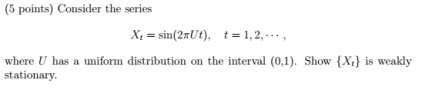 (5 points) Consider the series xt = sin(2nUt), t = 1.2, . . . , where U has a uniform distribution on the interval (0,1). Show {Xt) is weakly stationary.
Let Xi, ,Xn be a sample from N(μ, σ2) and assume that both parameters are unknown. Consider testi...
 Let Xi, ,Xn be a sample from N(μ, σ2) and assume that both parameters are unknown. Consider testing where μοισ., are given constants. Use LRT to derive the general form of the intersection-union rejection region in its simplest form. Identify the exact dis- tribution of statistics in the intersection-union rejection region . Hint: Use the fact that when the sample is from a Normal distribution, sample mean and sample variance are statistically independent.
Let Xi, ,Xn be a sample from...
Let Xi, ,Xn be a sample from N(μ, σ2) and assume that both parameters are unknown. Consider testing where μοισ., are given constants. Use LRT to derive the general form of the intersection-union rejection region in its simplest form. Identify the exact dis- tribution of statistics in the intersection-union rejection region . Hint: Use the fact that when the sample is from a Normal distribution, sample mean and sample variance are statistically independent.
Let Xi, ,Xn be a sample from...
Yt = 5 − 2t + Xt, where {Xt} is stationary with mean 0 and autocovariance...
Yt = 5 − 2t + Xt, where {Xt} is stationary with mean 0 and autocovariance function γk. Now, let Wt = Yt − Yt−1. (a) Find the mean function for {Wt}. (b) Find the autocovariance function for {Wt}. (c) Is {Wt} stationary? Why or why not?
Problem 2 [17 points]. Transformations! a) (5 points) Suppose the time, W, it takes to complete...
 Problem 2 [17 points]. Transformations! a) (5 points) Suppose the time, W, it takes to complete a technical task at a workshop has probability density function -w/2 f(w)y 0, 0, otherwise Using the appropriate transformation methods, find the density function for the a time it takes two workers to complete this technical task: S Wi + Ws b) (5 points) Derive the moment generating function of a standard normal randon variable. Use point form to explain each step in your...
 Consider the time series of Xt = Xt−1 + Wt, whereWt are i.i.d
and Wt ∼ N (0, σ2 ) and X0 = 0. Let X¯ = 1 n Pn i=1 Xi . Derive the
general form for var(X¯). (Hint: Pn i=1 i 2 = n(n+1)(2n+1) 6 )
Consider the time series of X-Xi-1+Wi, whereW are i.i.d and W N(0, σ2) and Xo 0. Let X = n Σ, Derive the general form for var(X). (Hint: Σ i- n(n+1)(2n+1))
Consider the time series of Xt = Xt−1 + Wt, whereWt are i.i.d
and Wt ∼ N (0, σ2 ) and X0 = 0. Let X¯ = 1 n Pn i=1 Xi . Derive the
general form for var(X¯). (Hint: Pn i=1 i 2 = n(n+1)(2n+1) 6 )
Consider the time series of X-Xi-1+Wi, whereW are i.i.d and W N(0, σ2) and Xo 0. Let X = n Σ, Derive the general form for var(X). (Hint: Σ i- n(n+1)(2n+1))
 Let wt for t = . . .,-2,-1, 0, 1, 2, . . . be an independent and identically distributed process with wt ~ M0, σ2). and consider the time series Determine the mean and the autocovariance function of xt and state whether it is stationary
 Let Wt de a (Gaussian) white noise with variance σ 2 . Then, let
Xt = WtWt−1 + µ, where µ is a real constant. Determine the mean and
autocovariance of (Xt)? Is this process stationary?
Let W, de a (Gaussian) white noise with variance σ2. Then, let of where μ is a real constant. Determine the mean and (X)? Is this process stationary?
Let Wt de a (Gaussian) white noise with variance σ 2 . Then, let
Xt = WtWt−1 + µ, where µ is a real constant. Determine the mean and
autocovariance of (Xt)? Is this process stationary?
Let W, de a (Gaussian) white noise with variance σ2. Then, let of where μ is a real constant. Determine the mean and (X)? Is this process stationary?
 Problem 3 Consider a random walk on the integers. Suppose we start from 0, and at each step, we either go left or right with probability 1/2, ie, Xo--0, and Xt+1 Xt+Zt, where Zt-1 with probability 1/2, and Zt1 with probability 1/2. What is the probability distribution of XT? What is E(X) and Var(XT)?
Problem 3 Consider a random walk on the integers. Suppose we start from 0, and at each step, we either go left or right with probability...
Problem 3 Consider a random walk on the integers. Suppose we start from 0, and at each step, we either go left or right with probability 1/2, ie, Xo--0, and Xt+1 Xt+Zt, where Zt-1 with probability 1/2, and Zt1 with probability 1/2. What is the probability distribution of XT? What is E(X) and Var(XT)?
Problem 3 Consider a random walk on the integers. Suppose we start from 0, and at each step, we either go left or right with probability...
 (5 points) Consider the series xt = sin(2nUt), t = 1.2, . . . , where U has a uniform distribution on the interval (0,1). Show {Xt) is weakly stationary.
 Let Xi, ,Xn be a sample from N(μ, σ2) and assume that both parameters are unknown. Consider testing where μοισ., are given constants. Use LRT to derive the general form of the intersection-union rejection region in its simplest form. Identify the exact dis- tribution of statistics in the intersection-union rejection region . Hint: Use the fact that when the sample is from a Normal distribution, sample mean and sample variance are statistically independent.
Let Xi, ,Xn be a sample from...
Let Xi, ,Xn be a sample from N(μ, σ2) and assume that both parameters are unknown. Consider testing where μοισ., are given constants. Use LRT to derive the general form of the intersection-union rejection region in its simplest form. Identify the exact dis- tribution of statistics in the intersection-union rejection region . Hint: Use the fact that when the sample is from a Normal distribution, sample mean and sample variance are statistically independent.
Let Xi, ,Xn be a sample from...
 Problem 2 [17 points]. Transformations! a) (5 points) Suppose the time, W, it takes to complete a technical task at a workshop has probability density function -w/2 f(w)y 0, 0, otherwise Using the appropriate transformation methods, find the density function for the a time it takes two workers to complete this technical task: S Wi + Ws b) (5 points) Derive the moment generating function of a standard normal randon variable. Use point form to explain each step in your...
Most questions answered within 3 hours.
-
Where is the error in this code sequence?
String s1 = "Hello";
String s2 = "ello";...
asked 10 months ago -
Financial data for Joel de Paris, Inc., for last year
follow:
Joel de Paris, Inc.
Balance...
asked 10 months ago -
Consider this reaction:
Al2(SO4)3 (aq)+ BaCl3
(aq) Al2Cl6 (aq)- +
3BaSO4(s) . What is the...
asked 10 months ago -
Suppose that Savneet is considering increasing her
recent random sample from 20 car rentals to 40...
asked 10 months ago -
Trucks arrive at an unloading terminal at an average rate of 120
per hour.
Trucks arrive...
asked 10 months ago -
Why are methanol and ethanol completely soluble in water while
octanol is not very little soluble....
asked 10 months ago -
A facilities manager at a university reads in a research report
that the mean amount of...
asked 10 months ago -
When the CuSO4 is rehydrated by adding water to the anhydrous
compound, is this an endothermic...
asked 10 months ago -
A ray of sunlight is passing from diamond into crown glass; the
angle of incidence is...
asked 10 months ago -
A block of mass 0.249 kg is placed on top of a light, vertical
spring of...
asked 10 months ago -
how do the kidneys compensate in the presences of acidosis
a) trigger hyperventilate
b) reserve acid...
asked 10 months ago -
Question 501 pts
The rental rate of capital to the firm increases. Which of the
following...
asked 10 months ago