Explain the following measures of incidence and compare their applications: incidence rate, cumulative incidence rate, incidence...
Explain the following measures of incidence and compare their applications: incidence rate, cumulative incidence rate, incidence density, and attack rate.
Homework Answers
- Incidence rate is defined as the number of new cases occurring in a defined population during a specified time period.
- No of new cases of specific disease during a given time period /population at risk during that period. It is often used to measure the occurance of acute or short term disease with exactly defined onset such as acute intestinal disease, poisoning, car accident, stroke etc.
- Cumulative incidence rate is number of new cases in a specific time period divided by number of population that is at risk of the disease.
- CI= No. of new cases during a specified period of time /no. of total population at risk
- Eg: 80 new cases of cervical cancer in 5 year period /4000women at risk =0.02=20 cases for 1000population
- Incidence density rate is the speed at which a defined at risk group or population develops a new clinical condition or outcome over a given time period.
- IDR = no.of newly diseased individual or cases /sum of time periods for all disease -free individual at risk.
- Attack rate is incidence rate which are calculated narrowly defined population during limited period of time such as an epidemic.
Add Answer to:
Explain the following measures of incidence and compare their
applications: incidence rate, cumulative incidence rate, incidence...
Which of the following statements regarding disease measures is not true? A. Incidence density is a...
Which of the following statements regarding disease measures is not true? A. Incidence density is a proportion, not a rate B. Prevalence is a proportion C. Prevalence equals duration times incidence D. Cumulative incidence is a proportion, not a rate
Indicate whether the following is an incidence proportion, incidence rate, prevalence. (1/2 point each) Incidence proportion/...
 Indicate whether the following is an incidence proportion,
incidence rate, prevalence. (1/2 point each)
Incidence proportion/ Cumulative incidence
Incidence rate / incidence density
Prevalence
7 number of women in town of Framingham who reported having heart disease in recent health survey estimated number of women residents of Framingham during same period L number of women in Framingham Study who have died through last year from heart disease number of person-years contributed through last year by women initially enrolled in Framingham...
Indicate whether the following is an incidence proportion,
incidence rate, prevalence. (1/2 point each)
Incidence proportion/ Cumulative incidence
Incidence rate / incidence density
Prevalence
7 number of women in town of Framingham who reported having heart disease in recent health survey estimated number of women residents of Framingham during same period L number of women in Framingham Study who have died through last year from heart disease number of person-years contributed through last year by women initially enrolled in Framingham...
Incidence and prevalence rates can also be used to compare the rates of disease across different...
Incidence and prevalence rates can also be used to compare the rates of disease across different settings (places), people, or time. We therefore need measures of comparison. The ratio of two measures of disease frequency is called the relative risk. The difference between two measures of disease frequency is called the risk difference, or rate difference. In some cases, it involves a measure in an exposed group (or groups) and a measure in an unexposed or comparison group. In other...
To compare welfare across individuals we can use which of the following measures? A Utility levels...
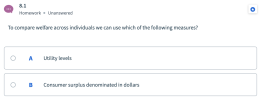 To compare welfare across individuals we can use which of the
following measures?
A
Utility levels
B
Consumer surplus denominated in dollar
... 8.1 Homework. Unanswered To compare welfare across individuals we can use which of the following measures? O A Utility levels Consumer surplus denominated in dollars
To compare welfare across individuals we can use which of the
following measures?
A
Utility levels
B
Consumer surplus denominated in dollar
... 8.1 Homework. Unanswered To compare welfare across individuals we can use which of the following measures? O A Utility levels Consumer surplus denominated in dollars
what is the incidence density rate (express as #HD per 100 patient-years) for non-coffee drinkers?
what is the incidence density rate (express as #HD per 100 patient-years) for non-coffee drinkers?
10. Explain in words, and words only, the following properties of a cumulative density function (CDF)...
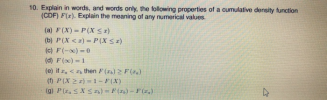 10. Explain in words, and words only, the following properties of a cumulative density function (CDF) F(x). Explain the meaning of any numerical values. (a) F(X) = P(X <r) (b) P (X<) = P(XSI) (c) F(---) = 0 (d) F(0) = 1 (e) if ro <, then F(r) > F(ta) (f) P (X > 1) = 1 - F(X) (9) P ( SX S16) -F ) - F ( )
What was the cumulative incidence of HIV among study participants in January 2003? What was the...
What was the cumulative incidence of HIV among study participants in January 2003? What was the cumulative incidence of HIV among study participants in January 2003? In January 2000, 5000 men and women aged 18-30 years were recruited from a semi-urban area near Durban (South Africa) and assessed for human immunodeficiency virus (HIV). Participants who did not test positive for HIV, at baseline in 2000, were followed-up and assessed again 3 years later in January 2003 (only those who previously...
Define each of the following and give examples of each pandemic,epidemic incidence rate
Define each of the following and give examples of each pandemic,epidemic incidence rate
Compare and contrast the following qualitative research approaches: Interactive and participatory qualitative applications 1. Summarize the...
Compare and contrast the following qualitative research approaches: Interactive and participatory qualitative applications 1. Summarize the characteristics of the approach of the research article you chose during your literature search. 2. Demonstrate knowledge of alignment between a research problem and research question using several qualitative approaches
Find 3 job applications online. Compare and contrast them, giving your thoughts about each one. Rank...
Find 3 job applications online. Compare and contrast them, giving your thoughts about each one. Rank them in order of effectiveness and explain why you chose that order. Are there any "risky" or illegal questions?
 Indicate whether the following is an incidence proportion,
incidence rate, prevalence. (1/2 point each)
Incidence proportion/ Cumulative incidence
Incidence rate / incidence density
Prevalence
7 number of women in town of Framingham who reported having heart disease in recent health survey estimated number of women residents of Framingham during same period L number of women in Framingham Study who have died through last year from heart disease number of person-years contributed through last year by women initially enrolled in Framingham...
Indicate whether the following is an incidence proportion,
incidence rate, prevalence. (1/2 point each)
Incidence proportion/ Cumulative incidence
Incidence rate / incidence density
Prevalence
7 number of women in town of Framingham who reported having heart disease in recent health survey estimated number of women residents of Framingham during same period L number of women in Framingham Study who have died through last year from heart disease number of person-years contributed through last year by women initially enrolled in Framingham...
 To compare welfare across individuals we can use which of the
following measures?
A
Utility levels
B
Consumer surplus denominated in dollar
... 8.1 Homework. Unanswered To compare welfare across individuals we can use which of the following measures? O A Utility levels Consumer surplus denominated in dollars
To compare welfare across individuals we can use which of the
following measures?
A
Utility levels
B
Consumer surplus denominated in dollar
... 8.1 Homework. Unanswered To compare welfare across individuals we can use which of the following measures? O A Utility levels Consumer surplus denominated in dollars
 10. Explain in words, and words only, the following properties of a cumulative density function (CDF) F(x). Explain the meaning of any numerical values. (a) F(X) = P(X <r) (b) P (X<) = P(XSI) (c) F(---) = 0 (d) F(0) = 1 (e) if ro <, then F(r) > F(ta) (f) P (X > 1) = 1 - F(X) (9) P ( SX S16) -F ) - F ( )
Most questions answered within 3 hours.
-
Where is the error in this code sequence?
String s1 = "Hello";
String s2 = "ello";...
asked 11 months ago -
Financial data for Joel de Paris, Inc., for last year
follow:
Joel de Paris, Inc.
Balance...
asked 11 months ago -
Consider this reaction:
Al2(SO4)3 (aq)+ BaCl3
(aq) Al2Cl6 (aq)- +
3BaSO4(s) . What is the...
asked 11 months ago -
Suppose that Savneet is considering increasing her
recent random sample from 20 car rentals to 40...
asked 11 months ago -
Trucks arrive at an unloading terminal at an average rate of 120
per hour.
Trucks arrive...
asked 11 months ago -
Why are methanol and ethanol completely soluble in water while
octanol is not very little soluble....
asked 11 months ago -
A facilities manager at a university reads in a research report
that the mean amount of...
asked 11 months ago -
When the CuSO4 is rehydrated by adding water to the anhydrous
compound, is this an endothermic...
asked 11 months ago -
A ray of sunlight is passing from diamond into crown glass; the
angle of incidence is...
asked 11 months ago -
A block of mass 0.249 kg is placed on top of a light, vertical
spring of...
asked 11 months ago -
how do the kidneys compensate in the presences of acidosis
a) trigger hyperventilate
b) reserve acid...
asked 11 months ago -
Question 501 pts
The rental rate of capital to the firm increases. Which of the
following...
asked 11 months ago