
Homework Answers
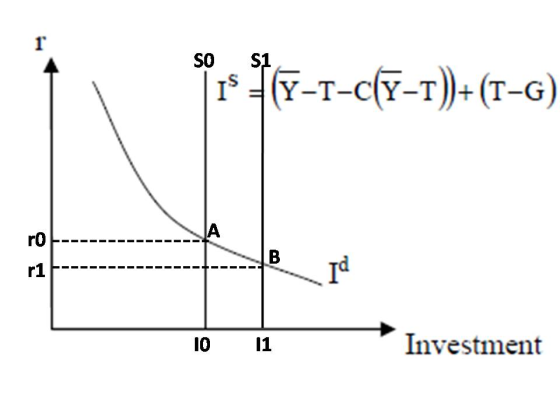
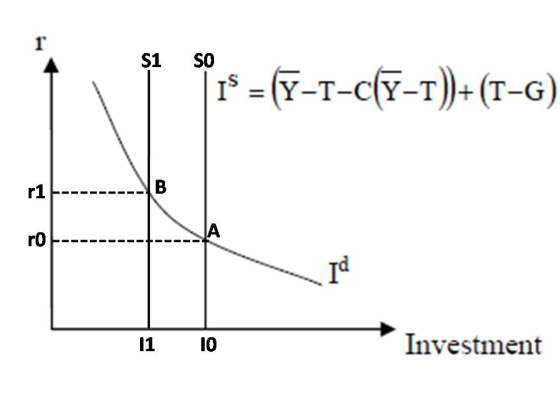
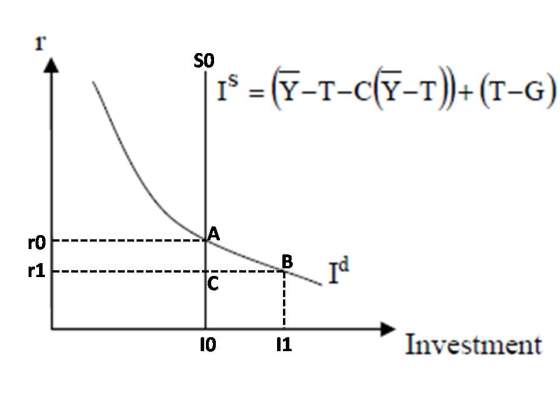
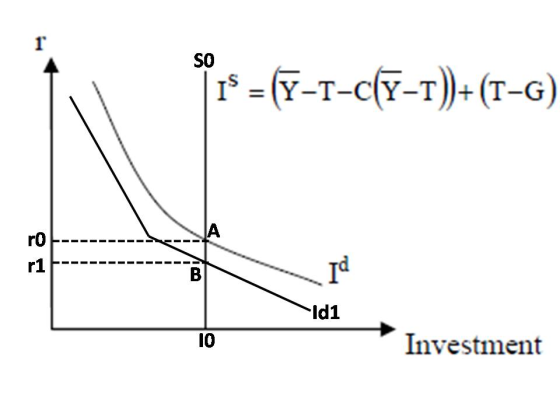
The vertical line is the saving function (S0), assumed independent of interest rate. Initial equilibrium is at point A with initial interest rate r0 and quantity of investment (and saving) I0.
(a) Increase in tax will decrease consumption and increase savings, shifting S0 rightward to S1, intersecting Id at point B with lower interest rate r1 and higher quantity of investment I1. Consumption, interest rate and output will fall.
(b) Decrease in private saving will shift S0 leftward to S1, intersecting Id at point B with higher interest rate r1 and lower quantity of investment I1. Consumption, interest rate and output will rise.
(c) Increase in money supply will decrease interest rate, which will increase the quantity of investment demanded. When r0 falls to r1, it intersects S0 at point C with amount of saving being constant at I0, but intersects Id at point B, with higher quantity of investment demanded being I1. There is a savings-investment imbalance equal to (I1 - I0). Consumption and output will rise.
(d) Decrease in investment demand will shift Id curve leftward to Id1, intersecting S0 at point B. Interest rate falls to r1 but quantity of investment remains the same at I0. Output and consumption will fall.
Add Answer to:
7. Show the changes in the graph below and predict the changes in output, interest rate,...
Assume that C Co + c(Y – T) and I = Io – i(r). Suppose that...
 Assume that C Co + c(Y – T) and I = Io – i(r). Suppose that taxes increase and money supply increases in such a way that output is constant in equilibrium (assume c < 1 ). These policy changes will produce: An increase in investment and a decrease in private saving. An increase in investment and a decrease in private consumption. An increase in investment and a decrease in government spending. O A decrease in investment and an increase...
show both changes in graph and answer 2. Assume the economy is initially in equilibrium, and...
 show both changes in graph and answer
2. Assume the economy is initially in equilibrium, and then firms expect future total factor productivity, z', to decrease. Using the New Keynesian Model framework, what are the implications on the following: a) Output supply increase / decrease / indeterminate / no change)? b) Output demand (increase / decrease / indeterminate/ no change)? c) Labor supply increase / decrease / indeterminate / no change)? d) Labor demand (increase / decrease / indeterminate/ no...
show both changes in graph and answer
2. Assume the economy is initially in equilibrium, and then firms expect future total factor productivity, z', to decrease. Using the New Keynesian Model framework, what are the implications on the following: a) Output supply increase / decrease / indeterminate / no change)? b) Output demand (increase / decrease / indeterminate/ no change)? c) Labor supply increase / decrease / indeterminate / no change)? d) Labor demand (increase / decrease / indeterminate/ no...
Use the IS-LM model to predict the short-run effects of each of the following shocks on...
 Use the IS-LM model to predict the short-run effects of each of the following shocks on income, the interest rate, consumption, and investment. In each case, explain what the Bank of Canada should do to keep income at its initial level. For each of these four shocks, (1) shift the appropriate curve in the IS-LM graph to reflect how the economy will respond to the shock; (2) indicate the impact of the shock on consumption, income, interest rate, and investment...
Which of the following best describes the process (in order) of how monetary policy effects the macroeconomy? A. The 3 players have to cooperate, the aggregate demand changes, interest rate change, in...
Which of the following best describes the process (in order) of how monetary policy effects the macroeconomy? A. The 3 players have to cooperate, the aggregate demand changes, interest rate change, investment and consumption change and then the money supply changes. B. The 3 players have to cooperate, the money supply changes, interest rate change, investment and consumption change, and then the aggregate demand changes. C. They 3 players have to cooperate, interest rate change, the money supply changes, investment...
Below is some data concerning the money market. Rate of Interest Asset Demand for Money $75...
 Below is some data concerning the money market. Rate of Interest Asset Demand for Money $75 5% National income $740 720 700 680 660 6% 65 7% 8% 35. Refer to the information above to answer this question. If the transactions demand for money is 10 percent of national income and the supply of money is $135 then what would be the equilibrium interest rate? A) 4%. B) 5%. C) 6%. D) 7%. E) 8%. 36. Refer to the information...
I. The economy of Zarland is operating below the full-employment level of output with a balanced budget. (a) Draw a correctly labeled graph of short-run aggregate supply, long-run aggregate supply, a...
 I. The economy of Zarland is operating below the full-employment level of output with a balanced budget. (a) Draw a correctly labeled graph of short-run aggregate supply, long-run aggregate supply, and aggregate demand, and show each of the following. (Gi) The country's current equilibrium output and price level, labeled Yj and PL1. respectively (ii) The full-employment output, labeled Yf (b) Ir Zarland increases government expenditures and taxes by equal amounts, can aggregate demand increase? Explain. (c) If Zarland decides to...
Below is a graph of the short run. Refer to the graph to answer the following...
 Below is a graph of the short run. Refer to the graph to answer the following three questions 1. Move the money supply curve to show what would happen if the Bank of Canada (BoC) chose to decrease the money supply. Assume that the B over the money supply 2. As a result of the change, the interest rate at the equilibrium has complete control falls O does not change rises Money Supply 3. What leads to the adjustment in...
21. G increase with algebra. Consider an economy described by the following model. Y = K1/3L2/3...
 21. G increase with algebra. Consider an economy described by the following model. Y = K1/3L2/3 K = 1000; L = 1000 G = 100 T = 100 C = 250 + 0.5(Y-T) 1 = 600 – 100r Calculate the equilibrium real interest rate, national saving, public saving, private saving, consumption, output, and investment. (Hint: you probably don't want to solve for them it in that order.) i.rs ii. national saving = iii. public saving = iv. private saving =...
Assume that investment spending depends only on the interest rate and no longer depends on output....
Assume that investment spending depends only on the interest rate and no longer depends on output. Given this information, a decrease in money supply: a. will cause investment to increase. b. may cause investment to increase or decrease. c. will have no effect on output. d. will cause a reduction in output and have no effect on the interest rate. e. will cause investment to decrease.
For each of the following scenarios, use supply and demand analysis to predict the resulting changes...
 For each of the following scenarios, use supply and demand analysis to predict the resulting changes in the real interest rate, national saving, and investment. Show all your diagrams. (LO6) a. The legislature passes a 10 percent investment tax credit. Under this program, for every $100 that a firm spends on new capital equipment, it receives an extra $10 in tax refunds from the government b. A reduction in military spending moves the government's budget from deficit into surplus. c....
 Assume that C Co + c(Y – T) and I = Io – i(r). Suppose that taxes increase and money supply increases in such a way that output is constant in equilibrium (assume c < 1 ). These policy changes will produce: An increase in investment and a decrease in private saving. An increase in investment and a decrease in private consumption. An increase in investment and a decrease in government spending. O A decrease in investment and an increase...
 show both changes in graph and answer
2. Assume the economy is initially in equilibrium, and then firms expect future total factor productivity, z', to decrease. Using the New Keynesian Model framework, what are the implications on the following: a) Output supply increase / decrease / indeterminate / no change)? b) Output demand (increase / decrease / indeterminate/ no change)? c) Labor supply increase / decrease / indeterminate / no change)? d) Labor demand (increase / decrease / indeterminate/ no...
show both changes in graph and answer
2. Assume the economy is initially in equilibrium, and then firms expect future total factor productivity, z', to decrease. Using the New Keynesian Model framework, what are the implications on the following: a) Output supply increase / decrease / indeterminate / no change)? b) Output demand (increase / decrease / indeterminate/ no change)? c) Labor supply increase / decrease / indeterminate / no change)? d) Labor demand (increase / decrease / indeterminate/ no...
 Use the IS-LM model to predict the short-run effects of each of the following shocks on income, the interest rate, consumption, and investment. In each case, explain what the Bank of Canada should do to keep income at its initial level. For each of these four shocks, (1) shift the appropriate curve in the IS-LM graph to reflect how the economy will respond to the shock; (2) indicate the impact of the shock on consumption, income, interest rate, and investment...
 Below is some data concerning the money market. Rate of Interest Asset Demand for Money $75 5% National income $740 720 700 680 660 6% 65 7% 8% 35. Refer to the information above to answer this question. If the transactions demand for money is 10 percent of national income and the supply of money is $135 then what would be the equilibrium interest rate? A) 4%. B) 5%. C) 6%. D) 7%. E) 8%. 36. Refer to the information...
 I. The economy of Zarland is operating below the full-employment level of output with a balanced budget. (a) Draw a correctly labeled graph of short-run aggregate supply, long-run aggregate supply, and aggregate demand, and show each of the following. (Gi) The country's current equilibrium output and price level, labeled Yj and PL1. respectively (ii) The full-employment output, labeled Yf (b) Ir Zarland increases government expenditures and taxes by equal amounts, can aggregate demand increase? Explain. (c) If Zarland decides to...
 Below is a graph of the short run. Refer to the graph to answer the following three questions 1. Move the money supply curve to show what would happen if the Bank of Canada (BoC) chose to decrease the money supply. Assume that the B over the money supply 2. As a result of the change, the interest rate at the equilibrium has complete control falls O does not change rises Money Supply 3. What leads to the adjustment in...
 21. G increase with algebra. Consider an economy described by the following model. Y = K1/3L2/3 K = 1000; L = 1000 G = 100 T = 100 C = 250 + 0.5(Y-T) 1 = 600 – 100r Calculate the equilibrium real interest rate, national saving, public saving, private saving, consumption, output, and investment. (Hint: you probably don't want to solve for them it in that order.) i.rs ii. national saving = iii. public saving = iv. private saving =...
 For each of the following scenarios, use supply and demand analysis to predict the resulting changes in the real interest rate, national saving, and investment. Show all your diagrams. (LO6) a. The legislature passes a 10 percent investment tax credit. Under this program, for every $100 that a firm spends on new capital equipment, it receives an extra $10 in tax refunds from the government b. A reduction in military spending moves the government's budget from deficit into surplus. c....
Most questions answered within 3 hours.
-
Where is the error in this code sequence?
String s1 = "Hello";
String s2 = "ello";...
asked 10 months ago -
Financial data for Joel de Paris, Inc., for last year
follow:
Joel de Paris, Inc.
Balance...
asked 10 months ago -
Consider this reaction:
Al2(SO4)3 (aq)+ BaCl3
(aq) Al2Cl6 (aq)- +
3BaSO4(s) . What is the...
asked 10 months ago -
Suppose that Savneet is considering increasing her
recent random sample from 20 car rentals to 40...
asked 10 months ago -
Trucks arrive at an unloading terminal at an average rate of 120
per hour.
Trucks arrive...
asked 10 months ago -
Why are methanol and ethanol completely soluble in water while
octanol is not very little soluble....
asked 10 months ago -
A facilities manager at a university reads in a research report
that the mean amount of...
asked 10 months ago -
When the CuSO4 is rehydrated by adding water to the anhydrous
compound, is this an endothermic...
asked 10 months ago -
A ray of sunlight is passing from diamond into crown glass; the
angle of incidence is...
asked 10 months ago -
A block of mass 0.249 kg is placed on top of a light, vertical
spring of...
asked 10 months ago -
how do the kidneys compensate in the presences of acidosis
a) trigger hyperventilate
b) reserve acid...
asked 10 months ago -
Question 501 pts
The rental rate of capital to the firm increases. Which of the
following...
asked 10 months ago