The Tasty Tuna Fishing Company decided to abandon gill-netting technology because of its adverse environmental side-effects....
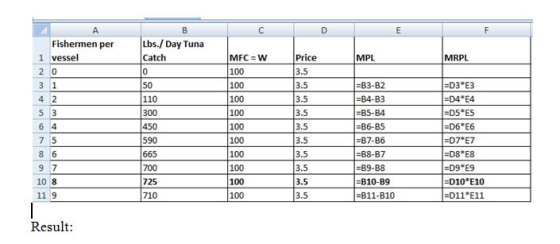
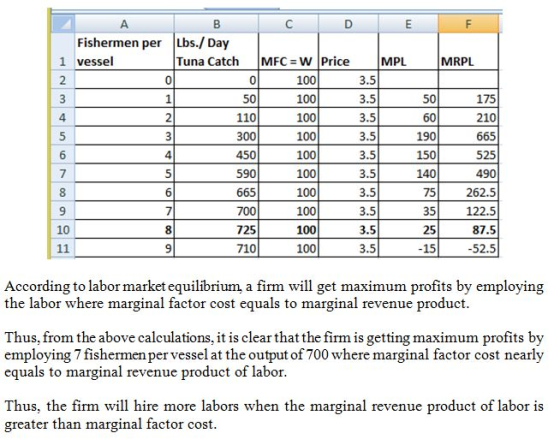
The Tasty Tuna Fishing Company decided to abandon gill-netting technology because of its adverse environmental side-effects. Tasty Tuna’s management decided to utilize a more traditional pole-and-line fishing method. They utilize a fishing vessel that can accommodate multiple fishermen per day. The managers were unsure of the optimal size of the crew who would man the vessel and catch the tuna. Tasty Tuna’s managers experimented with different size crews on the vessel. They generated the following short-run production relationship between the number of fishermen per vessel, and the daily catch of tuna (in total pounds):
|
# Fishermen per vessel |
|
# Lbs. / Day Tuna Catch |
|
Tasty Tuna’s Short-Run Production Function |
|
0 |
0 |
|
1 |
50 |
|
2 |
110 |
|
3 |
300 |
|
4 |
450 |
|
5 |
590 |
|
6 |
665 |
|
7 |
700 |
|
8 |
725 |
|
9 |
710 |
Based on Tasty Tuna’s production function above, please answer the questions below. Please also consult the companion MS-Excel Spreadsheet file. The spreadsheet file provides some calculations that will assist you to properly respond to the questions posed in this problem.
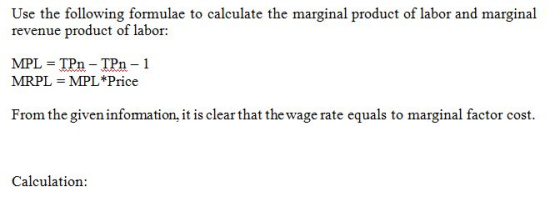
The daily wage rate for a fisherman is $100/day → this is the Marginal Factor Cost (DTC/DL). A multi-billionaire environmentalist, who was happy to see gill-netting go away, gave Tasty Tuna their vessel at no cost, causing Total Fixed Cost to be Zero. As a result, Total Cost (TC) simply equals Total Variable Cost (Daily Wage x #Fishermen). With these cost conditions identified, if the Market Price (P) of Tuna is $3.50 per pound, then what is the optimal number of fishermen to hire for maximum Total Profit? Does this maximum total profit occur within the boundaries of Stage 2 of short run production? Should it? Explain
Homework Answers

Add Answer to:
The Tasty Tuna Fishing Company decided to
abandon gill-netting technology because of its adverse
environmental side-effects....
Most questions answered within 3 hours.
-
Where is the error in this code sequence?
String s1 = "Hello";
String s2 = "ello";...
asked 11 months ago -
Financial data for Joel de Paris, Inc., for last year
follow:
Joel de Paris, Inc.
Balance...
asked 11 months ago -
Consider this reaction:
Al2(SO4)3 (aq)+ BaCl3
(aq) Al2Cl6 (aq)- +
3BaSO4(s) . What is the...
asked 11 months ago -
Suppose that Savneet is considering increasing her
recent random sample from 20 car rentals to 40...
asked 11 months ago -
Trucks arrive at an unloading terminal at an average rate of 120
per hour.
Trucks arrive...
asked 11 months ago -
Why are methanol and ethanol completely soluble in water while
octanol is not very little soluble....
asked 11 months ago -
A facilities manager at a university reads in a research report
that the mean amount of...
asked 11 months ago -
When the CuSO4 is rehydrated by adding water to the anhydrous
compound, is this an endothermic...
asked 11 months ago -
A ray of sunlight is passing from diamond into crown glass; the
angle of incidence is...
asked 11 months ago -
A block of mass 0.249 kg is placed on top of a light, vertical
spring of...
asked 11 months ago -
how do the kidneys compensate in the presences of acidosis
a) trigger hyperventilate
b) reserve acid...
asked 11 months ago -
Question 501 pts
The rental rate of capital to the firm increases. Which of the
following...
asked 11 months ago