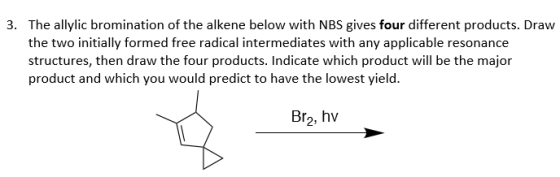
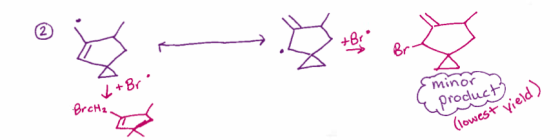
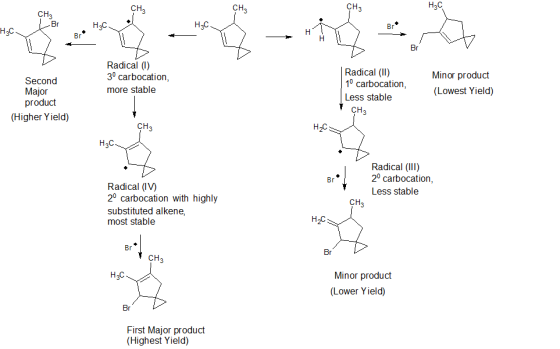
This is a question on free radical halogenation.
How and why does the bromoethane bond form for the 2nd resonance structure?
Homework Answers
Add Answer to:
This is a question on free radical halogenation.
How and why does the bromoethane bond form...
Answer the following questions about radical halogenation QUESTION 1 Performing allylic bromination of an asymmetric alkene...
 Answer the following questions about radical halogenation
QUESTION 1 Performing allylic bromination of an asymmetric alkene produces two regiochemical outcomes due to resonance, and two conformations (R) and (S) for each chirality center produced. This is further complicated if you make the mistake of using Br2 as your source of bromine radicals, as the addition reaction producing alkyl dibromides competes with the allylic bromination. Br2, hv ??? Categorize each of the compounds shown below as an [A] allylic bromination product,...
Answer the following questions about radical halogenation
QUESTION 1 Performing allylic bromination of an asymmetric alkene produces two regiochemical outcomes due to resonance, and two conformations (R) and (S) for each chirality center produced. This is further complicated if you make the mistake of using Br2 as your source of bromine radicals, as the addition reaction producing alkyl dibromides competes with the allylic bromination. Br2, hv ??? Categorize each of the compounds shown below as an [A] allylic bromination product,...
What is Wrong? Select the keyword or phrase that will best complete each sentence. Key terms: A radical...
 What is Wrong?
Select the keyword or phrase that will best complete each sentence. Key terms: A radical is a reactive intermediate with a single unpaired electron, formed by homoloysis of a covalent bond. paired unpaired Allylic radicals are stabilized by resonance, making them more stable than tertiary radicals increases inductive effects A compound that contains an especially weak bond that serves as a source of radicals is called a radical initiator ess homoloysis decreases more J Treatment of cyclohexene...
What is Wrong?
Select the keyword or phrase that will best complete each sentence. Key terms: A radical is a reactive intermediate with a single unpaired electron, formed by homoloysis of a covalent bond. paired unpaired Allylic radicals are stabilized by resonance, making them more stable than tertiary radicals increases inductive effects A compound that contains an especially weak bond that serves as a source of radicals is called a radical initiator ess homoloysis decreases more J Treatment of cyclohexene...
Provide the product you'd expect from the following reaction? OH SOCIL pyridine Draw the allylic radical...
 Provide the product you'd expect from the following reaction? OH SOCIL pyridine Draw the allylic radical intermediates you would expect to form as intermediates in the following reaction NBS "Вг + hv "Вr Predict the product(s) you'd expect when the following molecule is treated with NBS and irradiated with UV light? Draw all possible monochlorinated products you'd expect upon treating cyclohexane with Cl2 and irradiated with UV light. Draw all possible monochlorinated products you'd expect upon treating 2-methylbutane with Cl2...
Draw all possible monochlorinated products you'd expect upon treating 2-methylbutane with Cl2 and irradiated with UV...
 Draw all possible monochlorinated products you'd expect upon treating 2-methylbutane with Cl2 and irradiated with UV light. Draw all possible monochlorinated products you'd expect upon treating cyclohexane with Cl2 and irradiated with UV light. Predict the product(s) you'd expect when the following molecule is treated with NBS and irradiated with UV light? Draw the allylic radical intermediates you would expect to form as intermediates in the following reaction Br NBS + hv Br Provide the product you'd expect from the...
6. When the alkene shown below is treated with NBS, two isomeric products (ignoring R/S stereoisomers)...
 6. When the alkene shown below is treated with NBS, two isomeric products (ignoring R/S stereoisomers) are formed. A. (4 points) Draw the structures of these two products. (Hint: do part "B" first) NBS hv/CCl4 (4 points) Draw the structure of the allylic radical that is formed at the beginning of the propagation step, and then draw its resonance structure. B. C. (4 points) Draw the structure of the MAIOR product and give reasons for your choice.
hello please be as specific as possible please 188 ChemActivity 20 Radical Halogenation of Aanes Model...
 hello please be as specific as possible please
188 ChemActivity 20 Radical Halogenation of Aanes Model 8: Selectivity of the Photo-Halogenation Reaction • Radical halogenation with F, is unselective, violent and dangerous limiting the usefulness of this reaction in organic synthesis. • Radical halogenation with le is so slow as to be useless in organic synthesis • Radical halogenation with Br, is right It is very useful in organic synthesis. The rate is manageable and reactions with Br, are very...
hello please be as specific as possible please
188 ChemActivity 20 Radical Halogenation of Aanes Model 8: Selectivity of the Photo-Halogenation Reaction • Radical halogenation with F, is unselective, violent and dangerous limiting the usefulness of this reaction in organic synthesis. • Radical halogenation with le is so slow as to be useless in organic synthesis • Radical halogenation with Br, is right It is very useful in organic synthesis. The rate is manageable and reactions with Br, are very...
Organic Chemistry 1. Draw each one of the following molecules and label it as: alkyl halide,...
 Organic Chemistry
1. Draw each one of the following molecules and label it as:
alkyl halide, allyl halide or vinyl halide
a) 2-chloro-3-ethylpentane
b) 6-ethyl-3-lodocyclohexene
2. Give all resonance structures of the allylic radical
intermediate that arise from reaction above. All allylic C-H on the
molecule are equivalent so only show the two resonance structures
arising from one C-H bond reacting.
3. Are the resonance structures above equivalent or
non-equivalent?
4. Give all the products expected from the reaction
above....
Organic Chemistry
1. Draw each one of the following molecules and label it as:
alkyl halide, allyl halide or vinyl halide
a) 2-chloro-3-ethylpentane
b) 6-ethyl-3-lodocyclohexene
2. Give all resonance structures of the allylic radical
intermediate that arise from reaction above. All allylic C-H on the
molecule are equivalent so only show the two resonance structures
arising from one C-H bond reacting.
3. Are the resonance structures above equivalent or
non-equivalent?
4. Give all the products expected from the reaction
above....
Imagine that a free radical bromination was performed on butane. How many monobromination products would there...
Imagine that a free radical bromination was performed on butane. How many monobromination products would there be? Draw ChemDraw structures for them. Indicate what the major product would be.
Question 1a. (0.5 point) Consider the bond dissociation energies listed below in kcal/mol CH3 – Br...
Question 1a. (0.5 point) Consider the bond dissociation energies listed below in kcal/mol CH3 – Br 70 CH3CH2 – Br 68 (CH3)2CH – Br 68 (CH3)3C – Br 65 These data show that the carbon–bromine bond is weakest when bromine is bound to a ____. a) methyl carbon b) primary carbon c) secondary carbon d) tertiary carbon e) quaternary carbon 1b. Predict the product for the halogenation reaction given below when methyl cyclohexane is subjected to free radical bromination Br2...
pleas help 5,6,7,8,9,10 III IV 5. The product of free-radical halogenation reactions is an alkyl halide....
 pleas help 5,6,7,8,9,10
III IV 5. The product of free-radical halogenation reactions is an alkyl halide. The major amount of this halide forms during the second step of propagation. However, you should be aware that one possible termination step also forms alkyl halides. Why does the majority of the alkyl halide product come from the propagation step and not the termination step? A. At any given time during the reaction, the concentration of both the alkyl radical and the halide...
pleas help 5,6,7,8,9,10
III IV 5. The product of free-radical halogenation reactions is an alkyl halide. The major amount of this halide forms during the second step of propagation. However, you should be aware that one possible termination step also forms alkyl halides. Why does the majority of the alkyl halide product come from the propagation step and not the termination step? A. At any given time during the reaction, the concentration of both the alkyl radical and the halide...
 Answer the following questions about radical halogenation
QUESTION 1 Performing allylic bromination of an asymmetric alkene produces two regiochemical outcomes due to resonance, and two conformations (R) and (S) for each chirality center produced. This is further complicated if you make the mistake of using Br2 as your source of bromine radicals, as the addition reaction producing alkyl dibromides competes with the allylic bromination. Br2, hv ??? Categorize each of the compounds shown below as an [A] allylic bromination product,...
Answer the following questions about radical halogenation
QUESTION 1 Performing allylic bromination of an asymmetric alkene produces two regiochemical outcomes due to resonance, and two conformations (R) and (S) for each chirality center produced. This is further complicated if you make the mistake of using Br2 as your source of bromine radicals, as the addition reaction producing alkyl dibromides competes with the allylic bromination. Br2, hv ??? Categorize each of the compounds shown below as an [A] allylic bromination product,...
 What is Wrong?
Select the keyword or phrase that will best complete each sentence. Key terms: A radical is a reactive intermediate with a single unpaired electron, formed by homoloysis of a covalent bond. paired unpaired Allylic radicals are stabilized by resonance, making them more stable than tertiary radicals increases inductive effects A compound that contains an especially weak bond that serves as a source of radicals is called a radical initiator ess homoloysis decreases more J Treatment of cyclohexene...
What is Wrong?
Select the keyword or phrase that will best complete each sentence. Key terms: A radical is a reactive intermediate with a single unpaired electron, formed by homoloysis of a covalent bond. paired unpaired Allylic radicals are stabilized by resonance, making them more stable than tertiary radicals increases inductive effects A compound that contains an especially weak bond that serves as a source of radicals is called a radical initiator ess homoloysis decreases more J Treatment of cyclohexene...
 Provide the product you'd expect from the following reaction? OH SOCIL pyridine Draw the allylic radical intermediates you would expect to form as intermediates in the following reaction NBS "Вг + hv "Вr Predict the product(s) you'd expect when the following molecule is treated with NBS and irradiated with UV light? Draw all possible monochlorinated products you'd expect upon treating cyclohexane with Cl2 and irradiated with UV light. Draw all possible monochlorinated products you'd expect upon treating 2-methylbutane with Cl2...
 Draw all possible monochlorinated products you'd expect upon treating 2-methylbutane with Cl2 and irradiated with UV light. Draw all possible monochlorinated products you'd expect upon treating cyclohexane with Cl2 and irradiated with UV light. Predict the product(s) you'd expect when the following molecule is treated with NBS and irradiated with UV light? Draw the allylic radical intermediates you would expect to form as intermediates in the following reaction Br NBS + hv Br Provide the product you'd expect from the...
 6. When the alkene shown below is treated with NBS, two isomeric products (ignoring R/S stereoisomers) are formed. A. (4 points) Draw the structures of these two products. (Hint: do part "B" first) NBS hv/CCl4 (4 points) Draw the structure of the allylic radical that is formed at the beginning of the propagation step, and then draw its resonance structure. B. C. (4 points) Draw the structure of the MAIOR product and give reasons for your choice.
 hello please be as specific as possible please
188 ChemActivity 20 Radical Halogenation of Aanes Model 8: Selectivity of the Photo-Halogenation Reaction • Radical halogenation with F, is unselective, violent and dangerous limiting the usefulness of this reaction in organic synthesis. • Radical halogenation with le is so slow as to be useless in organic synthesis • Radical halogenation with Br, is right It is very useful in organic synthesis. The rate is manageable and reactions with Br, are very...
hello please be as specific as possible please
188 ChemActivity 20 Radical Halogenation of Aanes Model 8: Selectivity of the Photo-Halogenation Reaction • Radical halogenation with F, is unselective, violent and dangerous limiting the usefulness of this reaction in organic synthesis. • Radical halogenation with le is so slow as to be useless in organic synthesis • Radical halogenation with Br, is right It is very useful in organic synthesis. The rate is manageable and reactions with Br, are very...
 Organic Chemistry
1. Draw each one of the following molecules and label it as:
alkyl halide, allyl halide or vinyl halide
a) 2-chloro-3-ethylpentane
b) 6-ethyl-3-lodocyclohexene
2. Give all resonance structures of the allylic radical
intermediate that arise from reaction above. All allylic C-H on the
molecule are equivalent so only show the two resonance structures
arising from one C-H bond reacting.
3. Are the resonance structures above equivalent or
non-equivalent?
4. Give all the products expected from the reaction
above....
Organic Chemistry
1. Draw each one of the following molecules and label it as:
alkyl halide, allyl halide or vinyl halide
a) 2-chloro-3-ethylpentane
b) 6-ethyl-3-lodocyclohexene
2. Give all resonance structures of the allylic radical
intermediate that arise from reaction above. All allylic C-H on the
molecule are equivalent so only show the two resonance structures
arising from one C-H bond reacting.
3. Are the resonance structures above equivalent or
non-equivalent?
4. Give all the products expected from the reaction
above....
 pleas help 5,6,7,8,9,10
III IV 5. The product of free-radical halogenation reactions is an alkyl halide. The major amount of this halide forms during the second step of propagation. However, you should be aware that one possible termination step also forms alkyl halides. Why does the majority of the alkyl halide product come from the propagation step and not the termination step? A. At any given time during the reaction, the concentration of both the alkyl radical and the halide...
pleas help 5,6,7,8,9,10
III IV 5. The product of free-radical halogenation reactions is an alkyl halide. The major amount of this halide forms during the second step of propagation. However, you should be aware that one possible termination step also forms alkyl halides. Why does the majority of the alkyl halide product come from the propagation step and not the termination step? A. At any given time during the reaction, the concentration of both the alkyl radical and the halide...
Most questions answered within 3 hours.
-
Where is the error in this code sequence?
String s1 = "Hello";
String s2 = "ello";...
asked 10 months ago -
Financial data for Joel de Paris, Inc., for last year
follow:
Joel de Paris, Inc.
Balance...
asked 10 months ago -
Consider this reaction:
Al2(SO4)3 (aq)+ BaCl3
(aq) Al2Cl6 (aq)- +
3BaSO4(s) . What is the...
asked 10 months ago -
Suppose that Savneet is considering increasing her
recent random sample from 20 car rentals to 40...
asked 10 months ago -
Trucks arrive at an unloading terminal at an average rate of 120
per hour.
Trucks arrive...
asked 10 months ago -
Why are methanol and ethanol completely soluble in water while
octanol is not very little soluble....
asked 10 months ago -
A facilities manager at a university reads in a research report
that the mean amount of...
asked 10 months ago -
When the CuSO4 is rehydrated by adding water to the anhydrous
compound, is this an endothermic...
asked 10 months ago -
A ray of sunlight is passing from diamond into crown glass; the
angle of incidence is...
asked 10 months ago -
A block of mass 0.249 kg is placed on top of a light, vertical
spring of...
asked 10 months ago -
how do the kidneys compensate in the presences of acidosis
a) trigger hyperventilate
b) reserve acid...
asked 10 months ago -
Question 501 pts
The rental rate of capital to the firm increases. Which of the
following...
asked 10 months ago