Then assume the government imposes a price floor of p2. How does this affect the market?
Consider the market for soybeans illustrated in the figure below. Assume the market is initially in equilibrium at point A. Then assume the government imposes a price floor of p2. How does this affect the market?
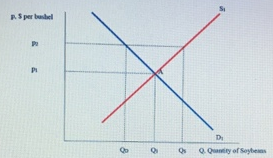
The price floor results in an equilibrium where supply equals demand.
The price floor results in a surplus of corn.
The price floor is not binding and has no effect
The price floor results in a shortage of corn
Homework Answers
The correct answer is (b) the price floor will result in surplus of corns
Initially Market is in equilibrium at Point A and Hence, Equilibrium Price = p1. Now Suppose government Impose a Price Floor at p2 i.e. Minimum Price possible in the Market is p2. As p2 > p1, Hence Price floor is binding and market will not reach its equilibrium. At p2 Quantity demand QD and Quantity supplied = QS. Surplus occurs in the market when Quantity supplied > Quantity demand and Shortage occurs in the market when Quantity supplied < Quantity demand. Here QS > QD, HenceThere will be surplus of corns.
Hence the correct answer is (b) the price floor will result in surplus of corns
Add Answer to:
Then assume the government imposes a price floor of p2. How does this affect the market?
Assume the market is initially in equilibrium at point A. Then assume the city imposes a price ceiling of pz
 Consider the market for apartments in New York City illustrated in the figure below. Assume the market is initially in equilibrium at point A. Then assume the city imposes a price ceiling of pz. How does this affect the market? The price ceiling results in a shortage of apartments The price ceiling results in an equilibrium where supply equals demand. The price ceiling is not binding and has no effect The price ceiling results in a surplus of apartments
Question 29 The market equilibrium is at price $11/hour. The government imposes a minimum wage of...
 Question 29 The market equilibrium is at price $11/hour. The government imposes a minimum wage of $14. The new equilibrium will be ? A. Not binding and we will have neither a surplus nor a shortage. B. Binding and we will have a surplus. C.Not binding and we will have a shortage D.Binding and we will have a shortage.
Consider the market for soybeans illustrated in the figure below.
 Consider the market for soybeans illustrated in the figure below. Assume the market is initially in equilibrium at point A. Suppose the price of peas increases (and that peas are a substitute for soybeans). How does this affect the market? The soybean demand curve will shift to the right. The soybean demand curve will shift to the left. The soybean supply curve will shift to the right. The soybean supply curve will shift to the left
11) Refer to the figure below, which shows the market for vitamins. Suppose the government imposes...
 11) Refer to the figure below, which shows the market for vitamins. Suppose the government imposes a price ceiling of Py. How will the price ceiling affect the quantity supplied, quantity demanded and quantity exchanged? Price Supply Price ceiling Demand Quantity of vitamins 12) Refer to the figure below, which shows the market for watermelons. Suppose the government imposes a price floor of Pw. How will the price floor affect the quantity supplied, quantity demanded and quantity exchanged? Price (dollars)...
Consider a market in which the government imposes a price ceiling. Assume that neither supply nor...
Consider a market in which the government imposes a price ceiling. Assume that neither supply nor demand is perfectly elastic nor perfectly inelastic. Which of the following groups will always gain from a price ceiling? Consumer Producers The government Society as a whole, because total surplus will increase No group will always gain from a price ceiling
Consider the market for corn. Suppose the market demand and supply curves are as given. Demand:...
 Consider the market for corn. Suppose the market demand and supply curves are as given. Demand: P = 270-3QD; Supply P = 30 + QS. Price is the price per metric ton (in cents). 1) Calculate the equilibrium price (P) and quantity (Q). 2) If the government impose a price floor of 100 cents per metric ton on corn, calculate the quantity demanded, quantity supplies and the surplus/ shortage at this price.
Refer to Figure 6-17. A government-imposed price of $24 in this market is an example of
 Refer to Figure 6-17. A government-imposed price of $24 in this market is an example of a non-binding price ceiling that creates a shortage. b. binding price floor that creates a surplus. c binding price ceiling that creates a shortage. d a non-binding price floor that creates a surplus.
Labor supply = -300 + 30W and Labor Demand = 700-50W c) Suppose the government imposes...
 Labor supply = -300 + 30W and Labor Demand =
700-50W
c) Suppose the government imposes a wage floor of $15 in this market. Will be there be a surplus or shortage of workers, and of what magnitude (how many workers)? Surplus or shortage: Magnitude of surplus or shortage
Labor supply = -300 + 30W and Labor Demand =
700-50W
c) Suppose the government imposes a wage floor of $15 in this market. Will be there be a surplus or shortage of workers, and of what magnitude (how many workers)? Surplus or shortage: Magnitude of surplus or shortage
Suppose that the government sets a price floor in the market for milk at $2.15 per...
Suppose that the government sets a price floor in the market for milk at $2.15 per gallon of milk. If the equilibrium price of milk is $1.99, the result of the price floor will be a _____________ of milk and ____________ exchanges will be made with the price floor than would be made in a free market. shortage; more shortage; fewer surplus; more surplus; fewer
5) Suppose a price floor on sparkling wine is proposed by the Health Minister of the...
5) Suppose a price floor on sparkling wine is proposed by the Health Minister of the country of Vinyardia. What will be the likely effect (relative to original equilibrium) on the market for sparkling wine in Vinyardia? a) Quantity demanded will decrease, quantity supplied will increase, and a surplus will result. b) Quantity demanded will increase, quantity supplied will decrease, and a surplus will result. c) Quantity demanded will decrease, quantity supplied will increase, and a shortage will result. d)...
 Question 29 The market equilibrium is at price $11/hour. The government imposes a minimum wage of $14. The new equilibrium will be ? A. Not binding and we will have neither a surplus nor a shortage. B. Binding and we will have a surplus. C.Not binding and we will have a shortage D.Binding and we will have a shortage.
 11) Refer to the figure below, which shows the market for vitamins. Suppose the government imposes a price ceiling of Py. How will the price ceiling affect the quantity supplied, quantity demanded and quantity exchanged? Price Supply Price ceiling Demand Quantity of vitamins 12) Refer to the figure below, which shows the market for watermelons. Suppose the government imposes a price floor of Pw. How will the price floor affect the quantity supplied, quantity demanded and quantity exchanged? Price (dollars)...
 Consider the market for corn. Suppose the market demand and supply curves are as given. Demand: P = 270-3QD; Supply P = 30 + QS. Price is the price per metric ton (in cents). 1) Calculate the equilibrium price (P) and quantity (Q). 2) If the government impose a price floor of 100 cents per metric ton on corn, calculate the quantity demanded, quantity supplies and the surplus/ shortage at this price.
 Labor supply = -300 + 30W and Labor Demand =
700-50W
c) Suppose the government imposes a wage floor of $15 in this market. Will be there be a surplus or shortage of workers, and of what magnitude (how many workers)? Surplus or shortage: Magnitude of surplus or shortage
Labor supply = -300 + 30W and Labor Demand =
700-50W
c) Suppose the government imposes a wage floor of $15 in this market. Will be there be a surplus or shortage of workers, and of what magnitude (how many workers)? Surplus or shortage: Magnitude of surplus or shortage
Most questions answered within 3 hours.
-
Where is the error in this code sequence?
String s1 = "Hello";
String s2 = "ello";...
asked 11 months ago -
Financial data for Joel de Paris, Inc., for last year
follow:
Joel de Paris, Inc.
Balance...
asked 11 months ago -
Consider this reaction:
Al2(SO4)3 (aq)+ BaCl3
(aq) Al2Cl6 (aq)- +
3BaSO4(s) . What is the...
asked 11 months ago -
Suppose that Savneet is considering increasing her
recent random sample from 20 car rentals to 40...
asked 11 months ago -
Trucks arrive at an unloading terminal at an average rate of 120
per hour.
Trucks arrive...
asked 11 months ago -
Why are methanol and ethanol completely soluble in water while
octanol is not very little soluble....
asked 11 months ago -
A facilities manager at a university reads in a research report
that the mean amount of...
asked 11 months ago -
When the CuSO4 is rehydrated by adding water to the anhydrous
compound, is this an endothermic...
asked 11 months ago -
A ray of sunlight is passing from diamond into crown glass; the
angle of incidence is...
asked 11 months ago -
A block of mass 0.249 kg is placed on top of a light, vertical
spring of...
asked 11 months ago -
how do the kidneys compensate in the presences of acidosis
a) trigger hyperventilate
b) reserve acid...
asked 11 months ago -
Question 501 pts
The rental rate of capital to the firm increases. Which of the
following...
asked 11 months ago