
Homework Answers


Add Answer to:
1. Consider a perfectly competitive market where the mar- ket demand curve is given by Q...
1. Consider a perfectly competitive market where the mar- ket demand curve is given by Q...
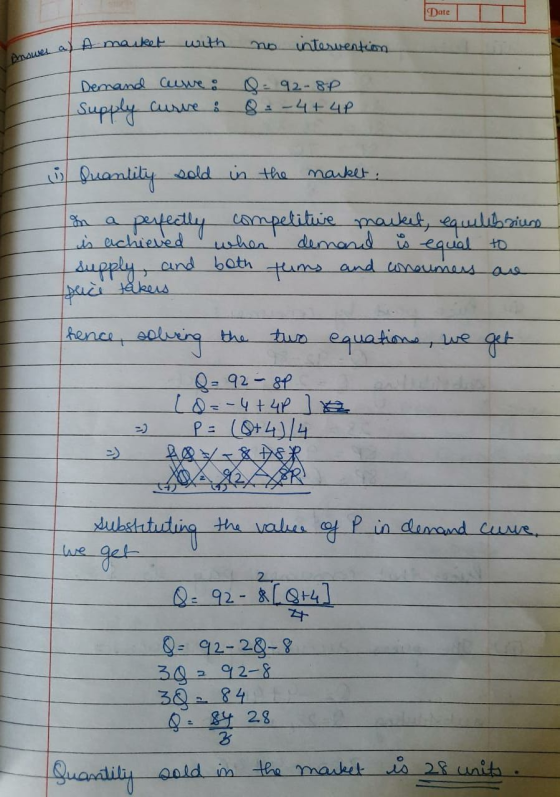
 1. Consider a perfectly competitive market where the mar- ket demand curve is given by Q = 92-8P and the market supply curve is given by Q = -4 + 4P. In each of the following situations (a-e), determine the following items (i-viii) i) The quantity sold in the market. ii) The price that consumers pay (before all taxes/subsidies). iii) The price that producers receive (after all taxes/subsidies). iv) The range of possible consumer surplus values. v) The range of...
Consider a perfectly competitive market where the market demand curve is given by Q = 76−8P...
Consider a perfectly competitive market where the market demand curve is given by Q = 76−8P and the market supply curve is given by Q=−8+4P. In situations (c), determine the following items (i-viii) (c) A market with subsidy S=9. i) The quantity sold in the market. ii) The price that consumers pay (before all taxes/subsidies). iii) The price that producers receive (after all taxes/subsidies). iv) The range of possible consumer surplus values. v) The range of possible producer surplus values....
1. Consider a perfectly competitive market where the market demand curve is given by Q 72-4P and ...
 Please answer question B
1. Consider a perfectly competitive market where the market demand curve is given by Q 72-4P and the market supply curve is given by Q-6+2P. In each of the following situations (a-e), determine the following items (i-vili) ) The quantity sold in the market. ii) The price that consumers pay (before all taxes/subsidies) ili) The price that producers receive (after all taxes/subsidies). iv) The range of possible consumer surplus values. v) The range of possible producer...
Please answer question B
1. Consider a perfectly competitive market where the market demand curve is given by Q 72-4P and the market supply curve is given by Q-6+2P. In each of the following situations (a-e), determine the following items (i-vili) ) The quantity sold in the market. ii) The price that consumers pay (before all taxes/subsidies) ili) The price that producers receive (after all taxes/subsidies). iv) The range of possible consumer surplus values. v) The range of possible producer...
Consider a perfectly competitive market where the market demand curve is given by Q = 72−4P...
Consider a perfectly competitive market where the market demand curve is given by Q = 72−4P and the market supply curve is given by Q = −6 + 2P. In each of the following situations (a-e), determine the following items v) The range of possible producer surplus values. vi) The government receipts. vii) The net benefit. viii) The range of deadweight loss. (a) A market with no intervention. (b) A market with tax T = 3. (c) A market with...
10.19. In a perfectly competitive market, the market demand curve is Qd = 10 -p, and...
 10.19. In a perfectly competitive market, the market demand curve is Qd = 10 -p, and the market supply curve is Q 1.5P a) Verify that the market equilibrium price and quantity in the absence of government intervention are Pd= P 4 and Qd Q 6. b) Consider two possible government interventions: (1)A price ceiling of $I per unit; (2) a subsidy of $5 per unit paid to producers. Verify that the equilibrium market price paid by consumers under the...
Question 1: In a perfectly competitive market, the demand curve is given as: Q=100-5P, the supply curve is given as Q=3P...
Question 1: In a perfectly competitive market, the demand curve is given as: Q=100-5P, the supply curve is given as Q=3P-12. Compute the total social surplus of this market. If the government impose a tax on the producers, and the tax rate is $2 per unit produced. What is the deadweight loss? If the government impose a tax on the consumers, and the tax rate is $2 per unit purchased, graphically show the change in the market equilibrium and the...
Question 1 (45%): In a perfectly competitive market, the demand curve is given as: Q=100-5P, the supply curve is given...
Question 1 (45%): In a perfectly competitive market, the demand curve is given as: Q=100-5P, the supply curve is given as Q=3P-12. I. Compute the total social surplus of this market. (10%) II. If the government impose a tax on the producers, and the tax rate is $2 per unit produced. What is the deadweight loss? (10%) III. If the government impose a tax on the consumers, and the tax rate is $2 per unit purchased, graphically show the change...
1. Consider a perfectly competitive market with demand curve given by P, 200 D. The industry...
 1. Consider a perfectly competitive market with demand curve given by P, 200 D. The industry supply curve in this market is PsQs (a) Draw the demand-supply graph for this market. Calculate the quantit;y traded, equilibrium price for this market. Also calculate the Total Consumer Surplus (TCS) and Total Producer Surplus (TPS) for this market (b) Suppose that the government is considering a price ceiling, P1 - $20 Find the quantity traded, equilibrium price, TCS and TPS under the price...
Consider a perfectly competitive market in which the market demand curve is given by Q D...
Consider a perfectly competitive market in which the market demand curve is given by Q D = 20 – 2P D , and the market supply curve is given by Q S = 2P S . a. Find the equilibrium price and quantity in the absence of government intervention. Graph it. 3 WINTER 2019 ECON 301 L03 ASSIGNMENT 3 b. Suppose the government imposes a price ceiling of $3 per unit. How much is supplied? c. Suppose, as an alternative,...
3. Consider a perfectly inelastic supply curve at q = 1,013, and a perfectly elastic demand...
 3. Consider a perfectly inelastic supply curve at q = 1,013, and a perfectly elastic demand curve at p = 101. A subsidy of $5 per unit is given to producers. Using a diagram, explain how the subsidy is shared between consumers and producers. What is the Deadweight Loss? (30%)
 1. Consider a perfectly competitive market where the mar- ket demand curve is given by Q = 92-8P and the market supply curve is given by Q = -4 + 4P. In each of the following situations (a-e), determine the following items (i-viii) i) The quantity sold in the market. ii) The price that consumers pay (before all taxes/subsidies). iii) The price that producers receive (after all taxes/subsidies). iv) The range of possible consumer surplus values. v) The range of...
 Please answer question B
1. Consider a perfectly competitive market where the market demand curve is given by Q 72-4P and the market supply curve is given by Q-6+2P. In each of the following situations (a-e), determine the following items (i-vili) ) The quantity sold in the market. ii) The price that consumers pay (before all taxes/subsidies) ili) The price that producers receive (after all taxes/subsidies). iv) The range of possible consumer surplus values. v) The range of possible producer...
Please answer question B
1. Consider a perfectly competitive market where the market demand curve is given by Q 72-4P and the market supply curve is given by Q-6+2P. In each of the following situations (a-e), determine the following items (i-vili) ) The quantity sold in the market. ii) The price that consumers pay (before all taxes/subsidies) ili) The price that producers receive (after all taxes/subsidies). iv) The range of possible consumer surplus values. v) The range of possible producer...
 10.19. In a perfectly competitive market, the market demand curve is Qd = 10 -p, and the market supply curve is Q 1.5P a) Verify that the market equilibrium price and quantity in the absence of government intervention are Pd= P 4 and Qd Q 6. b) Consider two possible government interventions: (1)A price ceiling of $I per unit; (2) a subsidy of $5 per unit paid to producers. Verify that the equilibrium market price paid by consumers under the...
 1. Consider a perfectly competitive market with demand curve given by P, 200 D. The industry supply curve in this market is PsQs (a) Draw the demand-supply graph for this market. Calculate the quantit;y traded, equilibrium price for this market. Also calculate the Total Consumer Surplus (TCS) and Total Producer Surplus (TPS) for this market (b) Suppose that the government is considering a price ceiling, P1 - $20 Find the quantity traded, equilibrium price, TCS and TPS under the price...
 3. Consider a perfectly inelastic supply curve at q = 1,013, and a perfectly elastic demand curve at p = 101. A subsidy of $5 per unit is given to producers. Using a diagram, explain how the subsidy is shared between consumers and producers. What is the Deadweight Loss? (30%)
Most questions answered within 3 hours.
-
Where is the error in this code sequence?
String s1 = "Hello";
String s2 = "ello";...
asked 10 months ago -
Financial data for Joel de Paris, Inc., for last year
follow:
Joel de Paris, Inc.
Balance...
asked 10 months ago -
Consider this reaction:
Al2(SO4)3 (aq)+ BaCl3
(aq) Al2Cl6 (aq)- +
3BaSO4(s) . What is the...
asked 10 months ago -
Suppose that Savneet is considering increasing her
recent random sample from 20 car rentals to 40...
asked 10 months ago -
Trucks arrive at an unloading terminal at an average rate of 120
per hour.
Trucks arrive...
asked 10 months ago -
Why are methanol and ethanol completely soluble in water while
octanol is not very little soluble....
asked 10 months ago -
A facilities manager at a university reads in a research report
that the mean amount of...
asked 10 months ago -
When the CuSO4 is rehydrated by adding water to the anhydrous
compound, is this an endothermic...
asked 10 months ago -
A ray of sunlight is passing from diamond into crown glass; the
angle of incidence is...
asked 10 months ago -
A block of mass 0.249 kg is placed on top of a light, vertical
spring of...
asked 10 months ago -
how do the kidneys compensate in the presences of acidosis
a) trigger hyperventilate
b) reserve acid...
asked 10 months ago -
Question 501 pts
The rental rate of capital to the firm increases. Which of the
following...
asked 10 months ago