

Homework Answers
a).
Now, the cost functions of two firms are given by, “C1 = 625 + q” and “C2 = 625 + 4q^2”. So, the “Average Total Cost” is given by, “ATC = C/q.
=> ATC1 = (625+q)/q = 625/q + 1, => ATC1 = 1 + 625/q. Now, ATC2 = (625 + 4q^2)/q.
=> ATC2 = 4q + 625/q.
Now, the AFC for both the firms are given by, “AFC1 = 625/q” and “AFC2 = 625/q”. Since, the “FC” for both the firms are same, => AFC for both the firms are also same.
Similarly, AVC for both the firms are given by, “AVC = VC/q”, => AVC1 = VC1/q = q/q = 1 =AVC1.
For 2nd firm it is given by, “AVC2 = VC2/q = 4q^2/q = 4*q = AVC2.
b).
Now, for “firm 1” the “ATC” and “MC” are given by.
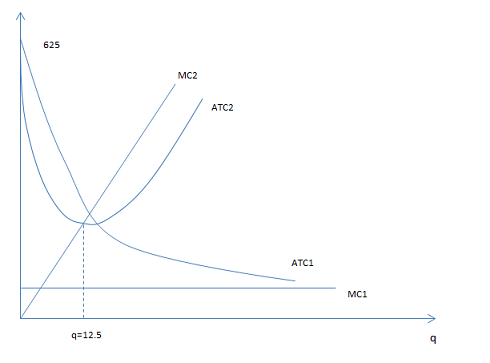
=> ATC1 = 1 + 625/q, => ATC is down ward sloping and MC = 1, => MC is constant at “1”. So, here “ATC” is asymptotic to “MC” at “MC = ATC”. So, when “q” is infinitely large “625/q” is close to “zero” and “ATC” is equal to “MC”.
Now, for the “firm2” the “ATC2 = 4q + 625/q” and “MC=8q”, => at “ATC2=MC2”.
=> 4q + 625/q = 8q, => 4q = 625/q, => 4q^2 = 625, => q^2 = 625/4, => q = 25/2 = 12.5. Now, for “firm 2” the minimum efficient scale is given by, “q=12.5”. So, at “q=12.5” the corresponding “ATC” and “MC” are given by, “100”.
c).
Consider the following fig shows the “ATC” and “MC” for both the firms.
d).
Here “type 1” will be more competitive compare to “type 2”. Since “type 1” having less “MC=1 < MC2=100” compare to “type 2” and having larger output or scale.
Add Answer to:
4. Consider two firms with identical fixed costs, but different variable costs (for example, one firm...
3. There are two types of firms in an industry. Type 1 firms have the costs...
 3. There are two types of firms in an industry. Type 1 firms have the costs TC(n) = 625+ 0.25qi and type 2 firms have costs TC(2) 50000.52 The fixed costs for both types of firms are NOT sunk. (a) Derive each firm's ATC(g), AVC() and MC() functions and plot the curves on separate diagrams (b) Derive each firm's supply function q(p) and show the corresponding curves in the diagrams (c Suppose that there are 10 firms of each type....
Consider the following hypothetical example of a boat building firm. The total fixed cost is £100,...
 Consider the following hypothetical example of a boat building firm. The total fixed cost is £100, irrespective of how many boats are produced. Total variable costs (TVC) will increase as output increases. Output Total variable cost(£) 50 2 80 100 - 4 Total fixed cost (£) 100 100 100 100 100 100 100 100 Total cost(£) 150 180 200 210 250 320 450 740 110 150 220 350 640 5 a. Plot the Total Cost (TC), Total Variable Cost (TVC),...
Consider the competitive market for copper. Assume that, regardless of how many firms are in the...
 Consider the competitive market for copper. Assume that, regardless of how many firms are in the industry, every firm in the industry is identical and faces the marginal cost (MC), average total cost (ATC), and average variable cost (AVC) curves shown on the following graph. COSTS (Dollars per pound) ATC MC D 0 5 45 50 10 15 20 25 30 35 40 QUANTITY (Thousands of pounds) Use the orange points (square symbol) to plot the initial short-run industry supply...
Consider a perfectly competitive market with many identical firms. Each firm has a long-run marginal cost...
Consider a perfectly competitive market with many identical firms. Each firm has a long-run marginal cost function given by LRMC(y) = y ^2 + 1. We do not know the firms’ LRAT C function, but we know that at a quantity of 3 it is equal to LRMC. In other words: LRAT C(3) = LRMC(3). (a) Find an expression for an individual firm’s long-run inverse supply curve: this will be p as a function of y. Note that it will...
QUESTION 1 Table 13-16 Quantity Total Cost Fixed Cost Variable Cost Marginal Cost Average Fixed Cost...
 QUESTION 1 Table 13-16 Quantity Total Cost Fixed Cost Variable Cost Marginal Cost Average Fixed Cost Average Variable Cost Average Total Cost 0 $24 $50 3 $108 $40 Refer to Table 13-16. What is the total cost of producing 2 units of output? a. $76 b. $50 c. $58 d. $74 Figure 14-13 Suppose a firm in a competitive industry has the following cost curves: sem MC ATC AVC Refer to Figure 14-13. If the price is $6 in the...
Suppose there are two firms competing in a market. Both firms produce identical products. Firm One...
Suppose there are two firms competing in a market. Both firms produce identical products. Firm One is an efficient firm and has total cost function C1=5q1; Firm Two is a less efficient firm and has total cost function C2=10q2 . Market demand for this product is given by Q=150-2p. If two firms compete in quantities of production, find out the best response function of each firm and the equilibrium output level of each firm.
The two side-by-side graphs are for two firms that between them supply all the organically grown...
 The two side-by-side graphs are for two firms that between them supply all the organically grown avocados for a local area. With vigorous competition between the firms, the price per pound has settled at a point where both firms are just breaking even. For each firm, the marginal cost (MC), average variable cost (AVC), and average total cost (ATC) curves are shown.
7. Consider an asymmetric Cournot duopoly game, where the two firms have different costs of production....
 7. Consider an asymmetric Cournot duopoly game, where the two firms have different costs of production. Firm 1 selects quantity qı at a pro- duction cost of 291. Firm 2 selects quantity 92 and pays the produc- tion cost 492. The market price is given by p = 12 – 91 - 92. Thus, the payoff functions are u(91,92) = (12 – 91 - 92.91 – 291 and uz(9192) = (12 – 91 - 92)92 – 492. Calculate the firms'...
Consider the competitive market for copper. Assume that, regardless of how many firms are in the industry, every firm in the industry is identical and faces the marginal cost (MC), average total cost (ATC), and average variable cost (AVC) curves shown on
 7. Short-run supply and long-run equilibrium Consider the competitive market for copper. Assume that, regardless of how many firms are in the industry, every firm in the industry is identical and faces the marginal cost (MC), average total cost (ATC), and average variable cost (AVC) curves shown on the following graph.The following diagram shows the market demand for copper.Use the orange points (square symbol) to plot the initial short-run industry supply curve when there are 20 firms in the market. (Hint:...
An industry currently has 100 firms, each of which has fixed costs of $15 and average variable costs as follows:
 An industry currently has 100 firms, each of which has fixed costs of $15 and average variable costs as follows: Complete the following table by deriving the total cost, marginal cost, and average total cost for each quantity from 1 to 6.
 3. There are two types of firms in an industry. Type 1 firms have the costs TC(n) = 625+ 0.25qi and type 2 firms have costs TC(2) 50000.52 The fixed costs for both types of firms are NOT sunk. (a) Derive each firm's ATC(g), AVC() and MC() functions and plot the curves on separate diagrams (b) Derive each firm's supply function q(p) and show the corresponding curves in the diagrams (c Suppose that there are 10 firms of each type....
 Consider the following hypothetical example of a boat building firm. The total fixed cost is £100, irrespective of how many boats are produced. Total variable costs (TVC) will increase as output increases. Output Total variable cost(£) 50 2 80 100 - 4 Total fixed cost (£) 100 100 100 100 100 100 100 100 Total cost(£) 150 180 200 210 250 320 450 740 110 150 220 350 640 5 a. Plot the Total Cost (TC), Total Variable Cost (TVC),...
 Consider the competitive market for copper. Assume that, regardless of how many firms are in the industry, every firm in the industry is identical and faces the marginal cost (MC), average total cost (ATC), and average variable cost (AVC) curves shown on the following graph. COSTS (Dollars per pound) ATC MC D 0 5 45 50 10 15 20 25 30 35 40 QUANTITY (Thousands of pounds) Use the orange points (square symbol) to plot the initial short-run industry supply...
 QUESTION 1 Table 13-16 Quantity Total Cost Fixed Cost Variable Cost Marginal Cost Average Fixed Cost Average Variable Cost Average Total Cost 0 $24 $50 3 $108 $40 Refer to Table 13-16. What is the total cost of producing 2 units of output? a. $76 b. $50 c. $58 d. $74 Figure 14-13 Suppose a firm in a competitive industry has the following cost curves: sem MC ATC AVC Refer to Figure 14-13. If the price is $6 in the...
 The two side-by-side graphs are for two firms that between them supply all the organically grown avocados for a local area. With vigorous competition between the firms, the price per pound has settled at a point where both firms are just breaking even. For each firm, the marginal cost (MC), average variable cost (AVC), and average total cost (ATC) curves are shown.
 7. Consider an asymmetric Cournot duopoly game, where the two firms have different costs of production. Firm 1 selects quantity qı at a pro- duction cost of 291. Firm 2 selects quantity 92 and pays the produc- tion cost 492. The market price is given by p = 12 – 91 - 92. Thus, the payoff functions are u(91,92) = (12 – 91 - 92.91 – 291 and uz(9192) = (12 – 91 - 92)92 – 492. Calculate the firms'...
 An industry currently has 100 firms, each of which has fixed costs of $15 and average variable costs as follows: Complete the following table by deriving the total cost, marginal cost, and average total cost for each quantity from 1 to 6.
Most questions answered within 3 hours.
-
Where is the error in this code sequence?
String s1 = "Hello";
String s2 = "ello";...
asked 10 months ago -
Financial data for Joel de Paris, Inc., for last year
follow:
Joel de Paris, Inc.
Balance...
asked 10 months ago -
Consider this reaction:
Al2(SO4)3 (aq)+ BaCl3
(aq) Al2Cl6 (aq)- +
3BaSO4(s) . What is the...
asked 10 months ago -
Suppose that Savneet is considering increasing her
recent random sample from 20 car rentals to 40...
asked 10 months ago -
Trucks arrive at an unloading terminal at an average rate of 120
per hour.
Trucks arrive...
asked 10 months ago -
Why are methanol and ethanol completely soluble in water while
octanol is not very little soluble....
asked 10 months ago -
A facilities manager at a university reads in a research report
that the mean amount of...
asked 10 months ago -
When the CuSO4 is rehydrated by adding water to the anhydrous
compound, is this an endothermic...
asked 10 months ago -
A ray of sunlight is passing from diamond into crown glass; the
angle of incidence is...
asked 10 months ago -
A block of mass 0.249 kg is placed on top of a light, vertical
spring of...
asked 10 months ago -
how do the kidneys compensate in the presences of acidosis
a) trigger hyperventilate
b) reserve acid...
asked 10 months ago -
Question 501 pts
The rental rate of capital to the firm increases. Which of the
following...
asked 10 months ago