
Homework Answers
C)Rotates Counterclockwise
This is because the Electric field will be in an upward direction for the positive half and it will be in the downward direction for the other negative half.
So observe the changing of the direction by Electric field you will see it in the counterclockwise direction.
Add Answer to:
look into the oncoming wave, which way does the E-field point? B not shown for simpli...
For a wave propagating to the right, if the E-field points out, which way does the...
 For a wave propagating to the right, if the E-field points out, which way does the B-field point? O A up B down C in D out E right
Faraday's Law: If B is increasing, which way does E point? Recall A clockwise B counter-clockwise...
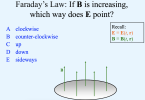 Faraday's Law: If B is increasing, which way does E point? Recall A clockwise B counter-clockwise C up D down E sideways B B,T)
answer all Q pls 8. A bar magnet is dropped through a loop of copper wire as shown. Recall that ou magnet, magnetic field lines point away from a north pole and toward a south p positive direct...
 answer all Q pls
8. A bar magnet is dropped through a loop of copper wire as shown. Recall that ou magnet, magnetic field lines point away from a north pole and toward a south p positive direction of the induced current I in the loop is as shown by the arrows on the loop, the variation of I with time as the bar magnet falls through th by which of the following graphs (the time when the midpoint of...
answer all Q pls
8. A bar magnet is dropped through a loop of copper wire as shown. Recall that ou magnet, magnetic field lines point away from a north pole and toward a south p positive direction of the induced current I in the loop is as shown by the arrows on the loop, the variation of I with time as the bar magnet falls through th by which of the following graphs (the time when the midpoint of...
3. Left circularly polarized light rotates counterclockwise viewed head on. It's complex notation...
 3. Left circularly polarized light rotates counterclockwise viewed head on. It's complex notation is (a) By taking the real part of this expression, trace out the path of the E-vector in time. (b) This light hits a mirror placed at -0. In order to zero the component of the electric field, the outgoing wave is Notice the negative sign in front of kz, indicating the direction has reversed. In looking at this light head-on, does the light rotate clockwise or...
1, 2, and 3 1. The square loop of wire of the following figure rotates around...
 1, 2, and 3
1. The square loop of wire of the following figure rotates around the Y-axis by an angle of 90° in a counter-clockwise direction from the position shown. The induced current in the loop a) ) increases and flows from point B to point A b) decreases and flows from point B to point A. c) increases and flows from point A to point B d) decreases and flows from point A to point B e) is...
1, 2, and 3
1. The square loop of wire of the following figure rotates around the Y-axis by an angle of 90° in a counter-clockwise direction from the position shown. The induced current in the loop a) ) increases and flows from point B to point A b) decreases and flows from point B to point A. c) increases and flows from point A to point B d) decreases and flows from point A to point B e) is...
3. Two wires carry equal currents in opposite direction, as shown. At which point does the...
 3. Two wires carry equal currents in opposite direction, as shown. At which point does the magnetic field have the largest magnitude? Point A (a) Point A, closer to both wires. (b) Point B, because the field at Point A is zero. (c) the answer depends on whether the current is carried Point B by electrons or by holes.
Question 2: For an electromagnetic plane wave, the electric field is given by: Ē = E,...
 Question 2: For an electromagnetic plane wave, the electric field is given by:$$ \vec{E}=E_{0} \cos (k z+\omega t) \hat{x}+0 \hat{y}+0 \hat{z} $$a) Determine the direction of propagation of the electromagnetic wave.b) Find the magnitude and direction of the magnetic field for the given electromagnetic wave \(\vec{B}\).c) Calculate the Poynting vector associated with this electromagnetic wave. What direction does this vector point? Does this makes sense?d) If the amplitude of the magnetic field was measured to be \(2.5 * 10^{-7} \mathrm{~T}\),...
Question 2: For an electromagnetic plane wave, the electric field is given by: Ē= E, cos(kz...
 Question 2: For an electromagnetic plane wave, the electric field is given by: Ē= E, cos(kz +wt) ĉ +0 ġ+02 a) Determine the direction of propagation of the electromagnetic wave. b) Find the magnitude and direction of the magnetic field for the given electromagnetic wave B. c) Calculate the Poynting vector associated with this electromagnetic wave. What direction does this vector point? Does this makes sense? d) If the amplitude of the magnetic field was measured to be 2.5 *...
Look at the MO diagram for NH3 shown below. Which property does each of the e...
 Look at the MO diagram for NH3 shown below. Which property does each of the e orbitals possess? Energy node LGO(2) LGO(3) 2p, (a)= 2p, 2p, (e) Representation of the HOMO (a) LGO(1) 2s (a) # Representation of one of the e MOs NH Representation of the lowest lying a, MO Select one: o a. N-H bonding character b. Two nodal planes O C. Lone pair character O d. No contribution from the H is orbitals Save response
A uniform electric field is shown below. Draw equipotential surfaces. In which direction does the voltage...
 A uniform electric field is
shown below. Draw equipotential surfaces. In which direction does
the voltage decrease? If an electron is placed in the electric
field at rest, draw the direction of the force. The electron moves
from higher potential point to lower potential point or the other
way around? If the potential difference between two locations of
the electron is 5V, what is the change in potential energy of the
electron. What is its speed at the end of...
A uniform electric field is
shown below. Draw equipotential surfaces. In which direction does
the voltage decrease? If an electron is placed in the electric
field at rest, draw the direction of the force. The electron moves
from higher potential point to lower potential point or the other
way around? If the potential difference between two locations of
the electron is 5V, what is the change in potential energy of the
electron. What is its speed at the end of...
 For a wave propagating to the right, if the E-field points out, which way does the B-field point? O A up B down C in D out E right
 Faraday's Law: If B is increasing, which way does E point? Recall A clockwise B counter-clockwise C up D down E sideways B B,T)
 answer all Q pls
8. A bar magnet is dropped through a loop of copper wire as shown. Recall that ou magnet, magnetic field lines point away from a north pole and toward a south p positive direction of the induced current I in the loop is as shown by the arrows on the loop, the variation of I with time as the bar magnet falls through th by which of the following graphs (the time when the midpoint of...
answer all Q pls
8. A bar magnet is dropped through a loop of copper wire as shown. Recall that ou magnet, magnetic field lines point away from a north pole and toward a south p positive direction of the induced current I in the loop is as shown by the arrows on the loop, the variation of I with time as the bar magnet falls through th by which of the following graphs (the time when the midpoint of...
 3. Left circularly polarized light rotates counterclockwise viewed head on. It's complex notation is (a) By taking the real part of this expression, trace out the path of the E-vector in time. (b) This light hits a mirror placed at -0. In order to zero the component of the electric field, the outgoing wave is Notice the negative sign in front of kz, indicating the direction has reversed. In looking at this light head-on, does the light rotate clockwise or...
 1, 2, and 3
1. The square loop of wire of the following figure rotates around the Y-axis by an angle of 90° in a counter-clockwise direction from the position shown. The induced current in the loop a) ) increases and flows from point B to point A b) decreases and flows from point B to point A. c) increases and flows from point A to point B d) decreases and flows from point A to point B e) is...
1, 2, and 3
1. The square loop of wire of the following figure rotates around the Y-axis by an angle of 90° in a counter-clockwise direction from the position shown. The induced current in the loop a) ) increases and flows from point B to point A b) decreases and flows from point B to point A. c) increases and flows from point A to point B d) decreases and flows from point A to point B e) is...
 3. Two wires carry equal currents in opposite direction, as shown. At which point does the magnetic field have the largest magnitude? Point A (a) Point A, closer to both wires. (b) Point B, because the field at Point A is zero. (c) the answer depends on whether the current is carried Point B by electrons or by holes.
 Question 2: For an electromagnetic plane wave, the electric field is given by:$$ \vec{E}=E_{0} \cos (k z+\omega t) \hat{x}+0 \hat{y}+0 \hat{z} $$a) Determine the direction of propagation of the electromagnetic wave.b) Find the magnitude and direction of the magnetic field for the given electromagnetic wave \(\vec{B}\).c) Calculate the Poynting vector associated with this electromagnetic wave. What direction does this vector point? Does this makes sense?d) If the amplitude of the magnetic field was measured to be \(2.5 * 10^{-7} \mathrm{~T}\),...
 Question 2: For an electromagnetic plane wave, the electric field is given by: Ē= E, cos(kz +wt) ĉ +0 ġ+02 a) Determine the direction of propagation of the electromagnetic wave. b) Find the magnitude and direction of the magnetic field for the given electromagnetic wave B. c) Calculate the Poynting vector associated with this electromagnetic wave. What direction does this vector point? Does this makes sense? d) If the amplitude of the magnetic field was measured to be 2.5 *...
 Look at the MO diagram for NH3 shown below. Which property does each of the e orbitals possess? Energy node LGO(2) LGO(3) 2p, (a)= 2p, 2p, (e) Representation of the HOMO (a) LGO(1) 2s (a) # Representation of one of the e MOs NH Representation of the lowest lying a, MO Select one: o a. N-H bonding character b. Two nodal planes O C. Lone pair character O d. No contribution from the H is orbitals Save response
 A uniform electric field is
shown below. Draw equipotential surfaces. In which direction does
the voltage decrease? If an electron is placed in the electric
field at rest, draw the direction of the force. The electron moves
from higher potential point to lower potential point or the other
way around? If the potential difference between two locations of
the electron is 5V, what is the change in potential energy of the
electron. What is its speed at the end of...
A uniform electric field is
shown below. Draw equipotential surfaces. In which direction does
the voltage decrease? If an electron is placed in the electric
field at rest, draw the direction of the force. The electron moves
from higher potential point to lower potential point or the other
way around? If the potential difference between two locations of
the electron is 5V, what is the change in potential energy of the
electron. What is its speed at the end of...
Most questions answered within 3 hours.
-
Where is the error in this code sequence?
String s1 = "Hello";
String s2 = "ello";...
asked 10 months ago -
Financial data for Joel de Paris, Inc., for last year
follow:
Joel de Paris, Inc.
Balance...
asked 10 months ago -
Consider this reaction:
Al2(SO4)3 (aq)+ BaCl3
(aq) Al2Cl6 (aq)- +
3BaSO4(s) . What is the...
asked 10 months ago -
Suppose that Savneet is considering increasing her
recent random sample from 20 car rentals to 40...
asked 10 months ago -
Trucks arrive at an unloading terminal at an average rate of 120
per hour.
Trucks arrive...
asked 10 months ago -
Why are methanol and ethanol completely soluble in water while
octanol is not very little soluble....
asked 10 months ago -
A facilities manager at a university reads in a research report
that the mean amount of...
asked 10 months ago -
When the CuSO4 is rehydrated by adding water to the anhydrous
compound, is this an endothermic...
asked 10 months ago -
A ray of sunlight is passing from diamond into crown glass; the
angle of incidence is...
asked 10 months ago -
A block of mass 0.249 kg is placed on top of a light, vertical
spring of...
asked 10 months ago -
how do the kidneys compensate in the presences of acidosis
a) trigger hyperventilate
b) reserve acid...
asked 10 months ago -
Question 501 pts
The rental rate of capital to the firm increases. Which of the
following...
asked 10 months ago