
Homework Answers
There are 2 types of households - A & B
a)
We need to maximize the utility of each household subject to two given budget constraints. For easy notations we are not considering the sign i in each equation. We will incorporate the value of i while considering cases of the specific type of household. The budget constraints for each household are:
and
look, we can find the value of b1 from second budget constraint and substitute it in first budget constraint to obtain :
If you wish to see the derivation of this equation, refer to the following image:

This equation of budget constraint hence obtained is called the lifetime budget constraint of each individual. Rather than solving the optimization exercise for two budget constraints, we only have one now. It makes the calculation easy.
The next exercise is to maximize the utility of each household based on the lifetime budget constraint.
subject to
Forming Lagrangian to solve the above optimization exercise:
b)
differentiating the with
respect to c1, c2 and
respectively
and then putting first order derivative of each to 0 (solving for
first-order conditions) gives:

Note that we substituted b1 while calculating the lifetime budget constraint. Taking the value of b1 from there and substituting in it the value of c2, we obtain :

Notice that b0 is exogenously given. Also, as a person lives only for 2 periods the given question, he won't invest in bonds period 2 (b2 = 0). Therefore, we have solved for part a and b of the above question.
c)
Now, bringing the type of households into consideration. We obtain :

Differentiating each household of A and B, we get :

for household A and

for household B
as there is N number of household A and M number of household B, The optimization exercise above will run N times for each household in type A and M times for each household in type B.
generating the market clearing conditions given by
d)
Putting the values of
calculated above into these equations, we get the final answer.
Add Answer to:
Consider an economy occupied by many households with two types denoted by i, (i- A, B)...
3. Heterogeneous Agents Con sider an economy occupied by many households with two types denoted by...
 3. Heterogeneous Agents Con sider an economy occupied by many households with two types denoted by i, (i-A, B) who are facing the two-period consumption problem. Each household i-A, B is facing the following utility maximization problem max where yl and yå are household i's exogenous income in period t-1,2 cl and c are hou sehold is con sumption in period t-1,2. b, bi is household i's bond holdings of which bo is exogenously given, r is the real interest...
Consider an economy occupied by two households (i- A, B) who are facing the two-period consumption...
 Consider an economy occupied by two households (i- A, B) who are facing the two-period consumption problem. Each household i - A, B is facing the following utility maximization problem: max subject to ci +biy(1+r)bo where Vi and US are household i's exogenous income in period t 1.2. cỈ and c are household i's consumption in period t 1,2. bo,bi is household i's bond holdings of which bo is exogenously given, r is the real interest rate, and 0 <...
Consider a two-period economy discussed in Chapter 9. Suppose there are only two households, and each...
 Consider a two-period economy discussed in Chapter 9. Suppose there are only two households, and each household's utility function and endowment are given as follows. u' (C1,C2) = (C122) and e' = (18,4). u? (C1,C2) = Incı + 2 Inc and e? = (3,6). el denote the allocation of endowment income for household i. For simplicity, there is no government, and therefore no tax in both periods. There is a perfectly competitive credit (financial market in which they can buy...
5. Consider the representative household in the static two-good consumption model whose preferences are represented by...
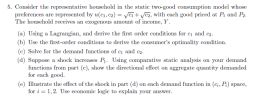 5. Consider the representative household in the static two-good consumption model whose preferences are represented by u(ci, c2)= / 2, with each good priced at P and P2. The household receives an exogenous amount of income, Y. (a) Using a Lagrangian, and derive the first order conditions for ci and c2 (b) Use the first-order conditions to derive the consumer's optimality condition. (c) Solve for the demand functions of ci and c2 (d) Suppose a shock increases P. Using comparative...
Nomy: Consider a static, one-per Static One Period Model of the Eco iod model of the economy. The...
 Hi, can someone please help me with this Macroeconomics
question? Thank you!
nomy: Consider a static, one-per Static One Period Model of the Eco iod model of the economy. There 1s a representative household who can choose how much to consume and how much to work. There is no saving since the model is static. The household problem is C,N I have dropped the t subscripts since there is only one period. Here N is hours of labor, C is...
Hi, can someone please help me with this Macroeconomics
question? Thank you!
nomy: Consider a static, one-per Static One Period Model of the Eco iod model of the economy. There 1s a representative household who can choose how much to consume and how much to work. There is no saving since the model is static. The household problem is C,N I have dropped the t subscripts since there is only one period. Here N is hours of labor, C is...
2) Consider an Exchange economy composed of two individuals A and B and two goodsx1 and...
 2) Consider an Exchange economy composed of two individuals A and B and two goodsx1 and x2. Individual A has an endowment of W(3,5) and individual B has an endowment of Wa^- (3,3). A's utility function is given byUA Xx2. Suppose that B is neutral about x1 (neither increasing nor decreasing the amount of x1 affects her utility) and she prefers more of x2 to less. Specifv a utility function for B. Eind the equilibrium price and allocations. 3) Consider...
I need Summary of this Paper i dont need long summary i need What methodology they used , what is the purpose of this p...
 I need Summary of this Paper i dont need long summary i need
What methodology they used , what is the purpose of this paper and
some conclusions and contributes of this paper. I need this for my
Finishing Project so i need this ASAP please ( IN 1-2-3 HOURS
PLEASE !!!)
Budgetary Policy and Economic Growth Errol D'Souza The share of capital expenditures in government expenditures has been slipping and the tax reforms have not yet improved the income...
I need Summary of this Paper i dont need long summary i need
What methodology they used , what is the purpose of this paper and
some conclusions and contributes of this paper. I need this for my
Finishing Project so i need this ASAP please ( IN 1-2-3 HOURS
PLEASE !!!)
Budgetary Policy and Economic Growth Errol D'Souza The share of capital expenditures in government expenditures has been slipping and the tax reforms have not yet improved the income...
 3. Heterogeneous Agents Con sider an economy occupied by many households with two types denoted by i, (i-A, B) who are facing the two-period consumption problem. Each household i-A, B is facing the following utility maximization problem max where yl and yå are household i's exogenous income in period t-1,2 cl and c are hou sehold is con sumption in period t-1,2. b, bi is household i's bond holdings of which bo is exogenously given, r is the real interest...
 Consider an economy occupied by two households (i- A, B) who are facing the two-period consumption problem. Each household i - A, B is facing the following utility maximization problem: max subject to ci +biy(1+r)bo where Vi and US are household i's exogenous income in period t 1.2. cỈ and c are household i's consumption in period t 1,2. bo,bi is household i's bond holdings of which bo is exogenously given, r is the real interest rate, and 0 <...
 Consider a two-period economy discussed in Chapter 9. Suppose there are only two households, and each household's utility function and endowment are given as follows. u' (C1,C2) = (C122) and e' = (18,4). u? (C1,C2) = Incı + 2 Inc and e? = (3,6). el denote the allocation of endowment income for household i. For simplicity, there is no government, and therefore no tax in both periods. There is a perfectly competitive credit (financial market in which they can buy...
 5. Consider the representative household in the static two-good consumption model whose preferences are represented by u(ci, c2)= / 2, with each good priced at P and P2. The household receives an exogenous amount of income, Y. (a) Using a Lagrangian, and derive the first order conditions for ci and c2 (b) Use the first-order conditions to derive the consumer's optimality condition. (c) Solve for the demand functions of ci and c2 (d) Suppose a shock increases P. Using comparative...
 Hi, can someone please help me with this Macroeconomics
question? Thank you!
nomy: Consider a static, one-per Static One Period Model of the Eco iod model of the economy. There 1s a representative household who can choose how much to consume and how much to work. There is no saving since the model is static. The household problem is C,N I have dropped the t subscripts since there is only one period. Here N is hours of labor, C is...
Hi, can someone please help me with this Macroeconomics
question? Thank you!
nomy: Consider a static, one-per Static One Period Model of the Eco iod model of the economy. There 1s a representative household who can choose how much to consume and how much to work. There is no saving since the model is static. The household problem is C,N I have dropped the t subscripts since there is only one period. Here N is hours of labor, C is...
 2) Consider an Exchange economy composed of two individuals A and B and two goodsx1 and x2. Individual A has an endowment of W(3,5) and individual B has an endowment of Wa^- (3,3). A's utility function is given byUA Xx2. Suppose that B is neutral about x1 (neither increasing nor decreasing the amount of x1 affects her utility) and she prefers more of x2 to less. Specifv a utility function for B. Eind the equilibrium price and allocations. 3) Consider...
 I need Summary of this Paper i dont need long summary i need
What methodology they used , what is the purpose of this paper and
some conclusions and contributes of this paper. I need this for my
Finishing Project so i need this ASAP please ( IN 1-2-3 HOURS
PLEASE !!!)
Budgetary Policy and Economic Growth Errol D'Souza The share of capital expenditures in government expenditures has been slipping and the tax reforms have not yet improved the income...
I need Summary of this Paper i dont need long summary i need
What methodology they used , what is the purpose of this paper and
some conclusions and contributes of this paper. I need this for my
Finishing Project so i need this ASAP please ( IN 1-2-3 HOURS
PLEASE !!!)
Budgetary Policy and Economic Growth Errol D'Souza The share of capital expenditures in government expenditures has been slipping and the tax reforms have not yet improved the income...
Most questions answered within 3 hours.
-
Where is the error in this code sequence?
String s1 = "Hello";
String s2 = "ello";...
asked 11 months ago -
Financial data for Joel de Paris, Inc., for last year
follow:
Joel de Paris, Inc.
Balance...
asked 11 months ago -
Consider this reaction:
Al2(SO4)3 (aq)+ BaCl3
(aq) Al2Cl6 (aq)- +
3BaSO4(s) . What is the...
asked 11 months ago -
Suppose that Savneet is considering increasing her
recent random sample from 20 car rentals to 40...
asked 11 months ago -
Trucks arrive at an unloading terminal at an average rate of 120
per hour.
Trucks arrive...
asked 11 months ago -
Why are methanol and ethanol completely soluble in water while
octanol is not very little soluble....
asked 11 months ago -
A facilities manager at a university reads in a research report
that the mean amount of...
asked 11 months ago -
When the CuSO4 is rehydrated by adding water to the anhydrous
compound, is this an endothermic...
asked 11 months ago -
A ray of sunlight is passing from diamond into crown glass; the
angle of incidence is...
asked 11 months ago -
A block of mass 0.249 kg is placed on top of a light, vertical
spring of...
asked 11 months ago -
how do the kidneys compensate in the presences of acidosis
a) trigger hyperventilate
b) reserve acid...
asked 11 months ago -
Question 501 pts
The rental rate of capital to the firm increases. Which of the
following...
asked 11 months ago