
Homework Answers
Add Answer to:
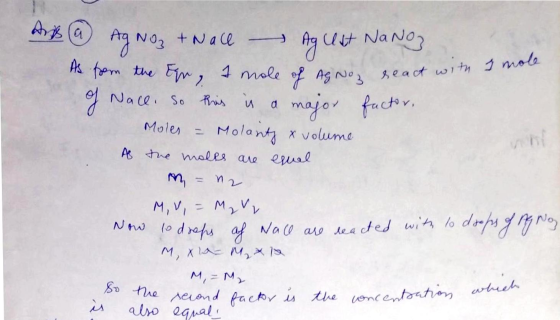
4. It was seen in todays experiment that about 10 drops of AgNO, solution were required...
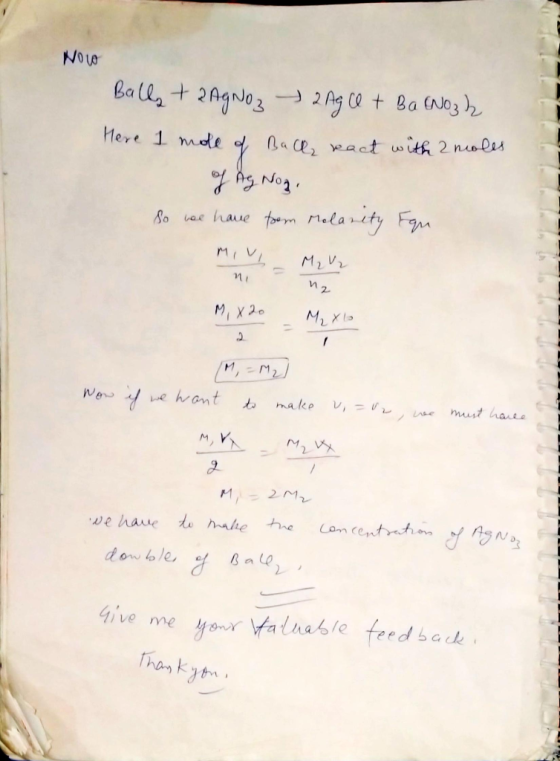
Molarity 7 How many drops of 0.10 M AgNO3 would be required to react with each...
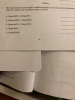 Molarity 7 How many drops of 0.10 M AgNO3 would be required to react with each of the following solutions? Assume each individual solution is 0.10 M. a. 5 drops NaCl + 10 drops KCI b. 10 drops NaCl + 5 drops BaCl2 c. 5 drops BaCl2 + 5 drops AlCl3 d. 5 drops SnCl4 e. 15 drops NHACI Thieting Calcium hydroxide
CHEMICALS AND EQUIPMENT Bunsen burner Striker or matches Wire loops -10 mL of 1 M NaCl...
 CHEMICALS AND EQUIPMENT Bunsen burner Striker or matches Wire loops -10 mL of 1 M NaCl -10 mL of 1 M KI -10 mL of 1 M Nal -10 mL of 1 M KCI -10 mL of 1 M CaCl, -10 mL of 1 M CuSO -10 mL of 1 M BaCl . -10 mL of 1 M Borax Safety Concerns Always wear safety goggles. Keep your hand away from the flame by holding the bottom of the wire loop...
please answer number 5 5. The AgNO3 test solution was not used to test the water...
 please
answer number 5
5. The AgNO3 test solution was not used to test the water insoluble but acid soluble unknowns, only the NaOH and Na2CO3 were used. Propose a reason why the AgNO3 was not used in part 3 of the experiment. Discussion/Conclusion (continue on the back of this page if needed) UTA-705 out each test tube at the sink with soap and water using a tes water and then analytical grade water (twice) and reuse the tu water...
please
answer number 5
5. The AgNO3 test solution was not used to test the water insoluble but acid soluble unknowns, only the NaOH and Na2CO3 were used. Propose a reason why the AgNO3 was not used in part 3 of the experiment. Discussion/Conclusion (continue on the back of this page if needed) UTA-705 out each test tube at the sink with soap and water using a tes water and then analytical grade water (twice) and reuse the tu water...
I MUCEDURES SHOP log indoor Your team will examine the impact of changing concentration and temperature...
 I MUCEDURES SHOP log indoor Your team will examine the impact of changing concentration and temperature on the position of equilibrium (Part I). Compare your observations with different teams and look for patterns in results to identify factors that shift the position of equilibrium toward reactants or products. In Part II, test your understanding as you make predictions and explain any shift in the equilibrium position of a new equilibrium system. Part Observations of Equilibria You and your teammate(s) will...
Microscale techniques: In today's experiment we will be using very small amounts of chemical reactants. This...
 Microscale techniques: In today's experiment we will be using very small amounts of chemical reactants. This method is generally less expensive and more environmentally-friendly than traditional "test tube" chemistry. Some of the waste products produced in today's experiment, particularly those containing lead and barium, are harmful to the environment. By using such small amounts of chemical reactants we generate far less waste than by using larger scale methods. Procedure 1. Put on your safety goggles. Be sure to wear them...
5. What was the purpose of the NaNO3 solution in this experiment? 6. Could a solution...
 5. What was the purpose of the NaNO3 solution in this experiment? 6. Could a solution of NaCl be used instead of NaNO3? 7. What was the purpose of FeSO4 solution in this experiment? 8. Could a solution of FeCl, be used instead of FeSO4? 9. Could a solution of NaSO4 be used instead of FeSO4? 10. Calculate the standard cell potential for the spontaneous redox reaction between a Pb(s)/Pb(NO3)2(aq) half-cell and a Ag(s)/AgNO3(aq) half-cell. Which metal would be oxidized?...
QUESTION 4 If you take a 171 mL of a 1.4 M NaCl solution and dilute...
 QUESTION 4
If you take a 171 mL of a 1.4 M NaCl solution and dilute it to
500 mL, what is the molarity of the final solution?
Enter the numerical answer in decimal notation
QUESTION 10
Information - Colligative
Properties
Colligative properties of solutions are those properties which
depend only on the number of dissolved solute particles in solution
not the chemical properties of the solute. For example when a
solute is dissolved in a solvent, vapor pressure
depression...
QUESTION 4
If you take a 171 mL of a 1.4 M NaCl solution and dilute it to
500 mL, what is the molarity of the final solution?
Enter the numerical answer in decimal notation
QUESTION 10
Information - Colligative
Properties
Colligative properties of solutions are those properties which
depend only on the number of dissolved solute particles in solution
not the chemical properties of the solute. For example when a
solute is dissolved in a solvent, vapor pressure
depression...
a.)Suppose you were preparing 1.0 L of a bleaching solution in a volumetric flask, and it...
a.)Suppose you were preparing 1.0 L of a bleaching solution in a volumetric flask, and it calls for 0.26 mol of NaOCl. If all you had available was a jug of bleach that contained 0.74 M NaOCl, what volume of bleach would you need to add to the volumetric flask before you added enough water to reach the 1.0 L line? Express the volume in milliliters to two significant figures b.) You need to prepare a 2.40 M solution of...
Experiment 8 Conservation of Mass kussion: action: 170 Mole wt. g/mol Aqual the combined masses of...
 Experiment 8 Conservation of Mass kussion: action: 170 Mole wt. g/mol Aqual the combined masses of all the reactants that were initially present. Furthermore, we fter any chemical reaction, the total mass of new products and any left over reactants) will a predict the mass of each product that will be formed if we know the molecular weight or the formula (from which we can predict the molecular weight). As an example, consider the dissolve the two substances in water,...
1) What chemical is the titrant in this experiment? What chemical is the analyte in this experiment? Experi...
 1) What chemical is the titrant in this experiment? What
chemical is the analyte in this
experiment?
Experiment #8: Measuring the Vitamin C Content of Emergen-C™ Objectives: • Students will learn how to use a burette. • Students will learn how to use the iodine starch indicator system to monitor oxidation/reduction reactions. Students will learn how to conduct a titration to determine the amount of analyte in an unknown solution. • Students will learn about ascorbic acid's role as a...
1) What chemical is the titrant in this experiment? What
chemical is the analyte in this
experiment?
Experiment #8: Measuring the Vitamin C Content of Emergen-C™ Objectives: • Students will learn how to use a burette. • Students will learn how to use the iodine starch indicator system to monitor oxidation/reduction reactions. Students will learn how to conduct a titration to determine the amount of analyte in an unknown solution. • Students will learn about ascorbic acid's role as a...
 Molarity 7 How many drops of 0.10 M AgNO3 would be required to react with each of the following solutions? Assume each individual solution is 0.10 M. a. 5 drops NaCl + 10 drops KCI b. 10 drops NaCl + 5 drops BaCl2 c. 5 drops BaCl2 + 5 drops AlCl3 d. 5 drops SnCl4 e. 15 drops NHACI Thieting Calcium hydroxide
 CHEMICALS AND EQUIPMENT Bunsen burner Striker or matches Wire loops -10 mL of 1 M NaCl -10 mL of 1 M KI -10 mL of 1 M Nal -10 mL of 1 M KCI -10 mL of 1 M CaCl, -10 mL of 1 M CuSO -10 mL of 1 M BaCl . -10 mL of 1 M Borax Safety Concerns Always wear safety goggles. Keep your hand away from the flame by holding the bottom of the wire loop...
 please
answer number 5
5. The AgNO3 test solution was not used to test the water insoluble but acid soluble unknowns, only the NaOH and Na2CO3 were used. Propose a reason why the AgNO3 was not used in part 3 of the experiment. Discussion/Conclusion (continue on the back of this page if needed) UTA-705 out each test tube at the sink with soap and water using a tes water and then analytical grade water (twice) and reuse the tu water...
please
answer number 5
5. The AgNO3 test solution was not used to test the water insoluble but acid soluble unknowns, only the NaOH and Na2CO3 were used. Propose a reason why the AgNO3 was not used in part 3 of the experiment. Discussion/Conclusion (continue on the back of this page if needed) UTA-705 out each test tube at the sink with soap and water using a tes water and then analytical grade water (twice) and reuse the tu water...
 I MUCEDURES SHOP log indoor Your team will examine the impact of changing concentration and temperature on the position of equilibrium (Part I). Compare your observations with different teams and look for patterns in results to identify factors that shift the position of equilibrium toward reactants or products. In Part II, test your understanding as you make predictions and explain any shift in the equilibrium position of a new equilibrium system. Part Observations of Equilibria You and your teammate(s) will...
 Microscale techniques: In today's experiment we will be using very small amounts of chemical reactants. This method is generally less expensive and more environmentally-friendly than traditional "test tube" chemistry. Some of the waste products produced in today's experiment, particularly those containing lead and barium, are harmful to the environment. By using such small amounts of chemical reactants we generate far less waste than by using larger scale methods. Procedure 1. Put on your safety goggles. Be sure to wear them...
 5. What was the purpose of the NaNO3 solution in this experiment? 6. Could a solution of NaCl be used instead of NaNO3? 7. What was the purpose of FeSO4 solution in this experiment? 8. Could a solution of FeCl, be used instead of FeSO4? 9. Could a solution of NaSO4 be used instead of FeSO4? 10. Calculate the standard cell potential for the spontaneous redox reaction between a Pb(s)/Pb(NO3)2(aq) half-cell and a Ag(s)/AgNO3(aq) half-cell. Which metal would be oxidized?...
 QUESTION 4
If you take a 171 mL of a 1.4 M NaCl solution and dilute it to
500 mL, what is the molarity of the final solution?
Enter the numerical answer in decimal notation
QUESTION 10
Information - Colligative
Properties
Colligative properties of solutions are those properties which
depend only on the number of dissolved solute particles in solution
not the chemical properties of the solute. For example when a
solute is dissolved in a solvent, vapor pressure
depression...
QUESTION 4
If you take a 171 mL of a 1.4 M NaCl solution and dilute it to
500 mL, what is the molarity of the final solution?
Enter the numerical answer in decimal notation
QUESTION 10
Information - Colligative
Properties
Colligative properties of solutions are those properties which
depend only on the number of dissolved solute particles in solution
not the chemical properties of the solute. For example when a
solute is dissolved in a solvent, vapor pressure
depression...
 Experiment 8 Conservation of Mass kussion: action: 170 Mole wt. g/mol Aqual the combined masses of all the reactants that were initially present. Furthermore, we fter any chemical reaction, the total mass of new products and any left over reactants) will a predict the mass of each product that will be formed if we know the molecular weight or the formula (from which we can predict the molecular weight). As an example, consider the dissolve the two substances in water,...
 1) What chemical is the titrant in this experiment? What
chemical is the analyte in this
experiment?
Experiment #8: Measuring the Vitamin C Content of Emergen-C™ Objectives: • Students will learn how to use a burette. • Students will learn how to use the iodine starch indicator system to monitor oxidation/reduction reactions. Students will learn how to conduct a titration to determine the amount of analyte in an unknown solution. • Students will learn about ascorbic acid's role as a...
1) What chemical is the titrant in this experiment? What
chemical is the analyte in this
experiment?
Experiment #8: Measuring the Vitamin C Content of Emergen-C™ Objectives: • Students will learn how to use a burette. • Students will learn how to use the iodine starch indicator system to monitor oxidation/reduction reactions. Students will learn how to conduct a titration to determine the amount of analyte in an unknown solution. • Students will learn about ascorbic acid's role as a...
Most questions answered within 3 hours.
-
Where is the error in this code sequence?
String s1 = "Hello";
String s2 = "ello";...
asked 10 months ago -
Financial data for Joel de Paris, Inc., for last year
follow:
Joel de Paris, Inc.
Balance...
asked 10 months ago -
Consider this reaction:
Al2(SO4)3 (aq)+ BaCl3
(aq) Al2Cl6 (aq)- +
3BaSO4(s) . What is the...
asked 10 months ago -
Suppose that Savneet is considering increasing her
recent random sample from 20 car rentals to 40...
asked 10 months ago -
Trucks arrive at an unloading terminal at an average rate of 120
per hour.
Trucks arrive...
asked 10 months ago -
Why are methanol and ethanol completely soluble in water while
octanol is not very little soluble....
asked 10 months ago -
A facilities manager at a university reads in a research report
that the mean amount of...
asked 10 months ago -
When the CuSO4 is rehydrated by adding water to the anhydrous
compound, is this an endothermic...
asked 10 months ago -
A ray of sunlight is passing from diamond into crown glass; the
angle of incidence is...
asked 10 months ago -
A block of mass 0.249 kg is placed on top of a light, vertical
spring of...
asked 10 months ago -
how do the kidneys compensate in the presences of acidosis
a) trigger hyperventilate
b) reserve acid...
asked 10 months ago -
Question 501 pts
The rental rate of capital to the firm increases. Which of the
following...
asked 10 months ago