 Please explain and show me the
process with answer. Thank you!
Please explain and show me the
process with answer. Thank you!
Homework Answers


Add Answer to:
Please explain and show me the
process with answer. Thank you!
1. (The AK Model) Consider...
1. (The AK Model) Consider an economy with an aggregate production function given by y =...
 1. (The AK Model) Consider an economy with an aggregate production function given by y = F(K) = AK Capital is the only relevant factor of production. A is fixed and represents the productivity of capital. The law of motion for capital is just as in the neoclassical model where s and δ are the savings rate and depreciation rate, respectively. a) Show whether F(K) exhibits constant, decreasing or increasing returns to scale. Com- pute the marginal product of capital....
1. (The AK Model) Consider an economy with an aggregate production function given by Y=F(K) =...
 1. (The AK Model) Consider an economy with an aggregate production function given by Y=F(K) = AK of capital. The law of motion for capital is just as in the neoclassical model where s and δ are the savings rate and depreciation rate, respectively. a) Show whether F(K) exhibits constant, decreasing or increasing returns to scale. Com pute the marginal product of capital. Does this function satisly the neoclassical assumptions?
3. (Steady state in the Solow model) Consider two economies identical in everything except the production...
 3. (Steady state in the Solow model) Consider two economies identical in everything except the production function. Economy 1 has a production function F(K, L)KoL1-a, economy 2 has a production function G(K, L)-aK(1-a)L. For both economies capital grows according to (1). a) Write output per worker as a function of capital per worker for both economies. b) Compute the steady state value of capital per worker for both these economies or, if it does not exist, show graphically that it...
2 Endogenous Growth Theory (5 marks) In the AK model with production function Y = AK....
 2 Endogenous Growth Theory (5 marks) In the AK model with production function Y = AK. Assume g- is fixed. The saving rate is s and the depreciate rate of capital of. = 0 and p a. What is the growth rate of capital (K) and output (Y)? b. Under what conditions can the economy experience perpetual (positive) growth? c. What is the key factor that drives the perpetual growth? Explain the intuition. (hint: compare the AK model with the...
MALTHUS AND SOLOW GROWTH MODEL
Malthusian Model of Growth Notation: Yt Aggregate output; Nt Population size; L¯ Land (fixed); ct Per capita consumption Production: Aggregate production function is Yt = F(Nt , Lt) = zN2/3 t L 1/3 t Population Dynamics: Nt+1 = g(ct)Nt Population growth function: g(ct) = (3ct) 1/3 Parameter Values: Land: L¯ = 1000 for all t. Productivity parameter: z = 1 ...
11. In the Solow model the key driver of economic growth is a) accumulation of human...
 11. In the Solow model the key driver of economic growth is a) accumulation of human capital b) accumulation of physical capital c) technological progress d) quality of institutions Kt+1-K The capital accumulation of physical capital is the key equation 12. Let AK+1 of the Solow model, which is the following a) Kt+1 +(1- d)K b) AK41= I+(1 - d)K c) Kt41 Ki-dK d)AK1I- K 13. According to the Solow diagram, no matter if the initial level of capital, Ko,...
MALTHUSIAN MODEL
 Notation: Yt Aggregate output; Nt Population size; L¯ Land (fixed); ct Per capita consumptionAggregate production function is Yt = F(Nt
, Lt) = zN2/3
t L
1/3
t
Population Dynamics: Nt+1 = g(ct)Nt
Population growth function: g(ct) = (3ct)
1/3
Parameter Values: Land: L¯ = 1000 for all t. Productivity parameter: z = 1
(a) Solve for the steady state of this economy (Steady state: Nt+1 = Nt). Report steady
state values for c and N.
(b) Suppose the economy...
Notation: Yt Aggregate output; Nt Population size; L¯ Land (fixed); ct Per capita consumptionAggregate production function is Yt = F(Nt
, Lt) = zN2/3
t L
1/3
t
Population Dynamics: Nt+1 = g(ct)Nt
Population growth function: g(ct) = (3ct)
1/3
Parameter Values: Land: L¯ = 1000 for all t. Productivity parameter: z = 1
(a) Solve for the steady state of this economy (Steady state: Nt+1 = Nt). Report steady
state values for c and N.
(b) Suppose the economy...
Please answer the last person didn't answer all of it. Thank you! 1 Growth Rates of...
 Please answer the last person didn't answer all of it. Thank
you!
1 Growth Rates of Capital and Output Consider the following production function: Assume that capital depreciates at rate ? and that savings is a constant proportion s of output: Assume that investment is equal to savings: Finally, assume that the population is constant Lt = Lt+1 = L 1. The production function above expresses output as a function of capital and labor (workers) Derive a function that expresses...
Please answer the last person didn't answer all of it. Thank
you!
1 Growth Rates of Capital and Output Consider the following production function: Assume that capital depreciates at rate ? and that savings is a constant proportion s of output: Assume that investment is equal to savings: Finally, assume that the population is constant Lt = Lt+1 = L 1. The production function above expresses output as a function of capital and labor (workers) Derive a function that expresses...
3. (Steady state in the Solow model) Consider two economies identical in everything except the production...
 3. (Steady state in the Solow model) Consider two economies identical in everything except the production function. Economy 1 has a production function F(K, L) KL,economy 2 has a production function G(K, L) aK1 - a)L. For both economies capital grows according to (1). a) Write output per worker as a function of capital per worker for both economies. b) Compute the steady state value of capital per worker for both these economies or, if it does not exist, show...
Please explain and show me the process with answer. Thank you! 1 2 2. (A siulated...
 Please explain and show me the process with answer. Thank
you!
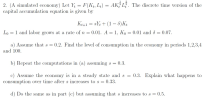
1 2 2. (A siulated economy) Let Y F(Kt, Lt) AK Lg. The discrete time version of the capital accumulation equation is given by Lo-1 and labor grows at a rate of n-0.01. A-1, Ko 0.01 and 0.07 a) Assume that s 0.2. Find the level of consumption in the economy in periods 1,2,3,4 and 100. b) Repeat the computations in (a) assuming s 0.3. c) Assume the economy...
Please explain and show me the process with answer. Thank
you!
1 2 2. (A siulated economy) Let Y F(Kt, Lt) AK Lg. The discrete time version of the capital accumulation equation is given by Lo-1 and labor grows at a rate of n-0.01. A-1, Ko 0.01 and 0.07 a) Assume that s 0.2. Find the level of consumption in the economy in periods 1,2,3,4 and 100. b) Repeat the computations in (a) assuming s 0.3. c) Assume the economy...
 1. (The AK Model) Consider an economy with an aggregate production function given by y = F(K) = AK Capital is the only relevant factor of production. A is fixed and represents the productivity of capital. The law of motion for capital is just as in the neoclassical model where s and δ are the savings rate and depreciation rate, respectively. a) Show whether F(K) exhibits constant, decreasing or increasing returns to scale. Com- pute the marginal product of capital....
 1. (The AK Model) Consider an economy with an aggregate production function given by Y=F(K) = AK of capital. The law of motion for capital is just as in the neoclassical model where s and δ are the savings rate and depreciation rate, respectively. a) Show whether F(K) exhibits constant, decreasing or increasing returns to scale. Com pute the marginal product of capital. Does this function satisly the neoclassical assumptions?
 3. (Steady state in the Solow model) Consider two economies identical in everything except the production function. Economy 1 has a production function F(K, L)KoL1-a, economy 2 has a production function G(K, L)-aK(1-a)L. For both economies capital grows according to (1). a) Write output per worker as a function of capital per worker for both economies. b) Compute the steady state value of capital per worker for both these economies or, if it does not exist, show graphically that it...
 2 Endogenous Growth Theory (5 marks) In the AK model with production function Y = AK. Assume g- is fixed. The saving rate is s and the depreciate rate of capital of. = 0 and p a. What is the growth rate of capital (K) and output (Y)? b. Under what conditions can the economy experience perpetual (positive) growth? c. What is the key factor that drives the perpetual growth? Explain the intuition. (hint: compare the AK model with the...
 11. In the Solow model the key driver of economic growth is a) accumulation of human capital b) accumulation of physical capital c) technological progress d) quality of institutions Kt+1-K The capital accumulation of physical capital is the key equation 12. Let AK+1 of the Solow model, which is the following a) Kt+1 +(1- d)K b) AK41= I+(1 - d)K c) Kt41 Ki-dK d)AK1I- K 13. According to the Solow diagram, no matter if the initial level of capital, Ko,...
 Please answer the last person didn't answer all of it. Thank
you!
1 Growth Rates of Capital and Output Consider the following production function: Assume that capital depreciates at rate ? and that savings is a constant proportion s of output: Assume that investment is equal to savings: Finally, assume that the population is constant Lt = Lt+1 = L 1. The production function above expresses output as a function of capital and labor (workers) Derive a function that expresses...
Please answer the last person didn't answer all of it. Thank
you!
1 Growth Rates of Capital and Output Consider the following production function: Assume that capital depreciates at rate ? and that savings is a constant proportion s of output: Assume that investment is equal to savings: Finally, assume that the population is constant Lt = Lt+1 = L 1. The production function above expresses output as a function of capital and labor (workers) Derive a function that expresses...
 3. (Steady state in the Solow model) Consider two economies identical in everything except the production function. Economy 1 has a production function F(K, L) KL,economy 2 has a production function G(K, L) aK1 - a)L. For both economies capital grows according to (1). a) Write output per worker as a function of capital per worker for both economies. b) Compute the steady state value of capital per worker for both these economies or, if it does not exist, show...
 Please explain and show me the process with answer. Thank
you!
1 2 2. (A siulated economy) Let Y F(Kt, Lt) AK Lg. The discrete time version of the capital accumulation equation is given by Lo-1 and labor grows at a rate of n-0.01. A-1, Ko 0.01 and 0.07 a) Assume that s 0.2. Find the level of consumption in the economy in periods 1,2,3,4 and 100. b) Repeat the computations in (a) assuming s 0.3. c) Assume the economy...
Please explain and show me the process with answer. Thank
you!
1 2 2. (A siulated economy) Let Y F(Kt, Lt) AK Lg. The discrete time version of the capital accumulation equation is given by Lo-1 and labor grows at a rate of n-0.01. A-1, Ko 0.01 and 0.07 a) Assume that s 0.2. Find the level of consumption in the economy in periods 1,2,3,4 and 100. b) Repeat the computations in (a) assuming s 0.3. c) Assume the economy...
Most questions answered within 3 hours.
-
Where is the error in this code sequence?
String s1 = "Hello";
String s2 = "ello";...
asked 11 months ago -
Financial data for Joel de Paris, Inc., for last year
follow:
Joel de Paris, Inc.
Balance...
asked 11 months ago -
Consider this reaction:
Al2(SO4)3 (aq)+ BaCl3
(aq) Al2Cl6 (aq)- +
3BaSO4(s) . What is the...
asked 11 months ago -
Suppose that Savneet is considering increasing her
recent random sample from 20 car rentals to 40...
asked 11 months ago -
Trucks arrive at an unloading terminal at an average rate of 120
per hour.
Trucks arrive...
asked 11 months ago -
Why are methanol and ethanol completely soluble in water while
octanol is not very little soluble....
asked 11 months ago -
A facilities manager at a university reads in a research report
that the mean amount of...
asked 11 months ago -
When the CuSO4 is rehydrated by adding water to the anhydrous
compound, is this an endothermic...
asked 11 months ago -
A ray of sunlight is passing from diamond into crown glass; the
angle of incidence is...
asked 11 months ago -
A block of mass 0.249 kg is placed on top of a light, vertical
spring of...
asked 11 months ago -
how do the kidneys compensate in the presences of acidosis
a) trigger hyperventilate
b) reserve acid...
asked 11 months ago -
Question 501 pts
The rental rate of capital to the firm increases. Which of the
following...
asked 11 months ago