9. Problems and Applications Q9 Indicate whether each of the following statements is true or false....
|
9. Problems and Applications Q9 Indicate whether each of the following statements is true or false.
|
Homework Answers
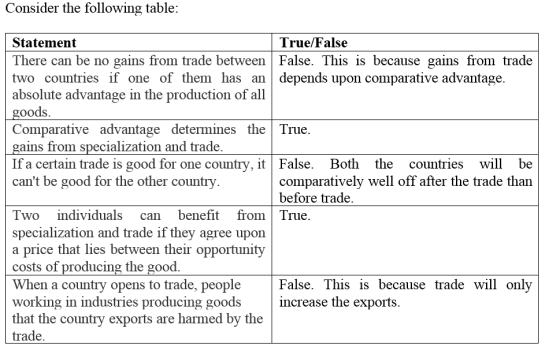
Add Answer to:
9. Problems and Applications Q9
Indicate whether each of the following statements is true or
false....
15. Problems and Applications Q9 Indicate whether each of the following statements is true or false...
 15. Problems and Applications Q9 Indicate whether each of the following statements is true or false True False 1. Two countries can achieve gains from trade even if one of the countries has an absolute advantage in the production of all goods 2. Certain very talented people have a comparative advantage in everything they do 3. If a certain trade is good for one person, it can't be good for the other one 4. If a certain trade is good...
Indicate whether each of the following statements is true or false. Statement True False Two countries can...
 Indicate whether each of the following statements is true or false. Statement True False Two countries can gain from specialization and trade as long as they have different opportunity costs in the production of some goods. The gains from specialization and trade are based on absolute advantage. If a certain trade is good for one country, it must be good for the other country. Two individuals can benefit from trade even if neither has a comparative advantage in some activity. Workers in importing industries are...
Which of the following is not true about the differences between comparative advantage and absolute advantages?...
Which of the following is not true about the differences between comparative advantage and absolute advantages? a. If each country has an absolute advantage in one of the goods, then they should each specialize in the good in which they have an absolute advantage. b. In order to achieve gains from trade, specialization should be based on comparative advantage and not absolute advantage. c. In the two nation, two good model, we will always see that a country will have...
Incorrect Question 11 0/1 pts Which of the following statements is true? Comparative advantage in producing...
 Incorrect Question 11 0/1 pts Which of the following statements is true? Comparative advantage in producing a certain item arises from being the first country to manufacture that item. All countries can gain from trade if they all specialize in production according to comparative advantage A country cannot have comparative advantage in producing a certain item if it causes an increasing opportunity cost in producing the item A country cannot have a comparative advantage in producing a particular good unless...
9. Comparative advantage is defined in terms of: efficiency. absolute advantage. opportunity cost. specialization. 10. David...
 9. Comparative advantage is defined in terms of: efficiency. absolute advantage. opportunity cost. specialization. 10. David can wash four cars in one hour or cut two lawns. Ralph can wash three cars in one hour or cut two lawns. David's opportunity cost for cutting one lawn is car washes, and Ralph's opportunity cost for cutting one lawn is car washes. a. 2; 1.5 4; 3.5 1.5; 2 d. 3.5; 4 11. Gains from trade are based on rather than: opportunity...
When a country has a comparative advantage in the production ofa good, it means that...
 When a country has a comparative advantage in the production of
a good, it means that it can produce this good at a lower
opportunity cost than its trading partner. Then the country will
specialize in the production of this good and trade it for other
goods.The following graphs show the production possibilities frontiers
(PPFs) for Candonia and Sylvania. Both countries produce lemons and
coffee, each initially (i.e., before specialization and trade)
producing 18 million pounds of lemons and 9...
When a country has a comparative advantage in the production of
a good, it means that it can produce this good at a lower
opportunity cost than its trading partner. Then the country will
specialize in the production of this good and trade it for other
goods.The following graphs show the production possibilities frontiers
(PPFs) for Candonia and Sylvania. Both countries produce lemons and
coffee, each initially (i.e., before specialization and trade)
producing 18 million pounds of lemons and 9...
1) True 2) False 7. Specialization and trade When a country specializes in the production of...
 1) True
2) False
7. Specialization and trade When a country specializes in the production of a good, this means that it can produce this good at a lower opportunity cost than its trading partner. Because of this comparative advantage, both countries benefit when they specialize and trade with each other The following graphs show the production possibilities frontiers (PPFs) for Candonia and Lamponia. Both countries produce grain and tea, each initially i.e., before specialization and trade) producing 24 million...
1) True
2) False
7. Specialization and trade When a country specializes in the production of a good, this means that it can produce this good at a lower opportunity cost than its trading partner. Because of this comparative advantage, both countries benefit when they specialize and trade with each other The following graphs show the production possibilities frontiers (PPFs) for Candonia and Lamponia. Both countries produce grain and tea, each initially i.e., before specialization and trade) producing 24 million...
When a country has a comparative advantage in the production of a good, it means that...
 When a country has a comparative advantage in the production of a good, it means that it can produce this good at a lower opportunity cost than its trading partner. Then the country will specialize in the production of this good and trade it for other goods. The following graphs show the production possibilities frontiers (PPFs) for Maldonia and Sylvania. Both countries produce potatoes and tea, each initially (i.e., before specialization and trade) producing 12 million pounds of potatoes and 6...
Freedonia has a comparative advantage in the production of
 4. Specialization and trade When a country has a comparative advantage in the production of a good, it means that it can produce this good at a lower opportunity cost than its trading partner. Then the country will specialize in the production of this good and trade it for other goods. The following graphs show the production possibilities frontiers (PPFs) for Freedonia and Sylvania. Both countries produce lemons and coffee, each initially (i.el, before specialization and trade) producing 24 million pounds of...
When a country has a comparative advantage in the production of a good, it means that it can produce this good at a lower opportunity cost than its trading partner
 4. Specialization and trade When a country has a comparative advantage in the production of a good, it means that it can produce this good at a lower opportunity cost than its trading partner. Then the country will specialize in the production of this good and trade it for other goods. The following graphs show the production possibilities frontiers (PPFs) for Maldonia and Desonia. Both countries produce potatoes and tea, each initially (i.el, before specialization and trade) producing 24 million pounds of...
 15. Problems and Applications Q9 Indicate whether each of the following statements is true or false True False 1. Two countries can achieve gains from trade even if one of the countries has an absolute advantage in the production of all goods 2. Certain very talented people have a comparative advantage in everything they do 3. If a certain trade is good for one person, it can't be good for the other one 4. If a certain trade is good...
 Indicate whether each of the following statements is true or false. Statement True False Two countries can gain from specialization and trade as long as they have different opportunity costs in the production of some goods. The gains from specialization and trade are based on absolute advantage. If a certain trade is good for one country, it must be good for the other country. Two individuals can benefit from trade even if neither has a comparative advantage in some activity. Workers in importing industries are...
 Incorrect Question 11 0/1 pts Which of the following statements is true? Comparative advantage in producing a certain item arises from being the first country to manufacture that item. All countries can gain from trade if they all specialize in production according to comparative advantage A country cannot have comparative advantage in producing a certain item if it causes an increasing opportunity cost in producing the item A country cannot have a comparative advantage in producing a particular good unless...
 9. Comparative advantage is defined in terms of: efficiency. absolute advantage. opportunity cost. specialization. 10. David can wash four cars in one hour or cut two lawns. Ralph can wash three cars in one hour or cut two lawns. David's opportunity cost for cutting one lawn is car washes, and Ralph's opportunity cost for cutting one lawn is car washes. a. 2; 1.5 4; 3.5 1.5; 2 d. 3.5; 4 11. Gains from trade are based on rather than: opportunity...
 When a country has a comparative advantage in the production of
a good, it means that it can produce this good at a lower
opportunity cost than its trading partner. Then the country will
specialize in the production of this good and trade it for other
goods.The following graphs show the production possibilities frontiers
(PPFs) for Candonia and Sylvania. Both countries produce lemons and
coffee, each initially (i.e., before specialization and trade)
producing 18 million pounds of lemons and 9...
When a country has a comparative advantage in the production of
a good, it means that it can produce this good at a lower
opportunity cost than its trading partner. Then the country will
specialize in the production of this good and trade it for other
goods.The following graphs show the production possibilities frontiers
(PPFs) for Candonia and Sylvania. Both countries produce lemons and
coffee, each initially (i.e., before specialization and trade)
producing 18 million pounds of lemons and 9...
 1) True
2) False
7. Specialization and trade When a country specializes in the production of a good, this means that it can produce this good at a lower opportunity cost than its trading partner. Because of this comparative advantage, both countries benefit when they specialize and trade with each other The following graphs show the production possibilities frontiers (PPFs) for Candonia and Lamponia. Both countries produce grain and tea, each initially i.e., before specialization and trade) producing 24 million...
1) True
2) False
7. Specialization and trade When a country specializes in the production of a good, this means that it can produce this good at a lower opportunity cost than its trading partner. Because of this comparative advantage, both countries benefit when they specialize and trade with each other The following graphs show the production possibilities frontiers (PPFs) for Candonia and Lamponia. Both countries produce grain and tea, each initially i.e., before specialization and trade) producing 24 million...
Most questions answered within 3 hours.
-
Where is the error in this code sequence?
String s1 = "Hello";
String s2 = "ello";...
asked 10 months ago -
Financial data for Joel de Paris, Inc., for last year
follow:
Joel de Paris, Inc.
Balance...
asked 10 months ago -
Consider this reaction:
Al2(SO4)3 (aq)+ BaCl3
(aq) Al2Cl6 (aq)- +
3BaSO4(s) . What is the...
asked 10 months ago -
Suppose that Savneet is considering increasing her
recent random sample from 20 car rentals to 40...
asked 10 months ago -
Trucks arrive at an unloading terminal at an average rate of 120
per hour.
Trucks arrive...
asked 10 months ago -
Why are methanol and ethanol completely soluble in water while
octanol is not very little soluble....
asked 10 months ago -
A facilities manager at a university reads in a research report
that the mean amount of...
asked 10 months ago -
When the CuSO4 is rehydrated by adding water to the anhydrous
compound, is this an endothermic...
asked 10 months ago -
A ray of sunlight is passing from diamond into crown glass; the
angle of incidence is...
asked 10 months ago -
A block of mass 0.249 kg is placed on top of a light, vertical
spring of...
asked 10 months ago -
how do the kidneys compensate in the presences of acidosis
a) trigger hyperventilate
b) reserve acid...
asked 10 months ago -
Question 501 pts
The rental rate of capital to the firm increases. Which of the
following...
asked 10 months ago