
Homework Answers
When a substance is either melted or boiled, the attraction that might break are hydrogen bonds, dipole-dipole interactions and london dispersion forces. These are weak forces and easily break by supplying little heat energy.
However covalent bonds are strong chemical bonds that do not easily break. Thus, when a substance is either melted or boiled, covalent bonds will not break.
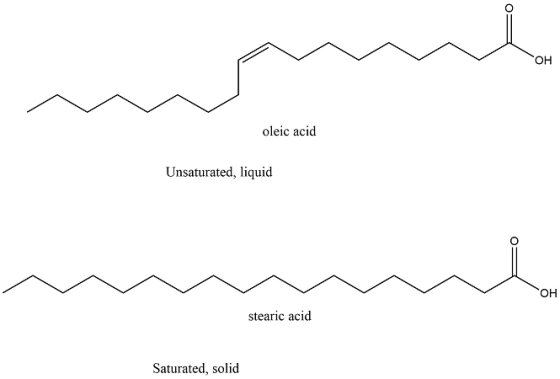
Unsaturated fatty acids are liquid at room temperature. The
structure on left is unsaturated fatty acid. It is a liquid at room
temperature. It contains  double bond in the hydrocarbon part.
Saturated fatty acids are solid at room temperature. The
structure on right is saturated fatty acid. It is a solid at room
temperature. It does not contains
double bond in the hydrocarbon part.
Hydrophilic parts are circled and hydrophobic parts are boxed as shown below.
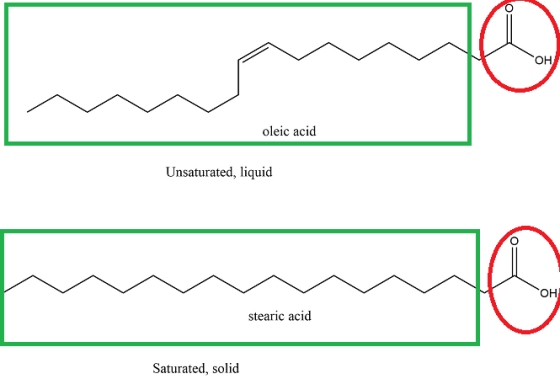
Due to presence of large (non polar) hydrocarbon part, these molecules are not likely to dissolve in (poalr) water. This is because like dissolves like.
| Step | Name of organic reaction |
| (a) succinate to fumarate | Dehydrogenation (A molecule of hydrogen is lost to form C=C double bond) |
| (b) fumarate to malate | Hydration (A water molecule is added to C=C double bond) |
| (c) malate to oxaloacetate | Oxidation (secondary alcohol is oxidised to ketone) |
| (d) isocitrate to alpha-ketoglutarate |
(1) Oxidation (secondary alcohol is oxidised to ketone) (2) Decarboxylation (A molecule of carbon dioxide is eliminated) |
Add Answer to:
When melting or boiling a substance (both of which are physical changes), which kinds of attractions...
Shape, melting point & solubility (2.5 pts) When melting or boiling a substance (both of which...
 Shape, melting point & solubility (2.5 pts) When melting or boiling a substance (both of which are physical changes), which kinds of attractions may be broken? Circle all that apply. hydrogen bonding covalent bonds dipole-dipole London forces vs. If I told you that only one of these molecules is a solid at room temperature, which one is that more likely to be? How can you tell from the structure? Circle the hydrophilic portion of the molecules above and put a...
show me the work in a clear hand writing so i can understand please Identifying Chemical...
 show me the work in a clear hand writing so i can understand
please
Identifying Chemical Reactions (2 pts) Pro ho fan cost can Name the organic reaction happening at each of the following steps in the Krebs cycle (pictured at right): (a) succinate → fumarate waloncette Malate (b) fumarate → malate Fumarate Pumarte o a-ketoglutarala Succinyl-CoA Succinate (c) malate → oxaloacetate (d) isocitrate → a-ketoglutarate* (two rxns!!)
show me the work in a clear hand writing so i can understand
please
Identifying Chemical Reactions (2 pts) Pro ho fan cost can Name the organic reaction happening at each of the following steps in the Krebs cycle (pictured at right): (a) succinate → fumarate waloncette Malate (b) fumarate → malate Fumarate Pumarte o a-ketoglutarala Succinyl-CoA Succinate (c) malate → oxaloacetate (d) isocitrate → a-ketoglutarate* (two rxns!!)
Identifying Chemical Reactions (2 pts) Name the organic reaction happening at each of the following steps...
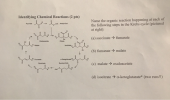 Identifying Chemical Reactions (2 pts) Name the organic reaction happening at each of the following steps in the Krebs cycle (pictured at right): Pyuvate o AcetylCoA (a) succinate fumarate Cie Calowcetate ualate socrateo (b) fumarate malate aKetnglutarate Fumarele Sucdinyl Co (c) malate oxaloacetate Suacnate a-ketoglutarate* (two rxns!!) (d) isocitrate
show me the work in a clear hand writing so i can understand please Shape, melting point & solubility (2.5 pts)...
 show me the work in a clear hand writing so i can understand
please
Shape, melting point & solubility (2.5 pts) When melting or boiling a substance (both of which are physical changes), which kinds of attractions may be broken? Circle all that apply. hydrogen bonding covalent bonds dipole-dipole London forces If I told you that only one of these molecules is a solid at room temperature, which one is that more likely to be? How can you tell from...
show me the work in a clear hand writing so i can understand
please
Shape, melting point & solubility (2.5 pts) When melting or boiling a substance (both of which are physical changes), which kinds of attractions may be broken? Circle all that apply. hydrogen bonding covalent bonds dipole-dipole London forces If I told you that only one of these molecules is a solid at room temperature, which one is that more likely to be? How can you tell from...
Molecule G is a four carbon molecule which is formed from the Molecule F a tricarboxylic...
Molecule G is a four carbon molecule which is formed from the Molecule F a tricarboxylic acid after it has gone through oxidative decarboxylations to yield G during citric acid cycle. Molecule F is formed from Molecule E which in turn is formed from Molecules C and D condensation. Molecule C is formed from the oxidative decarboxylation of Molecule A and Molecule D is formed from the oxidation of Molecule X. 1. Molecule X is: A. Alpha-ketoglutarate B. Oxaloacetate C....
14. Which of the following enzymes is involved in both glass and gluconeogenesis Pyruvate carboxylase, b....
 14. Which of the following enzymes is involved in both glass and gluconeogenesis Pyruvate carboxylase, b. Phosphofructokinase 1 Triose phosphate Isomerse Pyruvate kinase Heroine 15- Arsenal is an ion that can replace inorganic phosphate (Pi) is the reaction catalyzed by Glyceraldehyde 3-phosphate dehydrogenase, causing the direct conversion of Glyceraldehyde-3 phosphate into - phosphoglycente. NADH is will produced. Which of the following glycolytic metabolites will not be detectable in a cell that is exposed to reale? Glucose 6-phosphate b. Fructose 6-phosphate...
 Shape, melting point & solubility (2.5 pts) When melting or boiling a substance (both of which are physical changes), which kinds of attractions may be broken? Circle all that apply. hydrogen bonding covalent bonds dipole-dipole London forces vs. If I told you that only one of these molecules is a solid at room temperature, which one is that more likely to be? How can you tell from the structure? Circle the hydrophilic portion of the molecules above and put a...
 show me the work in a clear hand writing so i can understand
please
Identifying Chemical Reactions (2 pts) Pro ho fan cost can Name the organic reaction happening at each of the following steps in the Krebs cycle (pictured at right): (a) succinate → fumarate waloncette Malate (b) fumarate → malate Fumarate Pumarte o a-ketoglutarala Succinyl-CoA Succinate (c) malate → oxaloacetate (d) isocitrate → a-ketoglutarate* (two rxns!!)
show me the work in a clear hand writing so i can understand
please
Identifying Chemical Reactions (2 pts) Pro ho fan cost can Name the organic reaction happening at each of the following steps in the Krebs cycle (pictured at right): (a) succinate → fumarate waloncette Malate (b) fumarate → malate Fumarate Pumarte o a-ketoglutarala Succinyl-CoA Succinate (c) malate → oxaloacetate (d) isocitrate → a-ketoglutarate* (two rxns!!)
 Identifying Chemical Reactions (2 pts) Name the organic reaction happening at each of the following steps in the Krebs cycle (pictured at right): Pyuvate o AcetylCoA (a) succinate fumarate Cie Calowcetate ualate socrateo (b) fumarate malate aKetnglutarate Fumarele Sucdinyl Co (c) malate oxaloacetate Suacnate a-ketoglutarate* (two rxns!!) (d) isocitrate
 show me the work in a clear hand writing so i can understand
please
Shape, melting point & solubility (2.5 pts) When melting or boiling a substance (both of which are physical changes), which kinds of attractions may be broken? Circle all that apply. hydrogen bonding covalent bonds dipole-dipole London forces If I told you that only one of these molecules is a solid at room temperature, which one is that more likely to be? How can you tell from...
show me the work in a clear hand writing so i can understand
please
Shape, melting point & solubility (2.5 pts) When melting or boiling a substance (both of which are physical changes), which kinds of attractions may be broken? Circle all that apply. hydrogen bonding covalent bonds dipole-dipole London forces If I told you that only one of these molecules is a solid at room temperature, which one is that more likely to be? How can you tell from...
 14. Which of the following enzymes is involved in both glass and gluconeogenesis Pyruvate carboxylase, b. Phosphofructokinase 1 Triose phosphate Isomerse Pyruvate kinase Heroine 15- Arsenal is an ion that can replace inorganic phosphate (Pi) is the reaction catalyzed by Glyceraldehyde 3-phosphate dehydrogenase, causing the direct conversion of Glyceraldehyde-3 phosphate into - phosphoglycente. NADH is will produced. Which of the following glycolytic metabolites will not be detectable in a cell that is exposed to reale? Glucose 6-phosphate b. Fructose 6-phosphate...
Most questions answered within 3 hours.
-
Where is the error in this code sequence?
String s1 = "Hello";
String s2 = "ello";...
asked 11 months ago -
Financial data for Joel de Paris, Inc., for last year
follow:
Joel de Paris, Inc.
Balance...
asked 11 months ago -
Consider this reaction:
Al2(SO4)3 (aq)+ BaCl3
(aq) Al2Cl6 (aq)- +
3BaSO4(s) . What is the...
asked 11 months ago -
Suppose that Savneet is considering increasing her
recent random sample from 20 car rentals to 40...
asked 11 months ago -
Trucks arrive at an unloading terminal at an average rate of 120
per hour.
Trucks arrive...
asked 11 months ago -
Why are methanol and ethanol completely soluble in water while
octanol is not very little soluble....
asked 11 months ago -
A facilities manager at a university reads in a research report
that the mean amount of...
asked 11 months ago -
When the CuSO4 is rehydrated by adding water to the anhydrous
compound, is this an endothermic...
asked 11 months ago -
A ray of sunlight is passing from diamond into crown glass; the
angle of incidence is...
asked 11 months ago -
A block of mass 0.249 kg is placed on top of a light, vertical
spring of...
asked 11 months ago -
how do the kidneys compensate in the presences of acidosis
a) trigger hyperventilate
b) reserve acid...
asked 11 months ago -
Question 501 pts
The rental rate of capital to the firm increases. Which of the
following...
asked 11 months ago