A2. Using a diffraction grating how does the following changes affect interference pattern.... a.decreasing wavelength b.increasing...
A2. Using a diffraction grating how does the following changes affect interference pattern....
a.decreasing wavelength b.increasing wavelength c.decreasing slit width d.increasing slit width e.decreasing slit spacing f.increasing slit spacing
Homework Answers
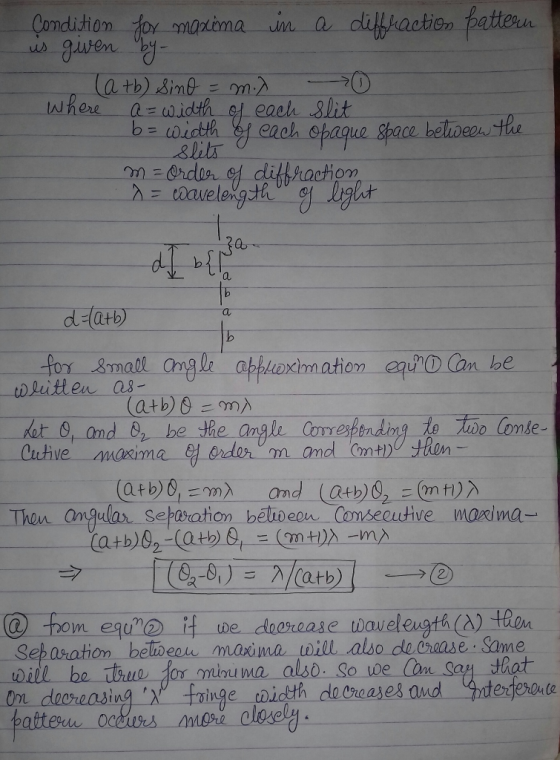

Add Answer to:
A2. Using a diffraction grating how does the following changes
affect interference pattern....
a.decreasing wavelength b.increasing...
1. Describe the pattern for the single-slit diffraction. How does it change when the slit width...
1. Describe the pattern for the single-slit diffraction. How does it change when the slit width changes? How does it change when the wavelength changes? 2. Describe the pattern for the double-slit interference. 3. Describe the pattern for the four-slit interference. 4. Compare the patterns of the single-slit diffraction to the double-slit interference.
beam of electrons is shot through a diffraction grating with 10,000 lines per centimeter. interference pattern...
beam of electrons is shot through a diffraction grating with 10,000 lines per centimeter. interference pattern on a detector is distance L= 0.3500 m from the thin slits. central maximum width= 1.45 x 10^-6 m. draw a diagram with slits, detector, L, W, and also angular position (theta) of first order minimum in 2 slit interference pattern. find theta, wavelength of electrons in meters, and if you doubled the number of lines per cm, what would happen to the width?
2) White light is being analyzed by a diffraction grating (100 lines/mm). In the interference pattern,...
2) White light is being analyzed by a diffraction grating (100 lines/mm). In the interference pattern, the third order blue (wavelength=400 nm) appears 10 cm from the central maxima. How far away is the screen placed from the grating? a) 0.83 m b) 6.52m c) 0.21m d) 8.33m Do you agree or disagree with the statement: "Single-slit interference shouldn't be possible if light was wave; for waves to interfere- you need at least two slits" a) agree b)disagree
*Question 246: Interference/Diffraction Two Slits A two slit Fraunhoffer diffraction-interference pattern is observed with light of...
 *Question 246: Interference/Diffraction Two Slits A two slit Fraunhoffer diffraction-interference pattern is observed with light of wavelength 700 nm. The slits have a width a = 0.01 mm and a separation d = 0.2 mm. How many bright fringes will be seen in the central diffraction maximum? Select one a. 38 b. 19 ec. 20 d. 3 e. 39
495 nm laser light falls on a diffraction grating and forms an interference pattern on a...
495 nm laser light falls on a diffraction grating and forms an interference pattern on a wall 0.98 m behind the grating. The third bright spot is 1088 mm from the central bright spot. a) What is the spacing between the lines in the grating? d = μm b) How many lines per mm is this? lines/mm = c) If the grating were illuminated instead with a red 625 nm laser, what would be the distances to the first five...
The figure shows the interference pattern on a screen 1.0m behind an 800 line/mm diffraction grating....
 The figure shows the interference pattern on a screen 1.0m
behind an 800 line/mm diffraction grating. What is the wavelength
of the light?
The figure shows the interference pattern on a screen 1.0m
behind an 800 line/mm diffraction grating. What is the wavelength
of the light?
Calculate the diffraction pattern of a finite grating. using the convolution theorem and the Fourier transforms...
Calculate the diffraction pattern of a finite grating. using the convolution theorem and the Fourier transforms of a single slit and an infinite comb. How is this pattern is related to the single and double-slit diffraction patterns.
Blue light of wavelength 455 nm passes through an interference grating with a slit spacing of...
Blue light of wavelength 455 nm passes through an interference grating with a slit spacing of 1.5×10⁻³ mm and makes an interference pattern on the wall. Part A How many bright fringes will be seen? Part B Find the critical angle for oil-air boundary. If the index of refraction of oil is 1.46.
Title: Interference and Diffraction of Light Attach all your graphs and table. Pre-Lab Questions ...
 Title: Interference and Diffraction of Light Attach all your graphs and table. Pre-Lab Questions For a single slit, as the slit width is increased, what happens to the pattern? Does the angle to the first diffraction minimum increase or decrease or stay the same? 1. For a double slit, as the slit width is increased, what happens to the pattern? Does the angle to the first diffraction minimum increase or decrease or stay the same? Does the angle to the...
2. You have a diffraction grating with 2500 lines/cm. You also have a light source that...
2. You have a diffraction grating with 2500 lines/cm. You also have a light source that emits light at 2 different wavelengths, 540 nm and 690 nm, at the same time. The screen for your experiment is 1.2 meters from the diffraction grating. A. What is the line spacing for the grating? B. What is the difference in the angle of the 2nd bright fringe for each wavelength for this grating? C. Which wavelength is closer to the center of...
 *Question 246: Interference/Diffraction Two Slits A two slit Fraunhoffer diffraction-interference pattern is observed with light of wavelength 700 nm. The slits have a width a = 0.01 mm and a separation d = 0.2 mm. How many bright fringes will be seen in the central diffraction maximum? Select one a. 38 b. 19 ec. 20 d. 3 e. 39
 The figure shows the interference pattern on a screen 1.0m
behind an 800 line/mm diffraction grating. What is the wavelength
of the light?
The figure shows the interference pattern on a screen 1.0m
behind an 800 line/mm diffraction grating. What is the wavelength
of the light?
 Title: Interference and Diffraction of Light Attach all your graphs and table. Pre-Lab Questions For a single slit, as the slit width is increased, what happens to the pattern? Does the angle to the first diffraction minimum increase or decrease or stay the same? 1. For a double slit, as the slit width is increased, what happens to the pattern? Does the angle to the first diffraction minimum increase or decrease or stay the same? Does the angle to the...
Most questions answered within 3 hours.
-
Where is the error in this code sequence?
String s1 = "Hello";
String s2 = "ello";...
asked 10 months ago -
Financial data for Joel de Paris, Inc., for last year
follow:
Joel de Paris, Inc.
Balance...
asked 10 months ago -
Consider this reaction:
Al2(SO4)3 (aq)+ BaCl3
(aq) Al2Cl6 (aq)- +
3BaSO4(s) . What is the...
asked 10 months ago -
Suppose that Savneet is considering increasing her
recent random sample from 20 car rentals to 40...
asked 10 months ago -
Trucks arrive at an unloading terminal at an average rate of 120
per hour.
Trucks arrive...
asked 10 months ago -
Why are methanol and ethanol completely soluble in water while
octanol is not very little soluble....
asked 10 months ago -
A facilities manager at a university reads in a research report
that the mean amount of...
asked 10 months ago -
When the CuSO4 is rehydrated by adding water to the anhydrous
compound, is this an endothermic...
asked 10 months ago -
A ray of sunlight is passing from diamond into crown glass; the
angle of incidence is...
asked 10 months ago -
A block of mass 0.249 kg is placed on top of a light, vertical
spring of...
asked 10 months ago -
how do the kidneys compensate in the presences of acidosis
a) trigger hyperventilate
b) reserve acid...
asked 10 months ago -
Question 501 pts
The rental rate of capital to the firm increases. Which of the
following...
asked 10 months ago