Would you expect the reaction O + O2 = O3 to be endo or exothermic? Use...
Would you expect the reaction O + O2 = O3 to be endo or exothermic? Use information about the types of bonds involved, not numbers, to justify your answer.
Homework Answers
The reaction here is
or, in structural form,

Thus, we see than in the molecule O3 an additional coordinate covalent bond is formed between two Oxygen atom. We know that any type of bond formation is an exothermic process i.e. bond formation releases energy. It also means that to break the bond, you will need to supply energy.
Thus, the process here is an exothermic process.
Add Answer to:
Would you expect the reaction O + O2 = O3 to be endo or
exothermic? Use...
is this endo or exo? Use the following bond energies to decide if the reaction of...
 is this endo or exo?
Use the following bond energies to decide if the reaction of CO2 +2H2 --> CH4 + O2 is endo or exo thermic. C--H 414 kJ/mol S C=O in CO2 = 799 kJ/mol 0=0 = 298 H-H = 436 Endothermic Exothermic
is this endo or exo?
Use the following bond energies to decide if the reaction of CO2 +2H2 --> CH4 + O2 is endo or exo thermic. C--H 414 kJ/mol S C=O in CO2 = 799 kJ/mol 0=0 = 298 H-H = 436 Endothermic Exothermic
The proposed mechanism for a reaction is O3 => O2 + O Slow O + NO...
The proposed mechanism for a reaction is O3 => O2 + O Slow O + NO => NO2 Fast Which of the following would be a rate law for the reaction?
The rate law for the reaction 2NO2 + O3 → N2O5 + O2 is rate =...
The rate law for the reaction 2NO2 + O3 → N2O5 + O2 is rate = k[NO2][O3]. Which one of the following mechanisms is consistent with this rate law? A) NO2 + NO2 → N2O4 (fast) N2O4 + O3 → N2O5 + O2 (slow) B) NO2 + O3 → NO5 (fast) NO5 + NO5 → N2O5 + 5/2O2 (slow) C) NO2 + O3 → NO3 + O2 (slow) NO3 + NO2 → N2O5 (fast) D) NO2 + NO2 → N2O2...
A chemist measures the energy change AH during the following reaction: 2 Fe,O3(s) — 4 FeO(s)+0...
 A chemist measures the energy change AH during the following reaction: 2 Fe,O3(s) — 4 FeO(s)+0 (9) AH= 560. kJ Use the information to answer the following questions. This reaction is... Suppose 73.4 g of Fe, O2 react. endothermic. exothermic. Yes, absorbed. Yes, released. No. Will any heat be released or absorbed? If you said heat will be released or absorbed in the second part of this question, calculate how much heat will be released or absorbed. Round your answer...
The reaction 2 SO2 + O2 = 2 SO3 is exothermic. Which of the following would...
The reaction 2 SO2 + O2 = 2 SO3 is exothermic. Which of the following would be true for a person wanting to force the equilibrium to the right? a. They should (increase/decrease) the reaction temperature b. They should (increase/decrease) the total pressure c. they should (add/remove) SO2 d. they should (add/remove) O2 e. they should (add/remove) SO3 why?
Would you expect the O−O bond in O2 to be shorter or longer than the O−O...
Would you expect the O−O bond in O2 to be shorter or longer than the O−O bond in compounds that contain an O−O single bond? Explain. Check all that apply. 1)The greater the number of shared electron pairs between two atoms, the shorter the distance between the atoms. 2)As O2 has two bonding electron pairs, the O−O distance will be shorter than the O−O single bond distance. 3)As O2 has two bonding electron pairs, the O−O distance will be longer...
Using the reaction in the picture, XeO3 + 4NaOH + O3 ---> 4Na^+ + XeO6^4- +...
 Using the reaction in the picture, XeO3 + 4NaOH + O3 ---> 4Na^+
+ XeO6^4- + O2 + 2H2O, write a reasonable mechanism for your
balanced redox reaction. Use only nucleophilic/electrophilic steps,
even though there may actually be some single electron transfer
steps involved.
Now we're ready to balance the redox reaction. To the equation below, first add the product that comes from O3, and then add the correct coefficients in front of the NaOH and the H2O species: XeO3...
Using the reaction in the picture, XeO3 + 4NaOH + O3 ---> 4Na^+
+ XeO6^4- + O2 + 2H2O, write a reasonable mechanism for your
balanced redox reaction. Use only nucleophilic/electrophilic steps,
even though there may actually be some single electron transfer
steps involved.
Now we're ready to balance the redox reaction. To the equation below, first add the product that comes from O3, and then add the correct coefficients in front of the NaOH and the H2O species: XeO3...
Which relationship or statement best describes AS for the following reaction? O3(g) + NO(g) + O2(g)...
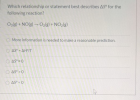 Which relationship or statement best describes AS for the following reaction? O3(g) + NO(g) + O2(g) + NO2(g) More information is needed to make a reasonable prediction. Ο ΔS = ΔΗ/T AS°=0 O AS'>0 O 45° < 0 W
1. A 25 grams piece of unknown metal at 80 ºC is dropped into 50 grams...
1. A 25 grams piece of unknown metal at 80 ºC is dropped into 50 grams of water at 25.0 ºC. The final temperature of the water is 26.16 ºC. What is the specific heat of the unknown metal? [Report answer to two sig figs and do not add the unit label.] 2. Determine the ∆H º for the third reaction; is it exothermic ? ClO(g) + O3(g) --> Cl(g) + 2 O2(g) ∆Hº = -29.90 kJ/mol 2 O3(g)...
True or False: To calculate change in temperature, you use Tinitial - Tfinal Does making a...
True or False: To calculate change in temperature, you use Tinitial - Tfinal Does making a bond release or require energy? Why do bond forming reactions release/require energy? Would you expect a bond forming reaction to be endo or exothermic?
 is this endo or exo?
Use the following bond energies to decide if the reaction of CO2 +2H2 --> CH4 + O2 is endo or exo thermic. C--H 414 kJ/mol S C=O in CO2 = 799 kJ/mol 0=0 = 298 H-H = 436 Endothermic Exothermic
is this endo or exo?
Use the following bond energies to decide if the reaction of CO2 +2H2 --> CH4 + O2 is endo or exo thermic. C--H 414 kJ/mol S C=O in CO2 = 799 kJ/mol 0=0 = 298 H-H = 436 Endothermic Exothermic
 A chemist measures the energy change AH during the following reaction: 2 Fe,O3(s) — 4 FeO(s)+0 (9) AH= 560. kJ Use the information to answer the following questions. This reaction is... Suppose 73.4 g of Fe, O2 react. endothermic. exothermic. Yes, absorbed. Yes, released. No. Will any heat be released or absorbed? If you said heat will be released or absorbed in the second part of this question, calculate how much heat will be released or absorbed. Round your answer...
 Using the reaction in the picture, XeO3 + 4NaOH + O3 ---> 4Na^+
+ XeO6^4- + O2 + 2H2O, write a reasonable mechanism for your
balanced redox reaction. Use only nucleophilic/electrophilic steps,
even though there may actually be some single electron transfer
steps involved.
Now we're ready to balance the redox reaction. To the equation below, first add the product that comes from O3, and then add the correct coefficients in front of the NaOH and the H2O species: XeO3...
Using the reaction in the picture, XeO3 + 4NaOH + O3 ---> 4Na^+
+ XeO6^4- + O2 + 2H2O, write a reasonable mechanism for your
balanced redox reaction. Use only nucleophilic/electrophilic steps,
even though there may actually be some single electron transfer
steps involved.
Now we're ready to balance the redox reaction. To the equation below, first add the product that comes from O3, and then add the correct coefficients in front of the NaOH and the H2O species: XeO3...
 Which relationship or statement best describes AS for the following reaction? O3(g) + NO(g) + O2(g) + NO2(g) More information is needed to make a reasonable prediction. Ο ΔS = ΔΗ/T AS°=0 O AS'>0 O 45° < 0 W
Most questions answered within 3 hours.
-
Where is the error in this code sequence?
String s1 = "Hello";
String s2 = "ello";...
asked 10 months ago -
Financial data for Joel de Paris, Inc., for last year
follow:
Joel de Paris, Inc.
Balance...
asked 10 months ago -
Consider this reaction:
Al2(SO4)3 (aq)+ BaCl3
(aq) Al2Cl6 (aq)- +
3BaSO4(s) . What is the...
asked 10 months ago -
Suppose that Savneet is considering increasing her
recent random sample from 20 car rentals to 40...
asked 10 months ago -
Trucks arrive at an unloading terminal at an average rate of 120
per hour.
Trucks arrive...
asked 10 months ago -
Why are methanol and ethanol completely soluble in water while
octanol is not very little soluble....
asked 10 months ago -
A facilities manager at a university reads in a research report
that the mean amount of...
asked 10 months ago -
When the CuSO4 is rehydrated by adding water to the anhydrous
compound, is this an endothermic...
asked 10 months ago -
A ray of sunlight is passing from diamond into crown glass; the
angle of incidence is...
asked 10 months ago -
A block of mass 0.249 kg is placed on top of a light, vertical
spring of...
asked 10 months ago -
how do the kidneys compensate in the presences of acidosis
a) trigger hyperventilate
b) reserve acid...
asked 10 months ago -
Question 501 pts
The rental rate of capital to the firm increases. Which of the
following...
asked 10 months ago