
Homework Answers
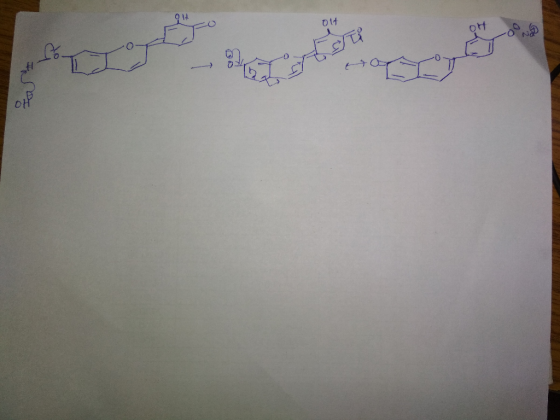
O-H present on benzene ring is more Acidic since O-H bonded electrons are in continousc conjugation and phenoxide ion is stabilized by resoanace.
Add Answer to:
HW4. Show the mechanism and products for the acid/base reaction between cyanidine-3-0- glucoside in its neutral...
6. Show the mechanism and products for the acid/base reaction between cyanidin in its neutral for...
 6. Show the mechanism and products for the acid/base reaction between cyanidin in its neutral form (clearly show the bond between the most acidic hydrogen atom and the oxygen to which it is attached) and a strong base, Sodium Hydroxide. 7. Show the mechanism and products for the acid/base reaction between cyanidin in its neutral form and a strong acid, Hydrochloric Acid (clearly show the bond between the most acidic hydrogen atom and the chlorine to which it is attached)....
HW5. Show the mechanism and products for the acid/base reaction between cyanidine-3-0- glucoside in its neutral for...
 HW5. Show the mechanism and products for the acid/base reaction between cyanidine-3-0- glucoside in its neutral form and a strong acid, Hydrochloric Acid (clearly show the bond between the most acidic hydrogen atom and the chlorine to which it is attached).
Show the mechanism and products for the acid/base reaction between cyanidin in its neutral form a...
Show the mechanism and products for the acid/base reaction between cyanidin in its neutral form and a strong acid, hydrochloric acid (clearly show the bond between the most acidic hydrogen atom and the chlorine to which it is attached)
8. Spectator ions a remain as ions in the reaction and precipitate b. remain as molecules...
 8. Spectator ions a remain as ions in the reaction and precipitate b. remain as molecules in the reactions and precipitate c. They form precipitate because they do not participate in the reaction d. None of the above 9. Polyprotic acids are a. Acids with more than one Hydrogen b. Acids that can form both hydrogen and Hydronium ions c. Acids that can act as acceptors as well as donors of Hydrogen d. Acids that have sweet taste 10. In...
Show the full mechanism Which intermediate is involved in the reaction shown? Formation and reactions of...
 Show the full mechanism
Which intermediate is involved in the reaction shown? Formation and reactions of carbenes with alkenes. The reaction conditions are rather specific for this reaction and probably must be taken into account. The potassium tert-butoxide is a sterically hindered strong base. When trihalomethanes are treated with the strong base, deprotonation gives the trihalomethyl anion, which loses a halide ion to give the neutral carbene. The dihalocarbene adds to the alkene in a a cycloaddition reaction to give...
Show the full mechanism
Which intermediate is involved in the reaction shown? Formation and reactions of carbenes with alkenes. The reaction conditions are rather specific for this reaction and probably must be taken into account. The potassium tert-butoxide is a sterically hindered strong base. When trihalomethanes are treated with the strong base, deprotonation gives the trihalomethyl anion, which loses a halide ion to give the neutral carbene. The dihalocarbene adds to the alkene in a a cycloaddition reaction to give...
1) Consider the acid-base reaction below. A) Predict the products and show the arrow.pushing mechanism and...
 1) Consider the acid-base reaction below. A) Predict the products and show the arrow.pushing mechanism and all of the resonance structures for any resonance-stabilized products. B) Estimate K for this reaction. + Na o
. You should include all products. . If the reaction is a Bronsted acid-base reaction, draw...
 . You should include all products. . If the reaction is a Bronsted acid-base reaction, draw the products in separate sketchers. o Separate multiple products using the +sign from the drop-down menu. . If the reaction is a Lewis acid-base reaction, draw the products in a single sketcher, with a single bond connecting the Lewis base and Lewis acid. e Note: Sodium and potassium never form covalent bonds to electronegative atoms. CH4
Regioselectivity of E1 and E2 Reactions 3. The reaction between a 1,2-dimethylcyclohexanol and concentrated strong acid...
 Regioselectivity of E1 and E2 Reactions 3. The reaction between a 1,2-dimethylcyclohexanol and concentrated strong acid results in an E1 reaction. Show the first step in this reaction (consider that the acid catalyst can protonate the OH group which eventually can form H2O that can act as a good leaving group). а. сн, OH conc.H2SO4 CH3 b. What is the geometry at the reaction center of the intermediate? Show the final step and all possible alkene products с. State the...
Polylactic acid is a polyester polymer that quickly decomposes using base. Show a stepwise reaction mechanism...
Polylactic acid is a polyester polymer that quickly decomposes using base. Show a stepwise reaction mechanism for the degredation of polylactic acid. You should use arrows and show how base (OH-) hydrolyzes the ester bond of the polymer into two fragments. Polylactic acid + OH- ----->
Question 1 1 pt Write the products of the following acid-base reaction. | CHGOCH3 + HBr...
 Question 1 1 pt Write the products of the following acid-base reaction. | CHGOCH3 + HBr . Question 2 1 pt Question 3 1 pt Question 4 1 pt Question 5 1 pt . You should include all products. • If the reaction is a Brønsted acid-base reaction, draw the products in separate sketchers. • Separate multiple products using the + sign from the drop-down menu. • If the reaction is a Lewis acid-base reaction, draw the products in a...
 6. Show the mechanism and products for the acid/base reaction between cyanidin in its neutral form (clearly show the bond between the most acidic hydrogen atom and the oxygen to which it is attached) and a strong base, Sodium Hydroxide. 7. Show the mechanism and products for the acid/base reaction between cyanidin in its neutral form and a strong acid, Hydrochloric Acid (clearly show the bond between the most acidic hydrogen atom and the chlorine to which it is attached)....
 HW5. Show the mechanism and products for the acid/base reaction between cyanidine-3-0- glucoside in its neutral form and a strong acid, Hydrochloric Acid (clearly show the bond between the most acidic hydrogen atom and the chlorine to which it is attached).
 8. Spectator ions a remain as ions in the reaction and precipitate b. remain as molecules in the reactions and precipitate c. They form precipitate because they do not participate in the reaction d. None of the above 9. Polyprotic acids are a. Acids with more than one Hydrogen b. Acids that can form both hydrogen and Hydronium ions c. Acids that can act as acceptors as well as donors of Hydrogen d. Acids that have sweet taste 10. In...
 Show the full mechanism
Which intermediate is involved in the reaction shown? Formation and reactions of carbenes with alkenes. The reaction conditions are rather specific for this reaction and probably must be taken into account. The potassium tert-butoxide is a sterically hindered strong base. When trihalomethanes are treated with the strong base, deprotonation gives the trihalomethyl anion, which loses a halide ion to give the neutral carbene. The dihalocarbene adds to the alkene in a a cycloaddition reaction to give...
Show the full mechanism
Which intermediate is involved in the reaction shown? Formation and reactions of carbenes with alkenes. The reaction conditions are rather specific for this reaction and probably must be taken into account. The potassium tert-butoxide is a sterically hindered strong base. When trihalomethanes are treated with the strong base, deprotonation gives the trihalomethyl anion, which loses a halide ion to give the neutral carbene. The dihalocarbene adds to the alkene in a a cycloaddition reaction to give...
 1) Consider the acid-base reaction below. A) Predict the products and show the arrow.pushing mechanism and all of the resonance structures for any resonance-stabilized products. B) Estimate K for this reaction. + Na o
 . You should include all products. . If the reaction is a Bronsted acid-base reaction, draw the products in separate sketchers. o Separate multiple products using the +sign from the drop-down menu. . If the reaction is a Lewis acid-base reaction, draw the products in a single sketcher, with a single bond connecting the Lewis base and Lewis acid. e Note: Sodium and potassium never form covalent bonds to electronegative atoms. CH4
 Regioselectivity of E1 and E2 Reactions 3. The reaction between a 1,2-dimethylcyclohexanol and concentrated strong acid results in an E1 reaction. Show the first step in this reaction (consider that the acid catalyst can protonate the OH group which eventually can form H2O that can act as a good leaving group). а. сн, OH conc.H2SO4 CH3 b. What is the geometry at the reaction center of the intermediate? Show the final step and all possible alkene products с. State the...
 Question 1 1 pt Write the products of the following acid-base reaction. | CHGOCH3 + HBr . Question 2 1 pt Question 3 1 pt Question 4 1 pt Question 5 1 pt . You should include all products. • If the reaction is a Brønsted acid-base reaction, draw the products in separate sketchers. • Separate multiple products using the + sign from the drop-down menu. • If the reaction is a Lewis acid-base reaction, draw the products in a...
Most questions answered within 3 hours.
-
Where is the error in this code sequence?
String s1 = "Hello";
String s2 = "ello";...
asked 11 months ago -
Financial data for Joel de Paris, Inc., for last year
follow:
Joel de Paris, Inc.
Balance...
asked 11 months ago -
Consider this reaction:
Al2(SO4)3 (aq)+ BaCl3
(aq) Al2Cl6 (aq)- +
3BaSO4(s) . What is the...
asked 11 months ago -
Suppose that Savneet is considering increasing her
recent random sample from 20 car rentals to 40...
asked 11 months ago -
Trucks arrive at an unloading terminal at an average rate of 120
per hour.
Trucks arrive...
asked 11 months ago -
Why are methanol and ethanol completely soluble in water while
octanol is not very little soluble....
asked 11 months ago -
A facilities manager at a university reads in a research report
that the mean amount of...
asked 11 months ago -
When the CuSO4 is rehydrated by adding water to the anhydrous
compound, is this an endothermic...
asked 11 months ago -
A ray of sunlight is passing from diamond into crown glass; the
angle of incidence is...
asked 11 months ago -
A block of mass 0.249 kg is placed on top of a light, vertical
spring of...
asked 11 months ago -
how do the kidneys compensate in the presences of acidosis
a) trigger hyperventilate
b) reserve acid...
asked 11 months ago -
Question 501 pts
The rental rate of capital to the firm increases. Which of the
following...
asked 11 months ago