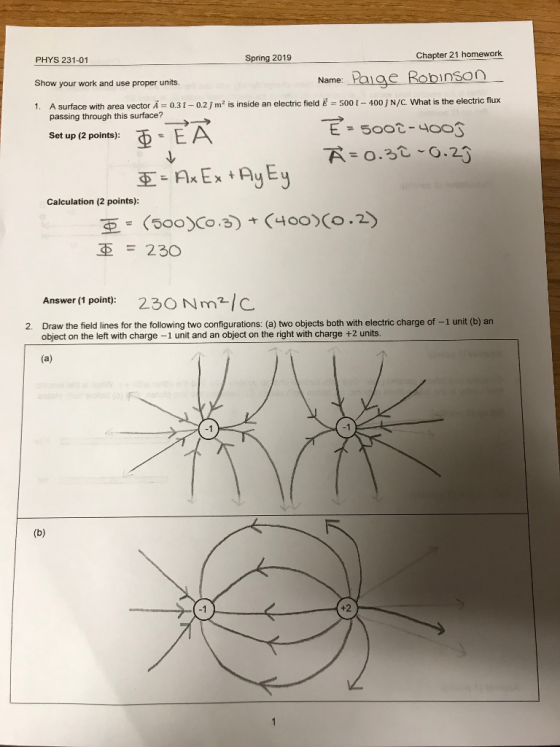
Hi Everyone,
I just wanted to make sure that I did these two problems correctly. Thank you!
Homework Answers
 please Rate me .
Add Answer to:
Hi Everyone,
I just wanted to make sure that I did these two problems
correctly. Thank...
Hi! I was very confused on these two problems. Can someone please show how to do...
 Hi!
I was very confused on these two problems. Can someone please
show how to do them and what formulas to use! Thank you!
PHYS 231-01 Spring 201 Chapter 21 homework 3 Consider two infinite parallel wires. One with linear charge density +22 and the other with - as shown below. (a) What is the electric field vector&at point A? (b) What is the electric field vector E, at point B7 Set up (2 points): +2λ Calculation (2 points): Answer...
Hi!
I was very confused on these two problems. Can someone please
show how to do them and what formulas to use! Thank you!
PHYS 231-01 Spring 201 Chapter 21 homework 3 Consider two infinite parallel wires. One with linear charge density +22 and the other with - as shown below. (a) What is the electric field vector&at point A? (b) What is the electric field vector E, at point B7 Set up (2 points): +2λ Calculation (2 points): Answer...
Hi, I just did this one problem, but I was hoping to get the right answer...
 Hi,
I just did this one problem, but I was hoping to get the right
answer to make sure I am doing these problems right before
continuing. Any help is greatly appreciated!
PHYS 231-01 Show your work and use proper units. 1. Consider three charged objects: q Spring 2019 Chapter 20 homework Name: +1 uC, q2 +2 uC, and 3--3 C. The distance between 1 and 3 is 0.4 m. The distance between 2 and 3 is 0.2 m. What...
Hi,
I just did this one problem, but I was hoping to get the right
answer to make sure I am doing these problems right before
continuing. Any help is greatly appreciated!
PHYS 231-01 Show your work and use proper units. 1. Consider three charged objects: q Spring 2019 Chapter 20 homework Name: +1 uC, q2 +2 uC, and 3--3 C. The distance between 1 and 3 is 0.4 m. The distance between 2 and 3 is 0.2 m. What...
Hi, I am confused on how to find the angles to use to find the net...
 Hi,
I am confused on how to find the angles to use to find the net
electric field vector. I hope it would be possible to work out this
whole problem. Thank you!
PHYS 231-01 Chapter 20 homewd 2. Consider two charged particles q1 distance from object 2 to point A is 0.5 m. What is the net electric field vector at point A? +1 μC and q2 -2 μο. The distance from object 1 to point A is 0.3...
Hi,
I am confused on how to find the angles to use to find the net
electric field vector. I hope it would be possible to work out this
whole problem. Thank you!
PHYS 231-01 Chapter 20 homewd 2. Consider two charged particles q1 distance from object 2 to point A is 0.5 m. What is the net electric field vector at point A? +1 μC and q2 -2 μο. The distance from object 1 to point A is 0.3...
Two hemispherical surfaces, 1 and 2, of respective radii r1 and r2, are centered at a...
Two hemispherical surfaces, 1 and 2, of respective radii r1 and r2, are centered at a point charge and are facing each other so that their edges define an annular ring (surface 3), as shown. The field at position r⃗ due to the point charge is: E⃗ (r⃗ )=Cr2r^ where C is a constant proportional to the charge, r=∣∣r⃗ ∣∣, and r^=r⃗ /r is the unit vector in the radial direction. a- What is the electric flux Φ3 through the annular...
Hi could you check my work and make sure I did this properly. I think I...
 Hi could you check my work and make sure I did this properly.
I think I did something wrong because on letter E shouldn’t I came
up with the same answer as I did for letter C. Please help.
PHYS 201 Fall 2017 19- Rigid Body Rotali Model: For a single (point) object travelling around a circle or radius r with angular ve its kinetic energy is We define the moment of inertia I (sometimes called rotational inertia) of this...
Hi could you check my work and make sure I did this properly.
I think I did something wrong because on letter E shouldn’t I came
up with the same answer as I did for letter C. Please help.
PHYS 201 Fall 2017 19- Rigid Body Rotali Model: For a single (point) object travelling around a circle or radius r with angular ve its kinetic energy is We define the moment of inertia I (sometimes called rotational inertia) of this...
Learning Goal: To understand the definition of electric flux, and how to calculate it. Flux is...
Learning Goal: To understand the definition of electric flux, and how to calculate it. Flux is the amount of a vector field that "flows" through a surface. We now discuss the electric flux through a surface (a quantity needed in Gauss's law): ΦE=∫E⃗ ⋅dA⃗ , where ΦE is the flux through a surface with differential area element dA⃗ , and E⃗ is the electric field in which the surface lies. There are several important points to consider in this expression:...
Quie 1 06 February, 2018 i. Which of the following laws, principles, or definitions that encloses...
 Quie 1 06 February, 2018 i. Which of the following laws, principles, or definitions that encloses charge? desch the electric flux through a sartace a) Faraday's law b) Gauss'law c) Kirchoff's law d) Fluxon principal e) Electric Field definition 2. Which of the following statements concerning the electric field inside a conductor is is true? a) The electric field inside a conductor is never zero N/C b) The electric field inside a conductor is always zero N/C. c) The electric...
I worked this but would love feedback or to see if I did it correctly. Thank...
 I worked this but would love feedback or to see if I did it
correctly. Thank you. The second picture is what they asked to go
by.
A-3. Derive the result in Section A. Step 8. Hint: For the field E to be zero, the vectors E, and E2 must be equal in magnitude and opposite in direction, Since both charges are negative, the fields E, and Ez point toward the corresponding charges. The only points where the fields are...
I worked this but would love feedback or to see if I did it
correctly. Thank you. The second picture is what they asked to go
by.
A-3. Derive the result in Section A. Step 8. Hint: For the field E to be zero, the vectors E, and E2 must be equal in magnitude and opposite in direction, Since both charges are negative, the fields E, and Ez point toward the corresponding charges. The only points where the fields are...
Hi,You've hung two very large sheets of plastic facing each other with distance d between them, as shown in Figure P26.50 ( http://i137
 Hi,You've hung two very large sheets of plastic facing each other with distance d between them, as shown in Figure P26.50 ( http://i137.photobucket.com/albums/q208/infinitbelt/p26-50-1.gif ). By rubbing them with wool and silk, you've managed to give one sheet a uniform surface charge density n1 = -4(n0) and the other a uniform surface charge density n2 = 5(n0). What is the electric field vector at points 1, 2, and 3?I drew the force diagrams for the three points but that is where...
I need help with questions 10 and 11 please 010 10. ints A nonuniform surface charge...
 I need help with questions 10 and 11 please
010 10. ints A nonuniform surface charge lies in the ya plane. At the origin, the surfe oc den- oed objects are sity is 3.5 uC/m2. present as well. Just to the right of the origin, the electric field has only an a component of magnitude 4.9 x 10⁵ N/C. Other What is the r component of the electric field just to the left of the origin? The permittivity of free...
I need help with questions 10 and 11 please
010 10. ints A nonuniform surface charge lies in the ya plane. At the origin, the surfe oc den- oed objects are sity is 3.5 uC/m2. present as well. Just to the right of the origin, the electric field has only an a component of magnitude 4.9 x 10⁵ N/C. Other What is the r component of the electric field just to the left of the origin? The permittivity of free...
 Hi!
I was very confused on these two problems. Can someone please
show how to do them and what formulas to use! Thank you!
PHYS 231-01 Spring 201 Chapter 21 homework 3 Consider two infinite parallel wires. One with linear charge density +22 and the other with - as shown below. (a) What is the electric field vector&at point A? (b) What is the electric field vector E, at point B7 Set up (2 points): +2λ Calculation (2 points): Answer...
Hi!
I was very confused on these two problems. Can someone please
show how to do them and what formulas to use! Thank you!
PHYS 231-01 Spring 201 Chapter 21 homework 3 Consider two infinite parallel wires. One with linear charge density +22 and the other with - as shown below. (a) What is the electric field vector&at point A? (b) What is the electric field vector E, at point B7 Set up (2 points): +2λ Calculation (2 points): Answer...
 Hi,
I just did this one problem, but I was hoping to get the right
answer to make sure I am doing these problems right before
continuing. Any help is greatly appreciated!
PHYS 231-01 Show your work and use proper units. 1. Consider three charged objects: q Spring 2019 Chapter 20 homework Name: +1 uC, q2 +2 uC, and 3--3 C. The distance between 1 and 3 is 0.4 m. The distance between 2 and 3 is 0.2 m. What...
Hi,
I just did this one problem, but I was hoping to get the right
answer to make sure I am doing these problems right before
continuing. Any help is greatly appreciated!
PHYS 231-01 Show your work and use proper units. 1. Consider three charged objects: q Spring 2019 Chapter 20 homework Name: +1 uC, q2 +2 uC, and 3--3 C. The distance between 1 and 3 is 0.4 m. The distance between 2 and 3 is 0.2 m. What...
 Hi,
I am confused on how to find the angles to use to find the net
electric field vector. I hope it would be possible to work out this
whole problem. Thank you!
PHYS 231-01 Chapter 20 homewd 2. Consider two charged particles q1 distance from object 2 to point A is 0.5 m. What is the net electric field vector at point A? +1 μC and q2 -2 μο. The distance from object 1 to point A is 0.3...
Hi,
I am confused on how to find the angles to use to find the net
electric field vector. I hope it would be possible to work out this
whole problem. Thank you!
PHYS 231-01 Chapter 20 homewd 2. Consider two charged particles q1 distance from object 2 to point A is 0.5 m. What is the net electric field vector at point A? +1 μC and q2 -2 μο. The distance from object 1 to point A is 0.3...
 Hi could you check my work and make sure I did this properly.
I think I did something wrong because on letter E shouldn’t I came
up with the same answer as I did for letter C. Please help.
PHYS 201 Fall 2017 19- Rigid Body Rotali Model: For a single (point) object travelling around a circle or radius r with angular ve its kinetic energy is We define the moment of inertia I (sometimes called rotational inertia) of this...
Hi could you check my work and make sure I did this properly.
I think I did something wrong because on letter E shouldn’t I came
up with the same answer as I did for letter C. Please help.
PHYS 201 Fall 2017 19- Rigid Body Rotali Model: For a single (point) object travelling around a circle or radius r with angular ve its kinetic energy is We define the moment of inertia I (sometimes called rotational inertia) of this...
 Quie 1 06 February, 2018 i. Which of the following laws, principles, or definitions that encloses charge? desch the electric flux through a sartace a) Faraday's law b) Gauss'law c) Kirchoff's law d) Fluxon principal e) Electric Field definition 2. Which of the following statements concerning the electric field inside a conductor is is true? a) The electric field inside a conductor is never zero N/C b) The electric field inside a conductor is always zero N/C. c) The electric...
 I worked this but would love feedback or to see if I did it
correctly. Thank you. The second picture is what they asked to go
by.
A-3. Derive the result in Section A. Step 8. Hint: For the field E to be zero, the vectors E, and E2 must be equal in magnitude and opposite in direction, Since both charges are negative, the fields E, and Ez point toward the corresponding charges. The only points where the fields are...
I worked this but would love feedback or to see if I did it
correctly. Thank you. The second picture is what they asked to go
by.
A-3. Derive the result in Section A. Step 8. Hint: For the field E to be zero, the vectors E, and E2 must be equal in magnitude and opposite in direction, Since both charges are negative, the fields E, and Ez point toward the corresponding charges. The only points where the fields are...
 I need help with questions 10 and 11 please
010 10. ints A nonuniform surface charge lies in the ya plane. At the origin, the surfe oc den- oed objects are sity is 3.5 uC/m2. present as well. Just to the right of the origin, the electric field has only an a component of magnitude 4.9 x 10⁵ N/C. Other What is the r component of the electric field just to the left of the origin? The permittivity of free...
I need help with questions 10 and 11 please
010 10. ints A nonuniform surface charge lies in the ya plane. At the origin, the surfe oc den- oed objects are sity is 3.5 uC/m2. present as well. Just to the right of the origin, the electric field has only an a component of magnitude 4.9 x 10⁵ N/C. Other What is the r component of the electric field just to the left of the origin? The permittivity of free...
Most questions answered within 3 hours.
-
Where is the error in this code sequence?
String s1 = "Hello";
String s2 = "ello";...
asked 11 months ago -
Financial data for Joel de Paris, Inc., for last year
follow:
Joel de Paris, Inc.
Balance...
asked 11 months ago -
Consider this reaction:
Al2(SO4)3 (aq)+ BaCl3
(aq) Al2Cl6 (aq)- +
3BaSO4(s) . What is the...
asked 11 months ago -
Suppose that Savneet is considering increasing her
recent random sample from 20 car rentals to 40...
asked 11 months ago -
Trucks arrive at an unloading terminal at an average rate of 120
per hour.
Trucks arrive...
asked 11 months ago -
Why are methanol and ethanol completely soluble in water while
octanol is not very little soluble....
asked 11 months ago -
A facilities manager at a university reads in a research report
that the mean amount of...
asked 11 months ago -
When the CuSO4 is rehydrated by adding water to the anhydrous
compound, is this an endothermic...
asked 11 months ago -
A ray of sunlight is passing from diamond into crown glass; the
angle of incidence is...
asked 11 months ago -
A block of mass 0.249 kg is placed on top of a light, vertical
spring of...
asked 11 months ago -
how do the kidneys compensate in the presences of acidosis
a) trigger hyperventilate
b) reserve acid...
asked 11 months ago -
Question 501 pts
The rental rate of capital to the firm increases. Which of the
following...
asked 11 months ago