
Homework Answers
Add Answer to:
REACTION OF COPPER AND ITS COMPOUNDS PRE-LABORATORY QUESTIONS The following preparatory questions should be answered before...
The following preparatory questions should be answered before coming to lab. They are intended to introduce...
 The following preparatory questions should be answered before coming to lab. They are intended to introduce you to several ideas that are important to aspects of the experiment. You must turn in your work to your instructor before you will be i allowed to begin the experiment. 1. Balance the three copper reactions: 1) Cu(s) + HNO3(aq) ii) Cu(NO3)2 (aq) + 2NaOH(aq) - iii) Cu(OH)2 (3) Cu(NO3)2 (aq) +NO2(g) + H2O (1) Cu(OH)2 (8) + NaNO (aq) CuO (s) +...
PRE-LABORATORY - QUESTIONS ....... The following preparatory questions should be answered before coming to lab. The...
 PRE-LABORATORY - QUESTIONS ....... The following preparatory questions should be answered before coming to lab. They are intended to introduce you to several ideas that are important to aspects of the experiment. You must turn in your work to your instructor before you will be allowed to begin the experiment. 1. What do we mean by thermoplastic polymer? 2. What is the definition of thermosetting polymer? 3. What is glass transition temperature (as it relates to polymers)?
PRE-LABORATORY QUESTIONS : The following preparatory questions should be answered before coming to lab. They: :...
 PRE-LABORATORY QUESTIONS : The following preparatory questions should be answered before coming to lab. They: : are intended to introduce you to several ideas that are important to aspects of the : experiment. You must turn in your work to your instructor before yo allowed to begin the experiment. 1. a) Write the equilibrium constant expression, for the reaction: 2 SO3 (g) CO2 (g)CS2(g 4 02 (g) b) What is the equilibrium constant, K if at equilibrium, [SOs] 2.0 x10²...
3. a. Why should the Cu(OH)2 precipitate that is formed during reaction (ii) be heated slowly...
 3. a. Why should the Cu(OH)2 precipitate that is formed during reaction (ii) be heated slowly during reaction (ii)? b. Why does reaction (i) have to be carried out in the fume hood? 4. Reaction (iii) is considered to be c) decomposition d) acid-base e) precipitation b) single displacement a) combination EXPERIMENT 9 REACTION OF COPPER AND ITS COMPOUNDS PRE-LABORATORY QUESTIONS The following preparatory questions should be answered before coming to lab. They are intended to introduce you to several...
1. Balance the three copper reactions: + H20 (1) Cu(NO3)2 (aq) + NO2(g) i) Cu (s)...
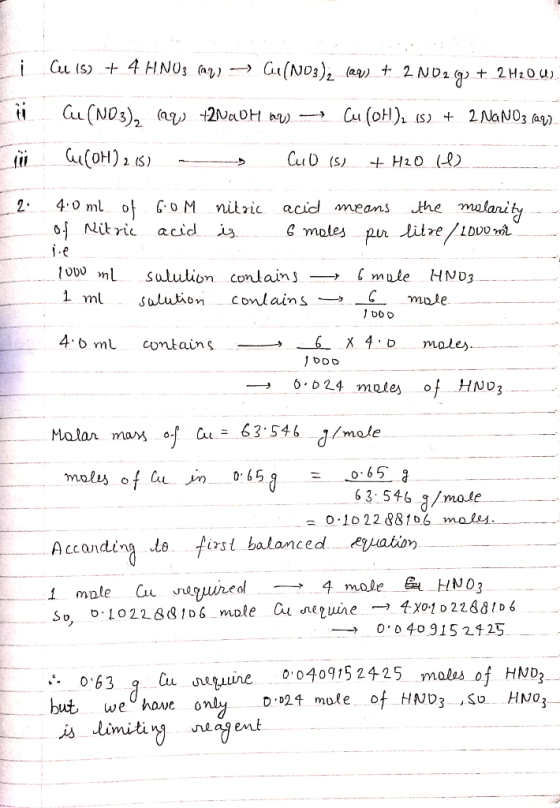
 1. Balance the three copper reactions: + H20 (1) Cu(NO3)2 (aq) + NO2(g) i) Cu (s) + HNO3 (aq) ii) Cu(NO3)2 (aq) + NaOH(aq) Cu(OH)2 (s) + NaNO3(aq) (aq) - iii) Cu(OH)2 (S) Cuo(s) + H2O (1) 2. In reaction (i), suppose you add 4.0 mL of 6 M nitric acid to a sphere of copper metal that weighs 0.65 grams. Which reactant is the limiting reagent? (Show your work)
1. Balance the three copper reactions: +H20 (1) +NO2 (g) Cu(NO3)2 (aq) i) Cu (s) HNO3...
 1. Balance the three copper reactions: +H20 (1) +NO2 (g) Cu(NO3)2 (aq) i) Cu (s) HNO3 (aq) NANO3 (aq) NaOH (aq) Cu(OH)2 (s) + ii) Cu(NOs)2 (aq) + H2O (1I) CuO (s) iii) Cu(OH)2 (s) 2. In reaction (i), suppose you add 4.0 mL of 6M nitric acid to a sphere of copper metal that weighs 0.65 grams. Which reactant is the limiting reagent? (Show your work)
Name Section/CRN EXPERIMENT 9 : PLASTICS AND POLYMERS PRE-LABORATORY - QUESTIONS The following preparatory questions should...
 Name Section/CRN EXPERIMENT 9 : PLASTICS AND POLYMERS PRE-LABORATORY - QUESTIONS The following preparatory questions should be answered before coming to lab. They : are intended to introduce you to several ideas that are important to aspects of the : experiment. You must turn in your work to your instructor before you will be allowed to begin the experiment. 1. What do we mean by thermoplastic polymer? 2. What is the definition of thermosetting polymer? 3. What is glass transition...
Name Section/CRN EXPERIMENT 12: PLASTICS AND POLYMERS PRE-LABORATORY-QUESTIONS : The following preparatory questions should be answered...
 Name Section/CRN EXPERIMENT 12: PLASTICS AND POLYMERS PRE-LABORATORY-QUESTIONS : The following preparatory questions should be answered before coming to lab. They : are intended to introduce you to several ideas that are important to aspects of the experiment. You must turn in your work to your instructor before you will be allowed to begin the experiment. 1. What is the difference between polymer and plastic? 2. a) Give one use of the polymer Nylon. b) What is the polymer found...
EXPERIENT 3: SEPARATION OF A SOLID MIXTURE PRE-LABORATORY QUESTIONS : The following preparatory questions should be...
 EXPERIENT 3: SEPARATION OF A SOLID MIXTURE PRE-LABORATORY QUESTIONS : The following preparatory questions should be answered before coming to lab. They : are intended to introduce you to several ideas that are important to aspects of the experiment. You must turn in your work to your instructor before you will be : allowed to begin the experiment. 1. What is the difference between a homogeneous and heterogeneous mixture? In the experiment, you are going to separate a solid mixture...
What is the product containing copper after the reaction of Cu(NO3)2(aq) + NaOH --> Cu(s) O...
 What is the product containing copper after the reaction of Cu(NO3)2(aq) + NaOH --> Cu(s) O Cu(NO3)2(aq) Cuo(s) Cu(OH)2(s) CuSO4(aq) none of these The previous problem had you calculate the mass of carbon dioxide produced when a given mass of potassium carbonate reacted with a given volume of nitric acid. In this reaction with the previously given amounts, what is the limiting reactant? K2CO3 (aq) + 2 HNO3 (aq) --> 2KNO3 (aq) + H20 (1) + CO2 (g) O CO2...
 The following preparatory questions should be answered before coming to lab. They are intended to introduce you to several ideas that are important to aspects of the experiment. You must turn in your work to your instructor before you will be i allowed to begin the experiment. 1. Balance the three copper reactions: 1) Cu(s) + HNO3(aq) ii) Cu(NO3)2 (aq) + 2NaOH(aq) - iii) Cu(OH)2 (3) Cu(NO3)2 (aq) +NO2(g) + H2O (1) Cu(OH)2 (8) + NaNO (aq) CuO (s) +...
 PRE-LABORATORY - QUESTIONS ....... The following preparatory questions should be answered before coming to lab. They are intended to introduce you to several ideas that are important to aspects of the experiment. You must turn in your work to your instructor before you will be allowed to begin the experiment. 1. What do we mean by thermoplastic polymer? 2. What is the definition of thermosetting polymer? 3. What is glass transition temperature (as it relates to polymers)?
 PRE-LABORATORY QUESTIONS : The following preparatory questions should be answered before coming to lab. They: : are intended to introduce you to several ideas that are important to aspects of the : experiment. You must turn in your work to your instructor before yo allowed to begin the experiment. 1. a) Write the equilibrium constant expression, for the reaction: 2 SO3 (g) CO2 (g)CS2(g 4 02 (g) b) What is the equilibrium constant, K if at equilibrium, [SOs] 2.0 x10²...
 3. a. Why should the Cu(OH)2 precipitate that is formed during reaction (ii) be heated slowly during reaction (ii)? b. Why does reaction (i) have to be carried out in the fume hood? 4. Reaction (iii) is considered to be c) decomposition d) acid-base e) precipitation b) single displacement a) combination EXPERIMENT 9 REACTION OF COPPER AND ITS COMPOUNDS PRE-LABORATORY QUESTIONS The following preparatory questions should be answered before coming to lab. They are intended to introduce you to several...
 1. Balance the three copper reactions: + H20 (1) Cu(NO3)2 (aq) + NO2(g) i) Cu (s) + HNO3 (aq) ii) Cu(NO3)2 (aq) + NaOH(aq) Cu(OH)2 (s) + NaNO3(aq) (aq) - iii) Cu(OH)2 (S) Cuo(s) + H2O (1) 2. In reaction (i), suppose you add 4.0 mL of 6 M nitric acid to a sphere of copper metal that weighs 0.65 grams. Which reactant is the limiting reagent? (Show your work)
 1. Balance the three copper reactions: +H20 (1) +NO2 (g) Cu(NO3)2 (aq) i) Cu (s) HNO3 (aq) NANO3 (aq) NaOH (aq) Cu(OH)2 (s) + ii) Cu(NOs)2 (aq) + H2O (1I) CuO (s) iii) Cu(OH)2 (s) 2. In reaction (i), suppose you add 4.0 mL of 6M nitric acid to a sphere of copper metal that weighs 0.65 grams. Which reactant is the limiting reagent? (Show your work)
 Name Section/CRN EXPERIMENT 9 : PLASTICS AND POLYMERS PRE-LABORATORY - QUESTIONS The following preparatory questions should be answered before coming to lab. They : are intended to introduce you to several ideas that are important to aspects of the : experiment. You must turn in your work to your instructor before you will be allowed to begin the experiment. 1. What do we mean by thermoplastic polymer? 2. What is the definition of thermosetting polymer? 3. What is glass transition...
 Name Section/CRN EXPERIMENT 12: PLASTICS AND POLYMERS PRE-LABORATORY-QUESTIONS : The following preparatory questions should be answered before coming to lab. They : are intended to introduce you to several ideas that are important to aspects of the experiment. You must turn in your work to your instructor before you will be allowed to begin the experiment. 1. What is the difference between polymer and plastic? 2. a) Give one use of the polymer Nylon. b) What is the polymer found...
 EXPERIENT 3: SEPARATION OF A SOLID MIXTURE PRE-LABORATORY QUESTIONS : The following preparatory questions should be answered before coming to lab. They : are intended to introduce you to several ideas that are important to aspects of the experiment. You must turn in your work to your instructor before you will be : allowed to begin the experiment. 1. What is the difference between a homogeneous and heterogeneous mixture? In the experiment, you are going to separate a solid mixture...
 What is the product containing copper after the reaction of Cu(NO3)2(aq) + NaOH --> Cu(s) O Cu(NO3)2(aq) Cuo(s) Cu(OH)2(s) CuSO4(aq) none of these The previous problem had you calculate the mass of carbon dioxide produced when a given mass of potassium carbonate reacted with a given volume of nitric acid. In this reaction with the previously given amounts, what is the limiting reactant? K2CO3 (aq) + 2 HNO3 (aq) --> 2KNO3 (aq) + H20 (1) + CO2 (g) O CO2...
Most questions answered within 3 hours.
-
Where is the error in this code sequence?
String s1 = "Hello";
String s2 = "ello";...
asked 10 months ago -
Financial data for Joel de Paris, Inc., for last year
follow:
Joel de Paris, Inc.
Balance...
asked 10 months ago -
Consider this reaction:
Al2(SO4)3 (aq)+ BaCl3
(aq) Al2Cl6 (aq)- +
3BaSO4(s) . What is the...
asked 10 months ago -
Suppose that Savneet is considering increasing her
recent random sample from 20 car rentals to 40...
asked 10 months ago -
Trucks arrive at an unloading terminal at an average rate of 120
per hour.
Trucks arrive...
asked 10 months ago -
Why are methanol and ethanol completely soluble in water while
octanol is not very little soluble....
asked 10 months ago -
A facilities manager at a university reads in a research report
that the mean amount of...
asked 10 months ago -
When the CuSO4 is rehydrated by adding water to the anhydrous
compound, is this an endothermic...
asked 10 months ago -
A ray of sunlight is passing from diamond into crown glass; the
angle of incidence is...
asked 10 months ago -
A block of mass 0.249 kg is placed on top of a light, vertical
spring of...
asked 10 months ago -
how do the kidneys compensate in the presences of acidosis
a) trigger hyperventilate
b) reserve acid...
asked 10 months ago -
Question 501 pts
The rental rate of capital to the firm increases. Which of the
following...
asked 10 months ago