
Homework Answers
Question 1
Balanced equation:
2 KHCO3 ====> K2CO3 +
H2O + CO2
Reaction type: decomposition
Mass of KHCO3 = 1.5 gm
Moles of KHCO3 = 1.5 gm / 100.115 gm/mol = 0.01498 Moles
Moles of K2CO3 produced = 0.0074913 Moles
Mass of K2CO3 produced = 0.0074913 Moles x 138.2055 g/mol = 1.0353 gm
The actual yield is 1.040 gm. Hence Theoretical yield is 100 %
Question 2
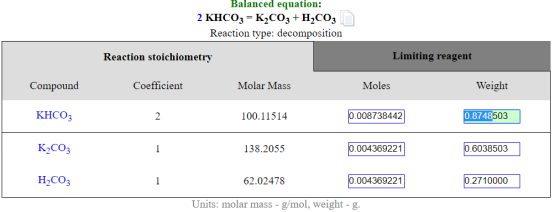
Balanced equation:
2 KHCO3 ===> K2CO3 +
H2CO3
Reaction type: decomposition
The loss of mass is 0.271 gm which is H2CO3.
Mass of H2CO3 = 0.271 gm
Moles of H2CO3 = 0.271g/ 62.02 g/mmol = 0.004369 Moles
Moles of KHCO3 reacted = 0.00873 Moles
Mass of KHCO3 presents = 0.00873 Moles x 100.115 g/mol = 0.8748 gm
Percentage of KHCO3 in the unknown mixture = 0.8748 gm x100% /1.750 gm = 49.988 %
Add Answer to:
SECTION T O POSTLABORATORY ASSIGNMENT 1. A 1.500-g sample of potassium hydrogen carbonate is decomposed by...
Is this answer correct? Also, please help me with the 2nd question. 1. A 1.500-g sample of potassium hydrogen carbon...
 Is this answer correct? Also, please help me with the 2nd
question.
1. A 1.500-g sample of potassium hydrogen carbonate is decomposed by heating to produce 1.040 g of potassium carbonate. Calculate the theoretical yield and percent yield of K CO. 2 KHCO3() 4 K2CO3(s) + H2O(g) + CO2(g) 1.500, KHEO3(-)x mo Brux Imot tos 138.2.109 K2CO3 100.129 Hle, 2 mot Kaso, x mol becos 1.0351x100 -0.996 2 (100% 1.040g 1.035 g K2CO3 - 100% 2. A 1.750-g sample containing...
Is this answer correct? Also, please help me with the 2nd
question.
1. A 1.500-g sample of potassium hydrogen carbonate is decomposed by heating to produce 1.040 g of potassium carbonate. Calculate the theoretical yield and percent yield of K CO. 2 KHCO3() 4 K2CO3(s) + H2O(g) + CO2(g) 1.500, KHEO3(-)x mo Brux Imot tos 138.2.109 K2CO3 100.129 Hle, 2 mot Kaso, x mol becos 1.0351x100 -0.996 2 (100% 1.040g 1.035 g K2CO3 - 100% 2. A 1.750-g sample containing...
NAME POSTLABORATORY ASSIGNMENT SECTION 8 sample of potassium hydrocarbonate is decomposed by heating potassium carbonate Caksulate...
 NAME POSTLABORATORY ASSIGNMENT SECTION 8 sample of potassium hydrocarbonate is decomposed by heating potassium carbonate Caksulate the theoretical vield and percent yield of onate is decomposed by heating to produce 2 KHCO3(-) K 00,6) + H2O) + coce) 2 A 1175 sample mixture of potassium hydropen carbonate is decomposed by heating of the malo is 0.275 g. what is the percentage of KHCO, in the unknown mixture 2 KHCO - KC0,0) + HCO3(e)
1. A 4.385 g sample of mercury (II)oxide was decomposed to produce 4.003 g of liquid...
 1. A 4.385 g sample of mercury (II)oxide was decomposed to produce 4.003 g of liquid mercury according to the equation below. Calculate the percent yield of mercury. 2 HgO(s)-> 2Hg() + O2(g) 4.385 (21656 =4.0039 2. Strontium carbonate decomposes into strontium oxide and carbon dioxide gas when heated, as shown below. What mass of strontium carbonate would be required to produce 49 g of strontium oxide, assuming the reaction went at 100% yield? SrCO3(s) > SEO (s) + CO2(g)...
Sodium hydrogen carbonate, NaHCO3, can be decomposed completely by heating. 2 NaHCO3(s)- Na2CO;(s)+ CO2(g)+H20g A sample...
 Sodium hydrogen carbonate, NaHCO3, can be decomposed completely by heating. 2 NaHCO3(s)- Na2CO;(s)+ CO2(g)+H20g A sample of impure NaHCO; with an initial mass of 0.890 g yielded a solid residue mass of 0.684 g. Determine the mass percent of NaHCOj in the sample. (consisting of Na CO3 and other solids) with a final
Experiment 9- Decomposition of Baking Soda A. mass of H2CO3 gas released, (H2CO3 decomposed into H2O...
 Experiment 9- Decomposition of Baking Soda
A. mass of H2CO3 gas released, (H2CO3 decomposed into H2O +
CO2)?
B. mass of NaHCO3 in unknown mixture?
C. mass of NaHCO3 in unknown mixture?
D. mass of KCL in unknown mixture?
CURCU ILI U ULICOS MOLLE (Part 2) Percent of NaHCO3 in an Unknown Mixture 1) Weigh out approximately 1 g of the unknown sample into your cruci 2) Repeat the steps of the previous procedure. ne steps of the previous procedure....
Experiment 9- Decomposition of Baking Soda
A. mass of H2CO3 gas released, (H2CO3 decomposed into H2O +
CO2)?
B. mass of NaHCO3 in unknown mixture?
C. mass of NaHCO3 in unknown mixture?
D. mass of KCL in unknown mixture?
CURCU ILI U ULICOS MOLLE (Part 2) Percent of NaHCO3 in an Unknown Mixture 1) Weigh out approximately 1 g of the unknown sample into your cruci 2) Repeat the steps of the previous procedure. ne steps of the previous procedure....
Laboratory Manual for Decomposing Bong Soda 3. Potassium chlorate is heated to give potassium chloride and...
 Laboratory Manual for Decomposing Bong Soda 3. Potassium chlorate is heated to give potassium chloride and o pen as Ira 1.115-g sample of potassium chlorate is decomposed, how many milliliters of oxygen gas is released at STP 2 KCIO36) 2 KCK) - 30%) 4. Potassium metal reacts with water to give potassium hydroxide and hydrogen gas. If 75.5 mL of hydrogen gas is produced at STP, what is the mass of potassium metal that reacted? 2 KO) + 2 H206...
what do I do? 3. Solid potassium nitrate is decomposed by heating to give potassium nitrite...
 what do I do?
3. Solid potassium nitrate is decomposed by heating to give potassium nitrite and oxygen gas. If 1.00 g of potassium nitrate is heated, what is the milliliter volume of oxygen gas at STP? 42 KNO2(s) 02(8) 2 KNO,(6) 4. Potassium metal reacts with water to give potassium hydroxide and hydrogen gas. If 50.0 mL of hydrogen gas is produced at STP, what is the mass of potassium that reacted? На) 2 КОН аg) 2 K(s) 2...
what do I do?
3. Solid potassium nitrate is decomposed by heating to give potassium nitrite and oxygen gas. If 1.00 g of potassium nitrate is heated, what is the milliliter volume of oxygen gas at STP? 42 KNO2(s) 02(8) 2 KNO,(6) 4. Potassium metal reacts with water to give potassium hydroxide and hydrogen gas. If 50.0 mL of hydrogen gas is produced at STP, what is the mass of potassium that reacted? На) 2 КОН аg) 2 K(s) 2...
Question 4 1 pts What is the term for the actual yield compared to the theoretical...
 Question 4 1 pts What is the term for the actual yield compared to the theoretical yield expressed as a percent? O percent yield O actual yield O reaction yield O theoretical yield Question 5 2 pts Identify the expected products of heating baking soda, solid NaHCO3 Gaseous H20 O Solid Na Gaseous carbon dioxide, CO2 Aqueous carbonic acid, H2CO3 Gaseous O2 Solid sodium carbonate, Na2CO3 Question 1 1 pts In this experiment, how can you tell when the baking...
Sodium hydrogen carbonate, NaHCO3, can be decomposed completely by heating. 2 NaHCO3(s) → Na2CO3(s) + CO2(g)...
Sodium hydrogen carbonate, NaHCO3, can be decomposed completely by heating. 2 NaHCO3(s) → Na2CO3(s) + CO2(g) + H2O(g) A sample of impure NaHCO3 with an initial mass of 0.821 g yielded a solid residue (consisting of Na2CO3 and other solids) with a final mass of 0.616 g. Determine the mass percent of NaHCO3 in the sample.
A recipe for scones asks for 1.80 g of baking soda (sodium hydrogen carbonate). Upon heating...
 A recipe for scones asks for 1.80 g of baking soda (sodium hydrogen carbonate). Upon heating at 180 °C at a pressure of 1.00 bar, baking soda decomposes as follows: 2 NaHCO3(s) + CO2(g) + Na2CO3(s) + H20(1) If the volume of the dough before baking (i.e. before the decomposition reaction takes place) is 668 ml, what will be the total volume of the scones after baking, in mL? Assume that the rising of the dough is only caused by...
 Is this answer correct? Also, please help me with the 2nd
question.
1. A 1.500-g sample of potassium hydrogen carbonate is decomposed by heating to produce 1.040 g of potassium carbonate. Calculate the theoretical yield and percent yield of K CO. 2 KHCO3() 4 K2CO3(s) + H2O(g) + CO2(g) 1.500, KHEO3(-)x mo Brux Imot tos 138.2.109 K2CO3 100.129 Hle, 2 mot Kaso, x mol becos 1.0351x100 -0.996 2 (100% 1.040g 1.035 g K2CO3 - 100% 2. A 1.750-g sample containing...
Is this answer correct? Also, please help me with the 2nd
question.
1. A 1.500-g sample of potassium hydrogen carbonate is decomposed by heating to produce 1.040 g of potassium carbonate. Calculate the theoretical yield and percent yield of K CO. 2 KHCO3() 4 K2CO3(s) + H2O(g) + CO2(g) 1.500, KHEO3(-)x mo Brux Imot tos 138.2.109 K2CO3 100.129 Hle, 2 mot Kaso, x mol becos 1.0351x100 -0.996 2 (100% 1.040g 1.035 g K2CO3 - 100% 2. A 1.750-g sample containing...
 NAME POSTLABORATORY ASSIGNMENT SECTION 8 sample of potassium hydrocarbonate is decomposed by heating potassium carbonate Caksulate the theoretical vield and percent yield of onate is decomposed by heating to produce 2 KHCO3(-) K 00,6) + H2O) + coce) 2 A 1175 sample mixture of potassium hydropen carbonate is decomposed by heating of the malo is 0.275 g. what is the percentage of KHCO, in the unknown mixture 2 KHCO - KC0,0) + HCO3(e)
 1. A 4.385 g sample of mercury (II)oxide was decomposed to produce 4.003 g of liquid mercury according to the equation below. Calculate the percent yield of mercury. 2 HgO(s)-> 2Hg() + O2(g) 4.385 (21656 =4.0039 2. Strontium carbonate decomposes into strontium oxide and carbon dioxide gas when heated, as shown below. What mass of strontium carbonate would be required to produce 49 g of strontium oxide, assuming the reaction went at 100% yield? SrCO3(s) > SEO (s) + CO2(g)...
 Sodium hydrogen carbonate, NaHCO3, can be decomposed completely by heating. 2 NaHCO3(s)- Na2CO;(s)+ CO2(g)+H20g A sample of impure NaHCO; with an initial mass of 0.890 g yielded a solid residue mass of 0.684 g. Determine the mass percent of NaHCOj in the sample. (consisting of Na CO3 and other solids) with a final
 Experiment 9- Decomposition of Baking Soda
A. mass of H2CO3 gas released, (H2CO3 decomposed into H2O +
CO2)?
B. mass of NaHCO3 in unknown mixture?
C. mass of NaHCO3 in unknown mixture?
D. mass of KCL in unknown mixture?
CURCU ILI U ULICOS MOLLE (Part 2) Percent of NaHCO3 in an Unknown Mixture 1) Weigh out approximately 1 g of the unknown sample into your cruci 2) Repeat the steps of the previous procedure. ne steps of the previous procedure....
Experiment 9- Decomposition of Baking Soda
A. mass of H2CO3 gas released, (H2CO3 decomposed into H2O +
CO2)?
B. mass of NaHCO3 in unknown mixture?
C. mass of NaHCO3 in unknown mixture?
D. mass of KCL in unknown mixture?
CURCU ILI U ULICOS MOLLE (Part 2) Percent of NaHCO3 in an Unknown Mixture 1) Weigh out approximately 1 g of the unknown sample into your cruci 2) Repeat the steps of the previous procedure. ne steps of the previous procedure....
 Laboratory Manual for Decomposing Bong Soda 3. Potassium chlorate is heated to give potassium chloride and o pen as Ira 1.115-g sample of potassium chlorate is decomposed, how many milliliters of oxygen gas is released at STP 2 KCIO36) 2 KCK) - 30%) 4. Potassium metal reacts with water to give potassium hydroxide and hydrogen gas. If 75.5 mL of hydrogen gas is produced at STP, what is the mass of potassium metal that reacted? 2 KO) + 2 H206...
 what do I do?
3. Solid potassium nitrate is decomposed by heating to give potassium nitrite and oxygen gas. If 1.00 g of potassium nitrate is heated, what is the milliliter volume of oxygen gas at STP? 42 KNO2(s) 02(8) 2 KNO,(6) 4. Potassium metal reacts with water to give potassium hydroxide and hydrogen gas. If 50.0 mL of hydrogen gas is produced at STP, what is the mass of potassium that reacted? На) 2 КОН аg) 2 K(s) 2...
what do I do?
3. Solid potassium nitrate is decomposed by heating to give potassium nitrite and oxygen gas. If 1.00 g of potassium nitrate is heated, what is the milliliter volume of oxygen gas at STP? 42 KNO2(s) 02(8) 2 KNO,(6) 4. Potassium metal reacts with water to give potassium hydroxide and hydrogen gas. If 50.0 mL of hydrogen gas is produced at STP, what is the mass of potassium that reacted? На) 2 КОН аg) 2 K(s) 2...
 Question 4 1 pts What is the term for the actual yield compared to the theoretical yield expressed as a percent? O percent yield O actual yield O reaction yield O theoretical yield Question 5 2 pts Identify the expected products of heating baking soda, solid NaHCO3 Gaseous H20 O Solid Na Gaseous carbon dioxide, CO2 Aqueous carbonic acid, H2CO3 Gaseous O2 Solid sodium carbonate, Na2CO3 Question 1 1 pts In this experiment, how can you tell when the baking...
 A recipe for scones asks for 1.80 g of baking soda (sodium hydrogen carbonate). Upon heating at 180 °C at a pressure of 1.00 bar, baking soda decomposes as follows: 2 NaHCO3(s) + CO2(g) + Na2CO3(s) + H20(1) If the volume of the dough before baking (i.e. before the decomposition reaction takes place) is 668 ml, what will be the total volume of the scones after baking, in mL? Assume that the rising of the dough is only caused by...
Most questions answered within 3 hours.
-
Where is the error in this code sequence?
String s1 = "Hello";
String s2 = "ello";...
asked 10 months ago -
Financial data for Joel de Paris, Inc., for last year
follow:
Joel de Paris, Inc.
Balance...
asked 10 months ago -
Consider this reaction:
Al2(SO4)3 (aq)+ BaCl3
(aq) Al2Cl6 (aq)- +
3BaSO4(s) . What is the...
asked 10 months ago -
Suppose that Savneet is considering increasing her
recent random sample from 20 car rentals to 40...
asked 10 months ago -
Trucks arrive at an unloading terminal at an average rate of 120
per hour.
Trucks arrive...
asked 10 months ago -
Why are methanol and ethanol completely soluble in water while
octanol is not very little soluble....
asked 10 months ago -
A facilities manager at a university reads in a research report
that the mean amount of...
asked 10 months ago -
When the CuSO4 is rehydrated by adding water to the anhydrous
compound, is this an endothermic...
asked 10 months ago -
A ray of sunlight is passing from diamond into crown glass; the
angle of incidence is...
asked 10 months ago -
A block of mass 0.249 kg is placed on top of a light, vertical
spring of...
asked 10 months ago -
how do the kidneys compensate in the presences of acidosis
a) trigger hyperventilate
b) reserve acid...
asked 10 months ago -
Question 501 pts
The rental rate of capital to the firm increases. Which of the
following...
asked 10 months ago