
Homework Answers
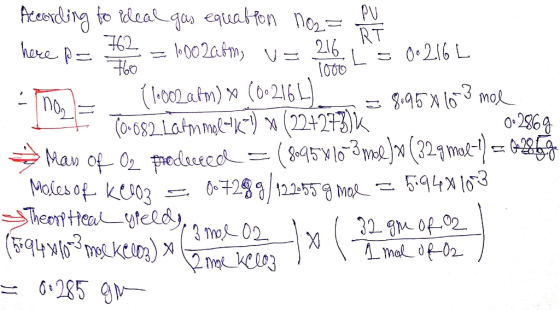
Percentage yield is almost 100%
Add Answer to:
Experiment 12: Generating Hydrogen Gas Post-lab 1. A sample of potassium chlorate is heated, and decomposes...
Potassium chlorate decomposes upon heating to form potassium chloride and oxygen gas. a. Write a balanced...
Potassium chlorate decomposes upon heating to form potassium chloride and oxygen gas. a. Write a balanced chemical equation for this process.b. If 83.69g of potassium chlorate are is heated and the reaction goes to completion, whatvolume of oxygen gas (at 22.0EC and 1.042 atm) is produced?
Experiment 12: Generating Hydrogen Gas Data: A. Percent yield of hydrogen gas Mass of magnesium 0.04298...
 Experiment 12: Generating Hydrogen Gas Data: A. Percent yield of hydrogen gas Mass of magnesium 0.04298 Volume of H2 gas (actual) 42.ml 0.0426 24.0°C 297 Temperature of H, gas Atmospheric pressure (see barometer) 765.8 mmHg a2.4 mmHg Vapor pressure of water Partial pressure of Hą gas 743.4 mmHg 0.976 1 atm Calculate the moles of hydrogen gas that should have been produced, starting with the mass of Mg and using the balanced equation. mg = 24.31 Mg(s) + 2 HCI...
Experiment 12. Generating Hydrogen Cas A. Percent yield of hydrogen gas Mass of magnesium -0.051 Volume...
 Experiment 12. Generating Hydrogen Cas A. Percent yield of hydrogen gas Mass of magnesium -0.051 Volume of gas (actual) Temperature of H gas Atmospheric pressure (see barometer) 20 °C 24 mmHg 26PmHg mmHg Vapor pressure of water there mmtig Partial pressure of He gas Calculate the moles of hydrogen gas that should have been produced, starting with the mass of Mg and using the balanced equation. Mg (8) + 2 HCI (aq) → MgCl(aq) + H2 (8) 0.08ling Imoling ....
Solid potassium chlorate (KClO3) decomposes into potassium chloride and oxygen gas when heated. How many moles...
 Solid potassium chlorate (KClO3) decomposes into potassium chloride and oxygen gas when heated. How many moles of oxygen form when 55.3 g completely decomposes? 0.338 mol 0.677 mol 0.451 mol 83.0 mol
15.45 grams of solid potassium chlorate decomposes when heated to form solid potassium chloride and oxygen...
 15.45 grams of solid potassium chlorate decomposes when heated to form solid potassium chloride and oxygen gas. Assuming 100 % yield, how many grams of solid potassium chloride will be produced? 6 IMo Xmo SUC Aniou1120
composition of potassium chlorate questions and problems REPORT FOR EXPERIMENT 9 (continued) B. Qualitative Examination of...
 composition of potassium chlorate questions and problems
REPORT FOR EXPERIMENT 9 (continued) B. Qualitative Examination of Residue 1. Record what you observed when silver nitrate was added to the following: (a) Potassium chloride solution (b) Potassium chlorate solution (c) Residue solution 2. (a) What evidence did you observe that would lead you to believe that the residue was potassium chloride? (b) What would happen if you added silver nitrate to a solution of sodium chloride? Explain your answer. e) Did...
composition of potassium chlorate questions and problems
REPORT FOR EXPERIMENT 9 (continued) B. Qualitative Examination of Residue 1. Record what you observed when silver nitrate was added to the following: (a) Potassium chloride solution (b) Potassium chlorate solution (c) Residue solution 2. (a) What evidence did you observe that would lead you to believe that the residue was potassium chloride? (b) What would happen if you added silver nitrate to a solution of sodium chloride? Explain your answer. e) Did...
11. At elevated temperatures, sodium chlorate decomposes to produce sodium chloride and oxygen gas. A 0.8685-g sample of impure sodium chlorate was heated until the production of oxygen gas ceased. Th...
11. At elevated temperatures, sodium chlorate decomposes to produce sodium chloride and oxygen gas. A 0.8685-g sample of impure sodium chlorate was heated until the production of oxygen gas ceased. The oxygen gas collected over water occupied 51.2 mL at a temperature of 25°C and a pressure of 731 torr. Calculate the mass percent of NaClO3 in the original sample. (At 25°C the vapor pressure of water is 23.8 torr.)
Experiment 12: Generating Hydrogen Gas Part B: Molar mass of unknown metal Unknown #: Mass of...
 Experiment 12: Generating Hydrogen Gas Part B: Molar mass of unknown metal Unknown #: Mass of unknown metal (X) .29 Volume of H2 gas L mL Temperature of H; gas 20 mm к C Atmospheric pressure (see barometer) Vapor pressure of water mmHg Partial pressure of H; gas mmHg atm Using PV-nRT and your data, calculate the moles of hydrogen gas produced in the experiment: l e epl8 moles H Convert moles of hydrogen gas to moles of the metal...
Please do the following questions! thank you! Experiment 12: Generating Hydrogen Gas Part B: Molar mass...
 Please do the following questions! thank you!
Experiment 12: Generating Hydrogen Gas Part B: Molar mass of unknown metal Unknown #: Mass of unknown metal (X): Volume of H2 gas L K Temperature of H2 gas 0.12588 54.4 mL 23.0 C 765.8 mmHg 21.1 mmHg 744.7 mmHg Atmospheric pressure (see barometer) Vapor pressure of water atm Partial pressure of H, gas Using PV=nRT and your data, calculate the moles of hydrogen gas produced in the experiment: PV = 0.97987x54.4xio RT...
Please do the following questions! thank you!
Experiment 12: Generating Hydrogen Gas Part B: Molar mass of unknown metal Unknown #: Mass of unknown metal (X): Volume of H2 gas L K Temperature of H2 gas 0.12588 54.4 mL 23.0 C 765.8 mmHg 21.1 mmHg 744.7 mmHg Atmospheric pressure (see barometer) Vapor pressure of water atm Partial pressure of H, gas Using PV=nRT and your data, calculate the moles of hydrogen gas produced in the experiment: PV = 0.97987x54.4xio RT...
Data Collecting hydrogen gas from the reaction of Mg with HCI Trial 1 Trial 2 Trial 3 Atmospheric pressure (in Hg)...
 Data Collecting hydrogen gas from the reaction of Mg with HCI Trial 1 Trial 2 Trial 3 Atmospheric pressure (in Hg) O pen Mass Mg ribbon 0.069 1.osa. 1.069 Volume Ha collected (ml) sim 40 mL de ML Temperature of water (°C) 23 с әət 1 22oC Vapor pressure of water (Table 10.1) 19.8WHO 19.8 mmHg 1.8 in Ho Atmospheric pressure (mm Hg) Partial pressure of H2 Temperature of water (K) Volume of H: collected (L) Moles Hz Theoretical moles...
 Experiment 12: Generating Hydrogen Gas Data: A. Percent yield of hydrogen gas Mass of magnesium 0.04298 Volume of H2 gas (actual) 42.ml 0.0426 24.0°C 297 Temperature of H, gas Atmospheric pressure (see barometer) 765.8 mmHg a2.4 mmHg Vapor pressure of water Partial pressure of Hą gas 743.4 mmHg 0.976 1 atm Calculate the moles of hydrogen gas that should have been produced, starting with the mass of Mg and using the balanced equation. mg = 24.31 Mg(s) + 2 HCI...
 Experiment 12. Generating Hydrogen Cas A. Percent yield of hydrogen gas Mass of magnesium -0.051 Volume of gas (actual) Temperature of H gas Atmospheric pressure (see barometer) 20 °C 24 mmHg 26PmHg mmHg Vapor pressure of water there mmtig Partial pressure of He gas Calculate the moles of hydrogen gas that should have been produced, starting with the mass of Mg and using the balanced equation. Mg (8) + 2 HCI (aq) → MgCl(aq) + H2 (8) 0.08ling Imoling ....
 Solid potassium chlorate (KClO3) decomposes into potassium chloride and oxygen gas when heated. How many moles of oxygen form when 55.3 g completely decomposes? 0.338 mol 0.677 mol 0.451 mol 83.0 mol
 15.45 grams of solid potassium chlorate decomposes when heated to form solid potassium chloride and oxygen gas. Assuming 100 % yield, how many grams of solid potassium chloride will be produced? 6 IMo Xmo SUC Aniou1120
 composition of potassium chlorate questions and problems
REPORT FOR EXPERIMENT 9 (continued) B. Qualitative Examination of Residue 1. Record what you observed when silver nitrate was added to the following: (a) Potassium chloride solution (b) Potassium chlorate solution (c) Residue solution 2. (a) What evidence did you observe that would lead you to believe that the residue was potassium chloride? (b) What would happen if you added silver nitrate to a solution of sodium chloride? Explain your answer. e) Did...
composition of potassium chlorate questions and problems
REPORT FOR EXPERIMENT 9 (continued) B. Qualitative Examination of Residue 1. Record what you observed when silver nitrate was added to the following: (a) Potassium chloride solution (b) Potassium chlorate solution (c) Residue solution 2. (a) What evidence did you observe that would lead you to believe that the residue was potassium chloride? (b) What would happen if you added silver nitrate to a solution of sodium chloride? Explain your answer. e) Did...
 Experiment 12: Generating Hydrogen Gas Part B: Molar mass of unknown metal Unknown #: Mass of unknown metal (X) .29 Volume of H2 gas L mL Temperature of H; gas 20 mm к C Atmospheric pressure (see barometer) Vapor pressure of water mmHg Partial pressure of H; gas mmHg atm Using PV-nRT and your data, calculate the moles of hydrogen gas produced in the experiment: l e epl8 moles H Convert moles of hydrogen gas to moles of the metal...
 Please do the following questions! thank you!
Experiment 12: Generating Hydrogen Gas Part B: Molar mass of unknown metal Unknown #: Mass of unknown metal (X): Volume of H2 gas L K Temperature of H2 gas 0.12588 54.4 mL 23.0 C 765.8 mmHg 21.1 mmHg 744.7 mmHg Atmospheric pressure (see barometer) Vapor pressure of water atm Partial pressure of H, gas Using PV=nRT and your data, calculate the moles of hydrogen gas produced in the experiment: PV = 0.97987x54.4xio RT...
Please do the following questions! thank you!
Experiment 12: Generating Hydrogen Gas Part B: Molar mass of unknown metal Unknown #: Mass of unknown metal (X): Volume of H2 gas L K Temperature of H2 gas 0.12588 54.4 mL 23.0 C 765.8 mmHg 21.1 mmHg 744.7 mmHg Atmospheric pressure (see barometer) Vapor pressure of water atm Partial pressure of H, gas Using PV=nRT and your data, calculate the moles of hydrogen gas produced in the experiment: PV = 0.97987x54.4xio RT...
 Data Collecting hydrogen gas from the reaction of Mg with HCI Trial 1 Trial 2 Trial 3 Atmospheric pressure (in Hg) O pen Mass Mg ribbon 0.069 1.osa. 1.069 Volume Ha collected (ml) sim 40 mL de ML Temperature of water (°C) 23 с әət 1 22oC Vapor pressure of water (Table 10.1) 19.8WHO 19.8 mmHg 1.8 in Ho Atmospheric pressure (mm Hg) Partial pressure of H2 Temperature of water (K) Volume of H: collected (L) Moles Hz Theoretical moles...
Most questions answered within 3 hours.
-
Where is the error in this code sequence?
String s1 = "Hello";
String s2 = "ello";...
asked 10 months ago -
Financial data for Joel de Paris, Inc., for last year
follow:
Joel de Paris, Inc.
Balance...
asked 10 months ago -
Consider this reaction:
Al2(SO4)3 (aq)+ BaCl3
(aq) Al2Cl6 (aq)- +
3BaSO4(s) . What is the...
asked 10 months ago -
Suppose that Savneet is considering increasing her
recent random sample from 20 car rentals to 40...
asked 10 months ago -
Trucks arrive at an unloading terminal at an average rate of 120
per hour.
Trucks arrive...
asked 10 months ago -
Why are methanol and ethanol completely soluble in water while
octanol is not very little soluble....
asked 10 months ago -
A facilities manager at a university reads in a research report
that the mean amount of...
asked 10 months ago -
When the CuSO4 is rehydrated by adding water to the anhydrous
compound, is this an endothermic...
asked 10 months ago -
A ray of sunlight is passing from diamond into crown glass; the
angle of incidence is...
asked 10 months ago -
A block of mass 0.249 kg is placed on top of a light, vertical
spring of...
asked 10 months ago -
how do the kidneys compensate in the presences of acidosis
a) trigger hyperventilate
b) reserve acid...
asked 10 months ago -
Question 501 pts
The rental rate of capital to the firm increases. Which of the
following...
asked 10 months ago