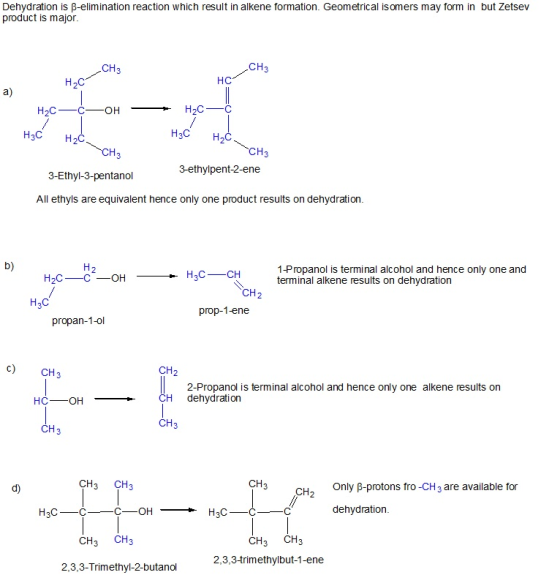
Identify the alkene obtained on dehydration of each of the following alcohols: (a) 3-Ethyl-3-pentanol (b) 1-Propanol...
Identify the alkene obtained on dehydration of each of the following alcohols:
(a) 3-Ethyl-3-pentanol
(b) 1-Propanol
(c) 2-Propanol
(d) 2,3,3-Trimethyl-2-butanol
Homework Answers
Answer:
==============XXXXXX============
Add Answer to:
Identify the alkene obtained on dehydration of each of the
following alcohols:
(a) 3-Ethyl-3-pentanol
(b) 1-Propanol...
Identify the alkene obtained on dehydration of each of the following alcohols: (a) 3-Ethyl-3-pentanol (b) 1-Propanol...
Identify the alkene obtained on dehydration of each of the following alcohols: (a) 3-Ethyl-3-pentanol (b) 1-Propanol (c) 2-Propanol (d) 2,3,3-Trimethyl-2-butanol please show the mechanism. I dont know how the hydrogens are moving in these reactions...
3. Classify each of the following alcohols as primary, secondary, or tertiary. a. 3-pentanol SELECT ONE...
 3. Classify each of the following alcohols as primary, secondary, or tertiary. a. 3-pentanol SELECT ONE SELECT ONE b. 2-methyl-2-butanol c. 1-propanol SELECT ONE 4. If you add chromate, an oxidizing agent, to each of the following would a green Cr solution be formed? SELECT ONE a. 3-pentanol b. 2-methyl-2-butanol SELECT ONE c. 1-propanol SELECT ONE
1- isopropanol (also known as 2-propanol) is formed primarily from the hydration reaction of an alkene....
 1- isopropanol (also known as 2-propanol) is formed primarily
from the hydration reaction of an alkene. The alkene is [ ]
2- When the O in an alcohol is replaced with a sulfur atom, the
resulting compound is called a(n) [ ]
3- The dehydration of two primary alcohols results in a(n) [
]
A alkene
B aldehyde
C carboxylic acid
D ester
E ether
4- Fill in the blank. CHCHCHC≡CCHCHCl
is named _______.
A 7-chloro-4-heptyne
B 5-chloro-2-heptene
C 1-acetylenenyl-3-chloropropane...
1- isopropanol (also known as 2-propanol) is formed primarily
from the hydration reaction of an alkene. The alkene is [ ]
2- When the O in an alcohol is replaced with a sulfur atom, the
resulting compound is called a(n) [ ]
3- The dehydration of two primary alcohols results in a(n) [
]
A alkene
B aldehyde
C carboxylic acid
D ester
E ether
4- Fill in the blank. CHCHCHC≡CCHCHCl
is named _______.
A 7-chloro-4-heptyne
B 5-chloro-2-heptene
C 1-acetylenenyl-3-chloropropane...
1. Of the following alcohols, _____ is likely to be least soluble in water. A. 3-pentanol...
1. Of the following alcohols, _____ is likely to be least soluble in water. A. 3-pentanol B. 1,2,3- propanetriol C. 1,2- ethanediol D. methanol E. 2-butanol
3. Which of the following alcohols is least soluble in water ? a. 1-pentanol c. 1-hexanol...
 3. Which of the following alcohols is least soluble in water ? a. 1-pentanol c. 1-hexanol b. 1-octanol d. 2-propanol
1. Draw the structures of the following alcohols: ethanol 2-propanol cyclohexanol 2-methyl-2-propanol Classify each of the...
 1. Draw the structures of the following alcohols: ethanol 2-propanol cyclohexanol 2-methyl-2-propanol Classify each of the alcohols in question 1 as primary, secondary, or tertiary. ethanol 2-methyl-2-propanol 2. 2-propanol cyclohexanol 3. Which alcohol would you expect to be more soluble in water, 1-butanol or 2-methyl-2- propanol? Why? (Hint: draw both alcohols examine their structures).
Give structures for the three (3) alkenes formed by the dehydration of 3-methyl-3-pentanol. From your knowledge...
 Give structures for the three (3) alkenes formed by the dehydration of 3-methyl-3-pentanol. From your knowledge of the dehydration of alcohols, which alkene should predominate in the product mixture? (3 points) 1
d. AG-AH-AS/T 42. How many stereoisomers of 4-chloro-2-methylpentane (CHs):CHCH:CHCICHs, exist? a. I b. 2 c. 3...
 d. AG-AH-AS/T 42. How many stereoisomers of 4-chloro-2-methylpentane (CHs):CHCH:CHCICHs, exist? a. I b. 2 c. 3 d. 4 43. What is the major organic product obtained from the reaction of 1-butanol with aqueous HBr at reflux? a. 1-bromobutane b. 2-bromobutane c. 2-bromo-1-butanol d. 1-butene 44. Which of the following alcohols reacts fastest with HBr to give the corresponding alkyl bromide? a. methanol b. ethanol 2-propanol d. 2-methyl-2-propanol C. 45.Which of the following alcohols undergoes the most H2SO4 to give rapid...
U.IUTUMIS 1. Write out the synthesis showing all the necessary reagents. (8) a. Prepare 3-ethyl-3-pentanol from...
 U.IUTUMIS 1. Write out the synthesis showing all the necessary reagents. (8) a. Prepare 3-ethyl-3-pentanol from 3-ethyl-2-pentene. b. Prepare 3-ethyl-2-pentanol from 3-ethyl-2-pentene. c. Prepare 2-methyl-1,2-epoxypropane from 2-methyl-1-propanol. d. Prepare trans-1,2-dichlorocyclohexane from cyclohexyl chloride.
21. Identify grain alcohol. A) methanol B) 2-propanol C) ethanol D) 1-butanol E) 1-propanol 22. Identify...
 21. Identify grain alcohol. A) methanol B) 2-propanol C) ethanol D) 1-butanol E) 1-propanol 22. Identify the alcohol in alcoholic drinks. A) methanol B) 2-propanol C) ethanol D) 1-butanol E) 1-propanol
 3. Classify each of the following alcohols as primary, secondary, or tertiary. a. 3-pentanol SELECT ONE SELECT ONE b. 2-methyl-2-butanol c. 1-propanol SELECT ONE 4. If you add chromate, an oxidizing agent, to each of the following would a green Cr solution be formed? SELECT ONE a. 3-pentanol b. 2-methyl-2-butanol SELECT ONE c. 1-propanol SELECT ONE
 1- isopropanol (also known as 2-propanol) is formed primarily
from the hydration reaction of an alkene. The alkene is [ ]
2- When the O in an alcohol is replaced with a sulfur atom, the
resulting compound is called a(n) [ ]
3- The dehydration of two primary alcohols results in a(n) [
]
A alkene
B aldehyde
C carboxylic acid
D ester
E ether
4- Fill in the blank. CHCHCHC≡CCHCHCl
is named _______.
A 7-chloro-4-heptyne
B 5-chloro-2-heptene
C 1-acetylenenyl-3-chloropropane...
1- isopropanol (also known as 2-propanol) is formed primarily
from the hydration reaction of an alkene. The alkene is [ ]
2- When the O in an alcohol is replaced with a sulfur atom, the
resulting compound is called a(n) [ ]
3- The dehydration of two primary alcohols results in a(n) [
]
A alkene
B aldehyde
C carboxylic acid
D ester
E ether
4- Fill in the blank. CHCHCHC≡CCHCHCl
is named _______.
A 7-chloro-4-heptyne
B 5-chloro-2-heptene
C 1-acetylenenyl-3-chloropropane...
 3. Which of the following alcohols is least soluble in water ? a. 1-pentanol c. 1-hexanol b. 1-octanol d. 2-propanol
 1. Draw the structures of the following alcohols: ethanol 2-propanol cyclohexanol 2-methyl-2-propanol Classify each of the alcohols in question 1 as primary, secondary, or tertiary. ethanol 2-methyl-2-propanol 2. 2-propanol cyclohexanol 3. Which alcohol would you expect to be more soluble in water, 1-butanol or 2-methyl-2- propanol? Why? (Hint: draw both alcohols examine their structures).
 Give structures for the three (3) alkenes formed by the dehydration of 3-methyl-3-pentanol. From your knowledge of the dehydration of alcohols, which alkene should predominate in the product mixture? (3 points) 1
 d. AG-AH-AS/T 42. How many stereoisomers of 4-chloro-2-methylpentane (CHs):CHCH:CHCICHs, exist? a. I b. 2 c. 3 d. 4 43. What is the major organic product obtained from the reaction of 1-butanol with aqueous HBr at reflux? a. 1-bromobutane b. 2-bromobutane c. 2-bromo-1-butanol d. 1-butene 44. Which of the following alcohols reacts fastest with HBr to give the corresponding alkyl bromide? a. methanol b. ethanol 2-propanol d. 2-methyl-2-propanol C. 45.Which of the following alcohols undergoes the most H2SO4 to give rapid...
 U.IUTUMIS 1. Write out the synthesis showing all the necessary reagents. (8) a. Prepare 3-ethyl-3-pentanol from 3-ethyl-2-pentene. b. Prepare 3-ethyl-2-pentanol from 3-ethyl-2-pentene. c. Prepare 2-methyl-1,2-epoxypropane from 2-methyl-1-propanol. d. Prepare trans-1,2-dichlorocyclohexane from cyclohexyl chloride.
 21. Identify grain alcohol. A) methanol B) 2-propanol C) ethanol D) 1-butanol E) 1-propanol 22. Identify the alcohol in alcoholic drinks. A) methanol B) 2-propanol C) ethanol D) 1-butanol E) 1-propanol
Most questions answered within 3 hours.
-
Where is the error in this code sequence?
String s1 = "Hello";
String s2 = "ello";...
asked 10 months ago -
Financial data for Joel de Paris, Inc., for last year
follow:
Joel de Paris, Inc.
Balance...
asked 10 months ago -
Consider this reaction:
Al2(SO4)3 (aq)+ BaCl3
(aq) Al2Cl6 (aq)- +
3BaSO4(s) . What is the...
asked 10 months ago -
Suppose that Savneet is considering increasing her
recent random sample from 20 car rentals to 40...
asked 10 months ago -
Trucks arrive at an unloading terminal at an average rate of 120
per hour.
Trucks arrive...
asked 10 months ago -
Why are methanol and ethanol completely soluble in water while
octanol is not very little soluble....
asked 10 months ago -
A facilities manager at a university reads in a research report
that the mean amount of...
asked 10 months ago -
When the CuSO4 is rehydrated by adding water to the anhydrous
compound, is this an endothermic...
asked 10 months ago -
A ray of sunlight is passing from diamond into crown glass; the
angle of incidence is...
asked 10 months ago -
A block of mass 0.249 kg is placed on top of a light, vertical
spring of...
asked 10 months ago -
how do the kidneys compensate in the presences of acidosis
a) trigger hyperventilate
b) reserve acid...
asked 10 months ago -
Question 501 pts
The rental rate of capital to the firm increases. Which of the
following...
asked 10 months ago