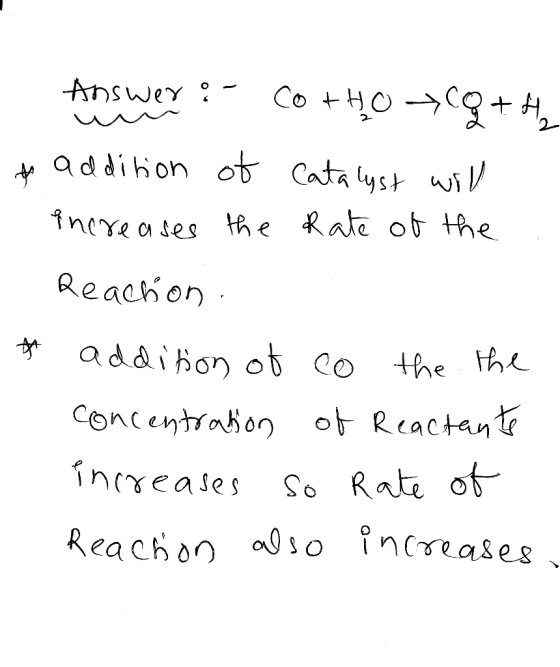
which change(s) to this reaction system would increase the rate of reaction? select all that apply....
Homework Answers
Add Answer to:
which change(s) to this reaction system would increase the rate of
reaction? select all that apply....
Indicate which direction the reaction Ishown below would shift in response to the change described &...
 Indicate which direction the reaction Ishown below would shift in response to the change described & why? Ha(g) + CO2(gl H2O(g) + Coigo АН ran +9.9kcal a.) addition of CO2 b.) addition of H2O ci) addition of a catalyst d.) Increase in temperature eil decrease in volume of the containe
Which of the following statements about enzymes are true? Select all that apply: Enzymes increase reaction...
Which of the following statements about enzymes are true? Select all that apply: Enzymes increase reaction rates by lowering the energy of the products. Enzymes increase the rate at which products are created by preventing reactions from running backwards. Enzymes increase reaction rates by lowering the activation energy of a reaction. Enzymes increase reaction rates by interacting with the substrate molecules to facilitate the reaction, for example by contorting them to facilitate bond-breakage or orienting them to favor bond formation.
Consider the following reaction at equilibrium: NiO(s)+CO(g) 2 Ni(s) + CO2(g). Select all of the following...
 Consider the following reaction at equilibrium: NiO(s)+CO(g) 2 Ni(s) + CO2(g). Select all of the following that will shift the reaction to the left side. Addition of CO Removal of CO Addition of Ni Increase the volume. Removal of CO2 Addition of CO2 Removal of NIO Question 1 What is the expression for equilibrium constant for the following reaction? 2 H2S(g) + SO2(g) = 35(s) + 2 H2O(g) Kc= [HQ][S] [SO][H251 Kc= [HO] [502][H,872 Kc= [502] [H2 51 (H20 Kc=...
QUESTION 5 Which change to this reaction system would cause the equilibrium to shift to the...
 QUESTION 5 Which change to this reaction system would cause the equilibrium to shift to the left? N2(g) + 3H2(g) = 2NH3(g) + heat addition of a catalyst removal of NH3(g) addition of H2 (g) cooling the system decreasing the pressure
16. Which of the changes listed will shift the equilibrium to the left for the following...
16. Which of the changes listed will shift the equilibrium to the left for the following reversible reaction? CO(g) + H2O(g) CO2(g) + H2(g) + heat add a catalyst decrease [CO2] increase temperature increase [H2O] decrease volume
Which will be the product(s) of the reaction. Select all that apply. CH3 NaSCHE - Bro...
 Which will be the product(s) of the reaction. Select all that apply. CH3 NaSCHE - Bro H₃C1 CH3 CH3 H2C CH3 Imagine that the concentration of the alkyl halide was doubled and the concentration of of the nucleophile is tripled. How will the overall rate change? The rate will be doubled (x2) The rate will be multiplied by The rate will be tripled (x3) The rate will be multiplied by 5
question #14 13. Which of the following will cause the value of the rate constant, k,...
 question #14
13. Which of the following will cause the value of the rate constant, k, for the reaction (A + 2B → C) to increase? a) increasing concentration of A b) increasing concentration of B c) increasing concentration of C d) increasing temperature e) all will cause the value of the rate constant to increase 4. The equilibrium constant, Kc, for the reaction (H2O(g) + CO(g) → H2(g) + CO2(g)) is 1.20 X 10'. What is the equilibrium constant...
question #14
13. Which of the following will cause the value of the rate constant, k, for the reaction (A + 2B → C) to increase? a) increasing concentration of A b) increasing concentration of B c) increasing concentration of C d) increasing temperature e) all will cause the value of the rate constant to increase 4. The equilibrium constant, Kc, for the reaction (H2O(g) + CO(g) → H2(g) + CO2(g)) is 1.20 X 10'. What is the equilibrium constant...
Kw changes for s sample of when there is a change in which of the following? (Select all that apply.) of the book: p...
 Kw
changes for s sample of when there is a change in which of the
following? (Select all that apply.)
of the book: p. /12#51, 55, number o if you sub Description Assignm Your last ncchem 6.2.012 0/2.76 points Previous Answers 2. K changes for a sample of water when there is a change in which of the following conditions? (Select all that apply.) [H] temperature pressure [OH") X Submit Answer View Next Que Question 12 of 13 View Previous...
Kw
changes for s sample of when there is a change in which of the
following? (Select all that apply.)
of the book: p. /12#51, 55, number o if you sub Description Assignm Your last ncchem 6.2.012 0/2.76 points Previous Answers 2. K changes for a sample of water when there is a change in which of the following conditions? (Select all that apply.) [H] temperature pressure [OH") X Submit Answer View Next Que Question 12 of 13 View Previous...
Consider the following reaction at equilibrium. Which of the following options will increase the vield of...
 Consider the following reaction at equilibrium. Which of the following options will increase the vield of CO? = 172.5 kJ CO2(g) + C(graphite) = 2 CO(g) AH Choose all that apply. Increasing the temperature Adding CO2 Increasing the volume. Decreasing the temperature Adding some C(graphite)
Question 7 (5 points) Consider the equilibrium below: CO(g) + H2O(g) = CO2(g) + H2(g) Kc...
 Question 7 (5 points) Consider the equilibrium below: CO(g) + H2O(g) = CO2(g) + H2(g) Kc = 0.0611 at 2000 K If Pco and PH20 are both initially 2.95 atm, what will be the equilibrium partial pressure of H2? Express your answer in decimal format to 3 significant figures. Your Answer: N. Answer Coal, which is primarily carbon, can be converted to natural gas (primarily methane, CH4) by the following exothermic reaction: + C(s) 2H2(g) CH4(g) Which of the following...
 Indicate which direction the reaction Ishown below would shift in response to the change described & why? Ha(g) + CO2(gl H2O(g) + Coigo АН ran +9.9kcal a.) addition of CO2 b.) addition of H2O ci) addition of a catalyst d.) Increase in temperature eil decrease in volume of the containe
 Consider the following reaction at equilibrium: NiO(s)+CO(g) 2 Ni(s) + CO2(g). Select all of the following that will shift the reaction to the left side. Addition of CO Removal of CO Addition of Ni Increase the volume. Removal of CO2 Addition of CO2 Removal of NIO Question 1 What is the expression for equilibrium constant for the following reaction? 2 H2S(g) + SO2(g) = 35(s) + 2 H2O(g) Kc= [HQ][S] [SO][H251 Kc= [HO] [502][H,872 Kc= [502] [H2 51 (H20 Kc=...
 QUESTION 5 Which change to this reaction system would cause the equilibrium to shift to the left? N2(g) + 3H2(g) = 2NH3(g) + heat addition of a catalyst removal of NH3(g) addition of H2 (g) cooling the system decreasing the pressure
 Which will be the product(s) of the reaction. Select all that apply. CH3 NaSCHE - Bro H₃C1 CH3 CH3 H2C CH3 Imagine that the concentration of the alkyl halide was doubled and the concentration of of the nucleophile is tripled. How will the overall rate change? The rate will be doubled (x2) The rate will be multiplied by The rate will be tripled (x3) The rate will be multiplied by 5
 question #14
13. Which of the following will cause the value of the rate constant, k, for the reaction (A + 2B → C) to increase? a) increasing concentration of A b) increasing concentration of B c) increasing concentration of C d) increasing temperature e) all will cause the value of the rate constant to increase 4. The equilibrium constant, Kc, for the reaction (H2O(g) + CO(g) → H2(g) + CO2(g)) is 1.20 X 10'. What is the equilibrium constant...
question #14
13. Which of the following will cause the value of the rate constant, k, for the reaction (A + 2B → C) to increase? a) increasing concentration of A b) increasing concentration of B c) increasing concentration of C d) increasing temperature e) all will cause the value of the rate constant to increase 4. The equilibrium constant, Kc, for the reaction (H2O(g) + CO(g) → H2(g) + CO2(g)) is 1.20 X 10'. What is the equilibrium constant...
 Kw
changes for s sample of when there is a change in which of the
following? (Select all that apply.)
of the book: p. /12#51, 55, number o if you sub Description Assignm Your last ncchem 6.2.012 0/2.76 points Previous Answers 2. K changes for a sample of water when there is a change in which of the following conditions? (Select all that apply.) [H] temperature pressure [OH") X Submit Answer View Next Que Question 12 of 13 View Previous...
Kw
changes for s sample of when there is a change in which of the
following? (Select all that apply.)
of the book: p. /12#51, 55, number o if you sub Description Assignm Your last ncchem 6.2.012 0/2.76 points Previous Answers 2. K changes for a sample of water when there is a change in which of the following conditions? (Select all that apply.) [H] temperature pressure [OH") X Submit Answer View Next Que Question 12 of 13 View Previous...
 Consider the following reaction at equilibrium. Which of the following options will increase the vield of CO? = 172.5 kJ CO2(g) + C(graphite) = 2 CO(g) AH Choose all that apply. Increasing the temperature Adding CO2 Increasing the volume. Decreasing the temperature Adding some C(graphite)
 Question 7 (5 points) Consider the equilibrium below: CO(g) + H2O(g) = CO2(g) + H2(g) Kc = 0.0611 at 2000 K If Pco and PH20 are both initially 2.95 atm, what will be the equilibrium partial pressure of H2? Express your answer in decimal format to 3 significant figures. Your Answer: N. Answer Coal, which is primarily carbon, can be converted to natural gas (primarily methane, CH4) by the following exothermic reaction: + C(s) 2H2(g) CH4(g) Which of the following...
Most questions answered within 3 hours.
-
Where is the error in this code sequence?
String s1 = "Hello";
String s2 = "ello";...
asked 10 months ago -
Financial data for Joel de Paris, Inc., for last year
follow:
Joel de Paris, Inc.
Balance...
asked 10 months ago -
Consider this reaction:
Al2(SO4)3 (aq)+ BaCl3
(aq) Al2Cl6 (aq)- +
3BaSO4(s) . What is the...
asked 10 months ago -
Suppose that Savneet is considering increasing her
recent random sample from 20 car rentals to 40...
asked 10 months ago -
Trucks arrive at an unloading terminal at an average rate of 120
per hour.
Trucks arrive...
asked 10 months ago -
Why are methanol and ethanol completely soluble in water while
octanol is not very little soluble....
asked 10 months ago -
A facilities manager at a university reads in a research report
that the mean amount of...
asked 10 months ago -
When the CuSO4 is rehydrated by adding water to the anhydrous
compound, is this an endothermic...
asked 10 months ago -
A ray of sunlight is passing from diamond into crown glass; the
angle of incidence is...
asked 10 months ago -
A block of mass 0.249 kg is placed on top of a light, vertical
spring of...
asked 10 months ago -
how do the kidneys compensate in the presences of acidosis
a) trigger hyperventilate
b) reserve acid...
asked 10 months ago -
Question 501 pts
The rental rate of capital to the firm increases. Which of the
following...
asked 10 months ago