The mass of the bucket attached to the pulley shown in the diagram below is gradually...
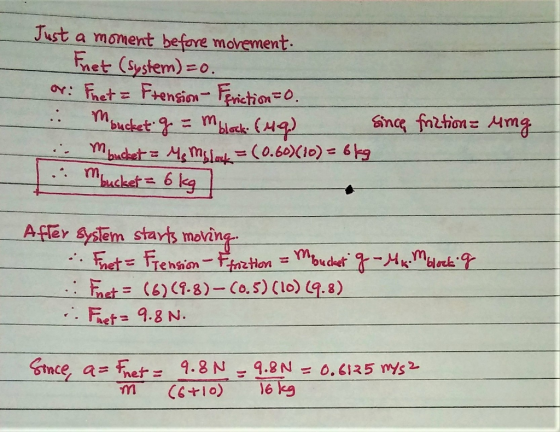
The mass of the bucket attached to the pulley shown in the diagram below is gradually increased by adding sand to the bucket. At some point, the 10 kg block begins to move. The values for the coefficients of static and kinetic friction are 0.60 and 0.50 respectively. a. What is the mass on the bucket and sand at this point? b. What is the acceleration of the block up the slope?
Homework Answers
Alright Dude, If that worked for you... dont forget to give THUMBS UP.(that will work for me!)
If I missed something feel free to leave a comment.
atleast before giving downvote.
and, Thanks for using homeworklib- Smarter way to study.
Add Answer to:
The mass of the bucket attached to the pulley shown in the
diagram below is gradually...
A 28.0-kg block is connected to an empty 2.32-kg bucket by a cord running over a...
A 28.0-kg block is connected to an empty 2.32-kg bucket by a cord running over a frictionless pulley. The coefficient of static friction between the table and the block is 0.49 and the coefficient of kinetic friction between the table and the block is 0.27. Sand is gradually added to the bucket until the system just begins to move. Ignore mass of cord. A. Calculate the mass of sand added to the bucket. B. calculate the acceleration of the system
A 29.5 kg block is connected to an empty 1.00 kg bucket by a cord running...
A 29.5 kg block is connected to an empty 1.00 kg bucket by a cord running over a frictionless pulley (Fig. 4-57). The coefficient of static friction between the table and the block is0.420 and the coefficient of kinetic friction between the table and the block is 0.320. Sand is gradually added to the bucket until the system just begins to move. The mass of the sand added to the bucket is 11.39 kg Calculate the acceleration of the system...
A 28.0 kg block is connected to an empty 1.80 kg bucket by a cord running...
 A 28.0 kg block is connected to an empty 1.80 kg bucket by a cord running over a frictionless pulley. The coefficient of static friction between the table and the block is 0.41 and the coefficient of kinetic friction between the table and the block is 0.31. Sand is gradually added to the bucket until the system just begins to move Calculate the mass of sand added to the bucket. Express your answer using two significant figures. Calculate the acceleration...
Two blocks are connected over a pulley. Block A is on a 30 degree incline and...
Two blocks are connected over a pulley. Block A is on a 30 degree incline and block b is hanging in the air. Block A has a mass of 40.0 kg, a coefficient of kinetic friction of 0.300 and a coefficient of static friction or 0.400. Block B has a mass of 130.0 Kg Draw a freebody diagram What is the value of static friction? What is the value of kinetic friction? will the blocks move? If so, which way...
A 2.70 kg bucket is attached to a disk-shaped pulley of radius 0.131 in and mass...
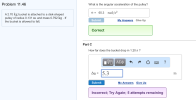 A 2.70 kg bucket is attached to a disk-shaped pulley of radius 0.131 in and mass 0.792 kg. If the bucket is allowed to fall, What is the angular acceleration of the pulley? alpha = 65.3 rad/s^2 How far does the bucket drop in 1.20 s ? Delta_y = 5.3
3.00 kg 2. In the diagram shown, the coefficients of friction between the 3.00kg block and...
 3.00 kg 2. In the diagram shown, the coefficients of friction between the 3.00kg block and the table are , -0.42 (static) and H = 0.32 (kinetic). a) Calculate the maximum possible mass M for which the blocks will not move. b) If M = 2.20kg, calculate the acceleration of the blocks.
1. The force = 9 i + 12 j + 5 k acts on a...
1. The force = 9 i + 12 j + 5 k acts on a small object. If the displacement of the object is = 16 i + 10 j . Find the work done by the force using the scalar product . 2. A 25 kg chandelier is hanging from a cable in an elevator (have you ever seen a chandelier in an elevator?). What is the tension in the cable if the elevator that moves downward...
Two blocks with mass M1 and M2 are arranged as shown with M sitting on an inclined plane
 Two blocks with mass M1 and M2 are arranged as shown with M sitting on an inclined plane and connected with a massless unstretchable string running over a massless, frictionless pulley to M2, which is hanging over the ground. The two masses are released initially from rest. The inclined plane has coefficients of static and kinetic friction μs and μk respectively where the angle θ is small enough that mass M1 , would remain at rest due to static friction if...
In the apparatus shown m -10 kg and the coefficients of static and kinetic friction are...
 In the apparatus shown m -10 kg and the coefficients of static and kinetic friction are 0.6 and 0.4, respectively. Determine if mass m2-7kg will set the system in motion. If the system moves, what is the acceleration of either block? Assume frictionless and massless pulley . mi m2
In the system shown below, there is a block of mass M = 3.6 kg resting...
In the system shown below, there is a block of mass M = 3.6 kg resting on a horizontal ledge. The coefficient of kinetic friction between the ledge and the block is 0.25. The block is attached to a string that passes over a pulley, and the other end of the string is attached to a hanging block of mass m = 2.2 kg. The pulley is a uniform disk of radius 7.9 cm and mass 0.66 kg. Find the...
 A 28.0 kg block is connected to an empty 1.80 kg bucket by a cord running over a frictionless pulley. The coefficient of static friction between the table and the block is 0.41 and the coefficient of kinetic friction between the table and the block is 0.31. Sand is gradually added to the bucket until the system just begins to move Calculate the mass of sand added to the bucket. Express your answer using two significant figures. Calculate the acceleration...
 A 2.70 kg bucket is attached to a disk-shaped pulley of radius 0.131 in and mass 0.792 kg. If the bucket is allowed to fall, What is the angular acceleration of the pulley? alpha = 65.3 rad/s^2 How far does the bucket drop in 1.20 s ? Delta_y = 5.3
 3.00 kg 2. In the diagram shown, the coefficients of friction between the 3.00kg block and the table are , -0.42 (static) and H = 0.32 (kinetic). a) Calculate the maximum possible mass M for which the blocks will not move. b) If M = 2.20kg, calculate the acceleration of the blocks.
 In the apparatus shown m -10 kg and the coefficients of static and kinetic friction are 0.6 and 0.4, respectively. Determine if mass m2-7kg will set the system in motion. If the system moves, what is the acceleration of either block? Assume frictionless and massless pulley . mi m2
Most questions answered within 3 hours.
-
Where is the error in this code sequence?
String s1 = "Hello";
String s2 = "ello";...
asked 11 months ago -
Financial data for Joel de Paris, Inc., for last year
follow:
Joel de Paris, Inc.
Balance...
asked 11 months ago -
Consider this reaction:
Al2(SO4)3 (aq)+ BaCl3
(aq) Al2Cl6 (aq)- +
3BaSO4(s) . What is the...
asked 11 months ago -
Suppose that Savneet is considering increasing her
recent random sample from 20 car rentals to 40...
asked 11 months ago -
Trucks arrive at an unloading terminal at an average rate of 120
per hour.
Trucks arrive...
asked 11 months ago -
Why are methanol and ethanol completely soluble in water while
octanol is not very little soluble....
asked 11 months ago -
A facilities manager at a university reads in a research report
that the mean amount of...
asked 11 months ago -
When the CuSO4 is rehydrated by adding water to the anhydrous
compound, is this an endothermic...
asked 11 months ago -
A ray of sunlight is passing from diamond into crown glass; the
angle of incidence is...
asked 11 months ago -
A block of mass 0.249 kg is placed on top of a light, vertical
spring of...
asked 11 months ago -
how do the kidneys compensate in the presences of acidosis
a) trigger hyperventilate
b) reserve acid...
asked 11 months ago -
Question 501 pts
The rental rate of capital to the firm increases. Which of the
following...
asked 11 months ago