Need help answering this question
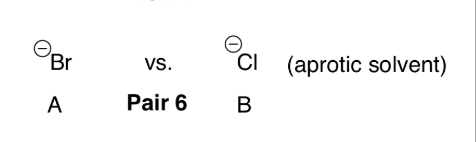
Compound [A,B,Both Equal] has a faster SN2 reaction due to ["a better leaving group", "a worse leaving group", "more branches at the reacting carbon", "fewer branches at the reacting carbon", "more steric hindrance near the leaving group", "less steric hindrance near the leaving group", "some other reason"]
![Comparing Pair 6: Compound [Select] is a better nucleophile due to [ Select]](http://img.homeworklib.com/questions/896c9060-6f99-11ea-a340-410db6a02fa9.png?x-oss-process=image/resize,w_560)
Homework Answers
the halogen reactivity towards the SN2 reaction is as follows
I > Br > Cl > F
here due to size of iodine which is larger and forms readily the positive charge on carbon and here the more will be size and acts as good leaving group
here in aprotic solvents the Br is good leaving group and because of the atomic size
here Compound A is good leaving group or better leaving group more steric hindrance due to the bigger size
Add Answer to:
Need help answering this question
Compound [A,B,Both Equal] has a faster SN2 reaction due to ["a...
For each of the given pairs indicate which substance (A or B) will react faster in...
 For each of the given pairs indicate which substance (A or B)
will react faster in an SN2 reaction by selecting the correct
compound from the dropdown menu. Then select the chemical principle
why that substance has a faster SN2 reaction.
Comparing Pair 1: Compound [ Select ] ["A",
"B", "both equal"] has a faster SN2 reaction due to [ Select
] ["a better leaving group", "a worse leaving group",
"more branches at the reacting carbon", "fewer branches at the
reacting...
For each of the given pairs indicate which substance (A or B)
will react faster in an SN2 reaction by selecting the correct
compound from the dropdown menu. Then select the chemical principle
why that substance has a faster SN2 reaction.
Comparing Pair 1: Compound [ Select ] ["A",
"B", "both equal"] has a faster SN2 reaction due to [ Select
] ["a better leaving group", "a worse leaving group",
"more branches at the reacting carbon", "fewer branches at the
reacting...
For each of the given pairs indicate which substance (A or B) will react faster in...
 For each of the given pairs indicate which substance (A or B)
will react faster in an SN2 reaction by selecting the correct
compound from the dropdown menu. Then select the chemical principle
why that substance has a faster SN2 reaction.
Comparing Pair 1: Compound [A,B,Both Equal] has
a faster SN2 reaction due to ["a better leaving group", "a worse
leaving group", "more branches at the reacting carbon", "fewer
branches at the reacting carbon", "more steric hindrance near the
leaving...
For each of the given pairs indicate which substance (A or B)
will react faster in an SN2 reaction by selecting the correct
compound from the dropdown menu. Then select the chemical principle
why that substance has a faster SN2 reaction.
Comparing Pair 1: Compound [A,B,Both Equal] has
a faster SN2 reaction due to ["a better leaving group", "a worse
leaving group", "more branches at the reacting carbon", "fewer
branches at the reacting carbon", "more steric hindrance near the
leaving...
plus state the reason why the following nucleophile is better nucleophile from the reasons given in...
 plus state the reason why the following nucleophile is
better nucleophile from the reasons given in pic.
Question 2 16 pts H2S vs. H2O A Pair 1 B VS. в OH Pair 2 VS. CI (protic solvent) OH A vs. H2O Pair 3 B Pair 4 " CH,CH NH2 vs. CH.CH OH Pair 5 B (aprotic solvent) A Pair 6 B NH2 o vs. Pair 7 F vs. M Pair 8 B A B For each of the given pairs...
plus state the reason why the following nucleophile is
better nucleophile from the reasons given in pic.
Question 2 16 pts H2S vs. H2O A Pair 1 B VS. в OH Pair 2 VS. CI (protic solvent) OH A vs. H2O Pair 3 B Pair 4 " CH,CH NH2 vs. CH.CH OH Pair 5 B (aprotic solvent) A Pair 6 B NH2 o vs. Pair 7 F vs. M Pair 8 B A B For each of the given pairs...
indicate which reaction will occur faster. explain your reasoning. reaction of 1 chlorobutane with sodium iodide...
 indicate which reaction will occur faster. explain
your reasoning. reaction of 1 chlorobutane with sodium iodide or
sodium p toluenesulfonate in aqueous ethanol.
Indicate which reaction will occur faster. Explain your reasoning. Select the single best answer Reaction of 1-chlorobutane with sodium iodide or sodium p-toluenesulfonate in aqueous ethanol Sodium iodide will react faster because the leaving group encounters less sterle hindrance. Sodium iodide will react faster because the intermediate is more stabilized in the solvent. Sodium p-toluenesulfonate will react...
indicate which reaction will occur faster. explain
your reasoning. reaction of 1 chlorobutane with sodium iodide or
sodium p toluenesulfonate in aqueous ethanol.
Indicate which reaction will occur faster. Explain your reasoning. Select the single best answer Reaction of 1-chlorobutane with sodium iodide or sodium p-toluenesulfonate in aqueous ethanol Sodium iodide will react faster because the leaving group encounters less sterle hindrance. Sodium iodide will react faster because the intermediate is more stabilized in the solvent. Sodium p-toluenesulfonate will react...
please help!!! are my answers right??? True Larger atoms are better nucleophiles due to polarizability. False...
 please help!!! are my answers right???
True Larger atoms are better nucleophiles due to polarizability. False The identity of the nucleophile affects the rate of an SN1 reaction. False SN2 reactions proceed via frontside attack. True Bimolecular reactions tend to be stereoselective. True SN2 reactions invert all stereocenters in a haloalkane. False Cl-, OH-, and H-are good all leaving groups. True Good bases tend to be good nucleophiles arch True Branching adjacent to a reacting carbon slows SN2 reactions due...
please help!!! are my answers right???
True Larger atoms are better nucleophiles due to polarizability. False The identity of the nucleophile affects the rate of an SN1 reaction. False SN2 reactions proceed via frontside attack. True Bimolecular reactions tend to be stereoselective. True SN2 reactions invert all stereocenters in a haloalkane. False Cl-, OH-, and H-are good all leaving groups. True Good bases tend to be good nucleophiles arch True Branching adjacent to a reacting carbon slows SN2 reactions due...
Determine if each of the following statements is true or false 1 Larger atoms are better...
Determine if each of the following statements is true or false 1 Larger atoms are better nucleophiles due to polarizability. 2 The identity of the nucleophile affects the rate of an SN1 reaction. 3 SN2 reactions proceed via frontside attack. 4 Bimolecular reactions tend to be stereoselective. 5 SN2 reactions invert all stereocenters in a haloalkane. 6 Cl-, OH-, and...
I Select ] I Select ] True False I Select J ▼ The identity of the...
 I Select ] I Select ] True False I Select J ▼ The identity of the nucleophile affects the rate of an SN1 reaction SN2 reactions proceed via frontside attack ▼ Bimolecular reactions tend to be stereoselective. Select ] SN2 reactions invert all stereocenters in a haloalkane Select] Cl-, OH-, and H- are good all leaving groups [ Select ] Good bases tend to be good nucleophiles Select ▼ Branching adjacent to a reacting carbon slows SN2 reactions due to...
1. In both the sodium iodide test and the silver nitrate test, why does 2-bromobutane react faster...
 1. In both the sodium iodide
test and the silver nitrate test, why does 2-bromobutane react
faster than 2-chlorobutane?
Bromine is a better leaving group since it is a weaker base than
chlorine is.
2. a. Why does benzyl chloride react under both
SN1 and SN2 conditions?
Benzyl
chloride is a primary alkyl halide, hence reactive under SN2
conditions.
The
primary carbocation formed due to the departure of Cl- is
stabilized by the pi electrons in the benzene ring.
b. Why is...
1. In both the sodium iodide
test and the silver nitrate test, why does 2-bromobutane react
faster than 2-chlorobutane?
Bromine is a better leaving group since it is a weaker base than
chlorine is.
2. a. Why does benzyl chloride react under both
SN1 and SN2 conditions?
Benzyl
chloride is a primary alkyl halide, hence reactive under SN2
conditions.
The
primary carbocation formed due to the departure of Cl- is
stabilized by the pi electrons in the benzene ring.
b. Why is...
need help with the boxed bullet point. writing the chemical reaction scheme for the experiment. Synthesis of an A...
 need help with the boxed bullet point. writing the chemical
reaction scheme for the experiment.
Synthesis of an Alkyl Halide: A Nucleophilic Substitution Reaction, Part I Pre-lab Assignment for Synthesis of an Alkyl Halide: A Nucleophilic Substitution Reaction, Part 1 1. From The Organic Chem Lab Survival Manual ( edition) by Zubrick • Review pages 201-204: Standard Reflux. • Review pages 127-140: Extraction • Review pages 164-189: Distillation, Simple Distillation. The Distillation Example, and The Distillation Mistake. 2. Read this...
need help with the boxed bullet point. writing the chemical
reaction scheme for the experiment.
Synthesis of an Alkyl Halide: A Nucleophilic Substitution Reaction, Part I Pre-lab Assignment for Synthesis of an Alkyl Halide: A Nucleophilic Substitution Reaction, Part 1 1. From The Organic Chem Lab Survival Manual ( edition) by Zubrick • Review pages 201-204: Standard Reflux. • Review pages 127-140: Extraction • Review pages 164-189: Distillation, Simple Distillation. The Distillation Example, and The Distillation Mistake. 2. Read this...
Consider the SN2 reaction of butyl bromide with hydroxide ion , Assuming no other changes, what...
Consider the SN2 reaction of butyl bromide with hydroxide ion , Assuming no other changes, what effect on the reaction rate would result from simultaneously doubling the concentrations of both butyl bromide and hydroxyl ion No effect (B)It would double the rate (C)it would increase the rate six times (D) It would increase the rate four times. 2. Which alky halide would you expect to undergo SN1 hydrolysis most rapidly? (A) (CH3)3C-I (B) (CH3)3C-Br (C) (CH3)3C-Cl (D) (CH3)3C-F 3....
 For each of the given pairs indicate which substance (A or B)
will react faster in an SN2 reaction by selecting the correct
compound from the dropdown menu. Then select the chemical principle
why that substance has a faster SN2 reaction.
Comparing Pair 1: Compound [ Select ] ["A",
"B", "both equal"] has a faster SN2 reaction due to [ Select
] ["a better leaving group", "a worse leaving group",
"more branches at the reacting carbon", "fewer branches at the
reacting...
For each of the given pairs indicate which substance (A or B)
will react faster in an SN2 reaction by selecting the correct
compound from the dropdown menu. Then select the chemical principle
why that substance has a faster SN2 reaction.
Comparing Pair 1: Compound [ Select ] ["A",
"B", "both equal"] has a faster SN2 reaction due to [ Select
] ["a better leaving group", "a worse leaving group",
"more branches at the reacting carbon", "fewer branches at the
reacting...
 For each of the given pairs indicate which substance (A or B)
will react faster in an SN2 reaction by selecting the correct
compound from the dropdown menu. Then select the chemical principle
why that substance has a faster SN2 reaction.
Comparing Pair 1: Compound [A,B,Both Equal] has
a faster SN2 reaction due to ["a better leaving group", "a worse
leaving group", "more branches at the reacting carbon", "fewer
branches at the reacting carbon", "more steric hindrance near the
leaving...
For each of the given pairs indicate which substance (A or B)
will react faster in an SN2 reaction by selecting the correct
compound from the dropdown menu. Then select the chemical principle
why that substance has a faster SN2 reaction.
Comparing Pair 1: Compound [A,B,Both Equal] has
a faster SN2 reaction due to ["a better leaving group", "a worse
leaving group", "more branches at the reacting carbon", "fewer
branches at the reacting carbon", "more steric hindrance near the
leaving...
 plus state the reason why the following nucleophile is
better nucleophile from the reasons given in pic.
Question 2 16 pts H2S vs. H2O A Pair 1 B VS. в OH Pair 2 VS. CI (protic solvent) OH A vs. H2O Pair 3 B Pair 4 " CH,CH NH2 vs. CH.CH OH Pair 5 B (aprotic solvent) A Pair 6 B NH2 o vs. Pair 7 F vs. M Pair 8 B A B For each of the given pairs...
plus state the reason why the following nucleophile is
better nucleophile from the reasons given in pic.
Question 2 16 pts H2S vs. H2O A Pair 1 B VS. в OH Pair 2 VS. CI (protic solvent) OH A vs. H2O Pair 3 B Pair 4 " CH,CH NH2 vs. CH.CH OH Pair 5 B (aprotic solvent) A Pair 6 B NH2 o vs. Pair 7 F vs. M Pair 8 B A B For each of the given pairs...
 indicate which reaction will occur faster. explain
your reasoning. reaction of 1 chlorobutane with sodium iodide or
sodium p toluenesulfonate in aqueous ethanol.
Indicate which reaction will occur faster. Explain your reasoning. Select the single best answer Reaction of 1-chlorobutane with sodium iodide or sodium p-toluenesulfonate in aqueous ethanol Sodium iodide will react faster because the leaving group encounters less sterle hindrance. Sodium iodide will react faster because the intermediate is more stabilized in the solvent. Sodium p-toluenesulfonate will react...
indicate which reaction will occur faster. explain
your reasoning. reaction of 1 chlorobutane with sodium iodide or
sodium p toluenesulfonate in aqueous ethanol.
Indicate which reaction will occur faster. Explain your reasoning. Select the single best answer Reaction of 1-chlorobutane with sodium iodide or sodium p-toluenesulfonate in aqueous ethanol Sodium iodide will react faster because the leaving group encounters less sterle hindrance. Sodium iodide will react faster because the intermediate is more stabilized in the solvent. Sodium p-toluenesulfonate will react...
 please help!!! are my answers right???
True Larger atoms are better nucleophiles due to polarizability. False The identity of the nucleophile affects the rate of an SN1 reaction. False SN2 reactions proceed via frontside attack. True Bimolecular reactions tend to be stereoselective. True SN2 reactions invert all stereocenters in a haloalkane. False Cl-, OH-, and H-are good all leaving groups. True Good bases tend to be good nucleophiles arch True Branching adjacent to a reacting carbon slows SN2 reactions due...
please help!!! are my answers right???
True Larger atoms are better nucleophiles due to polarizability. False The identity of the nucleophile affects the rate of an SN1 reaction. False SN2 reactions proceed via frontside attack. True Bimolecular reactions tend to be stereoselective. True SN2 reactions invert all stereocenters in a haloalkane. False Cl-, OH-, and H-are good all leaving groups. True Good bases tend to be good nucleophiles arch True Branching adjacent to a reacting carbon slows SN2 reactions due...
 I Select ] I Select ] True False I Select J ▼ The identity of the nucleophile affects the rate of an SN1 reaction SN2 reactions proceed via frontside attack ▼ Bimolecular reactions tend to be stereoselective. Select ] SN2 reactions invert all stereocenters in a haloalkane Select] Cl-, OH-, and H- are good all leaving groups [ Select ] Good bases tend to be good nucleophiles Select ▼ Branching adjacent to a reacting carbon slows SN2 reactions due to...
 1. In both the sodium iodide
test and the silver nitrate test, why does 2-bromobutane react
faster than 2-chlorobutane?
Bromine is a better leaving group since it is a weaker base than
chlorine is.
2. a. Why does benzyl chloride react under both
SN1 and SN2 conditions?
Benzyl
chloride is a primary alkyl halide, hence reactive under SN2
conditions.
The
primary carbocation formed due to the departure of Cl- is
stabilized by the pi electrons in the benzene ring.
b. Why is...
1. In both the sodium iodide
test and the silver nitrate test, why does 2-bromobutane react
faster than 2-chlorobutane?
Bromine is a better leaving group since it is a weaker base than
chlorine is.
2. a. Why does benzyl chloride react under both
SN1 and SN2 conditions?
Benzyl
chloride is a primary alkyl halide, hence reactive under SN2
conditions.
The
primary carbocation formed due to the departure of Cl- is
stabilized by the pi electrons in the benzene ring.
b. Why is...
 need help with the boxed bullet point. writing the chemical
reaction scheme for the experiment.
Synthesis of an Alkyl Halide: A Nucleophilic Substitution Reaction, Part I Pre-lab Assignment for Synthesis of an Alkyl Halide: A Nucleophilic Substitution Reaction, Part 1 1. From The Organic Chem Lab Survival Manual ( edition) by Zubrick • Review pages 201-204: Standard Reflux. • Review pages 127-140: Extraction • Review pages 164-189: Distillation, Simple Distillation. The Distillation Example, and The Distillation Mistake. 2. Read this...
need help with the boxed bullet point. writing the chemical
reaction scheme for the experiment.
Synthesis of an Alkyl Halide: A Nucleophilic Substitution Reaction, Part I Pre-lab Assignment for Synthesis of an Alkyl Halide: A Nucleophilic Substitution Reaction, Part 1 1. From The Organic Chem Lab Survival Manual ( edition) by Zubrick • Review pages 201-204: Standard Reflux. • Review pages 127-140: Extraction • Review pages 164-189: Distillation, Simple Distillation. The Distillation Example, and The Distillation Mistake. 2. Read this...
Most questions answered within 3 hours.
-
Where is the error in this code sequence?
String s1 = "Hello";
String s2 = "ello";...
asked 10 months ago -
Financial data for Joel de Paris, Inc., for last year
follow:
Joel de Paris, Inc.
Balance...
asked 10 months ago -
Consider this reaction:
Al2(SO4)3 (aq)+ BaCl3
(aq) Al2Cl6 (aq)- +
3BaSO4(s) . What is the...
asked 10 months ago -
Suppose that Savneet is considering increasing her
recent random sample from 20 car rentals to 40...
asked 10 months ago -
Trucks arrive at an unloading terminal at an average rate of 120
per hour.
Trucks arrive...
asked 10 months ago -
Why are methanol and ethanol completely soluble in water while
octanol is not very little soluble....
asked 10 months ago -
A facilities manager at a university reads in a research report
that the mean amount of...
asked 10 months ago -
When the CuSO4 is rehydrated by adding water to the anhydrous
compound, is this an endothermic...
asked 10 months ago -
A ray of sunlight is passing from diamond into crown glass; the
angle of incidence is...
asked 10 months ago -
A block of mass 0.249 kg is placed on top of a light, vertical
spring of...
asked 10 months ago -
how do the kidneys compensate in the presences of acidosis
a) trigger hyperventilate
b) reserve acid...
asked 10 months ago -
Question 501 pts
The rental rate of capital to the firm increases. Which of the
following...
asked 10 months ago