
Homework Answers
Add Answer to:
My lextbook Solutions Problem 4 moldon What size camera aperture do you need to resolve two...
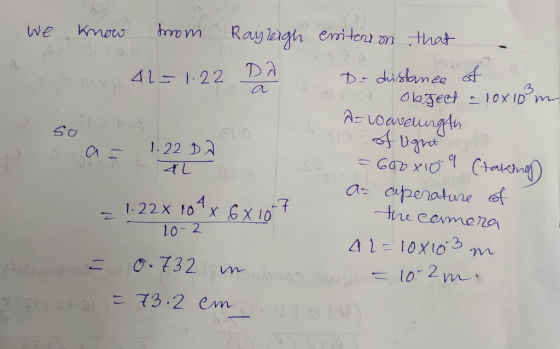
What size camera aperture do you need to resolve two objects separated by 10 millimeters if...
What size camera aperture do you need to resolve two objects separated by 10 millimeters if the objects are 10 kilometer away from the camera?
Problem 28.57 8 of 8 PartA Find the minimum aperture diameter of a camera that can...
 Problem 28.57 8 of 8 PartA Find the minimum aperture diameter of a camera that can resolve detail on the ground the size of a person (1.7 m) from an SR-71 Blackbird airplane flying at an altitude of 22 km. (Assume light with a wavelength of 500 nm.) Express your answer using two significant figures. D- Submit Request Answer < Return to Assignment Provide Feedback
If a camera with a 60 mm lens is to resolve two objects that are 3.0...
If a camera with a 60 mm lens is to resolve two objects that are 3.0 mm from each other and both objects are 4.0 m from the camera lens, what is the minimum diameter of the camera lens? Assume the wavelength of the light is 550 nm Express your answer using two significant figures What is the revolving power? Express your answer using two significant figures.
1. What is the minimum telescope aperture needed to resolve an object whose angular diameter is...
1. What is the minimum telescope aperture needed to resolve an object whose angular diameter is 0.38 arc seconds, observed at 540 nm wavelength? Note: 1arcsec=(1/3600)∘. **express in cm 2. Find the minimum angular separation resolvable with 625 nm laser light passing through a circular aperture of diameter 2.1 cm . 3. The interference pattern from two slits separated by 0.35 mm has bright fringes with angular spacing 0.073 ∘. **express in nm**
Problem 2 a. Using the telescope on-board his spaceship, Captain Kirk barely manages to resolve two...
 Problem 2 a. Using the telescope on-board his spaceship, Captain Kirk barely manages to resolve two distant galaxies that are 0.3 arc-seconds apart (1 arc-second 1/3600 Degree). If he is imaging at 550 nm wavelength, what is the effective aperture (diameter) of the objective lens of the telescope? Assume that there are no geometrical aberrations. (5 points) b. Consider the following imaging setup with a transverse magnification Iml3, If we are to resolve the image of the two fixed point...
What is the linear size of the smallest feature on the moon you could resolve with...
What is the linear size of the smallest feature on the moon you could resolve with a Galilean telescope that has an objective lens with a diameter of 58.0 mm? Assume that the resolution would be diffraction limited and that the moon is 380,000 km away. Take the wavelength of light as 550 nm, which is near the peak of our sensitivity. Please include units of answer.
(10%) Problem 8: Consider a camera with a lens with focal length f and is being...
 (10%) Problem 8: Consider a camera with a lens with focal length f and is being used to photograph a flower a distance do away × How far away from the lens must the film】 in the camera be in order for the image to be displayed on it? Give your answer as an equation using the variables given in the problem statement. Grade Summary Deductions Potential di = f(do )/do (-7) 20% 80% 78 9 HOME Submissions Attempts remaining:...
(10%) Problem 8: Consider a camera with a lens with focal length f and is being...
 (10%) Problem 8: Consider a camera with a lens with focal length f and is being used to photograph a flower a distance do away How far away from the lens must the film in the camera be in order for the image to be displayed on it? Give your answer as an equation using the variables given in the problem statement. Grade Summary Deductions Potential 100% 0% 78 9 4 5 6 Submissions Attempts remaining: 3 % per attempt)...
I need (c) and (d) answered 3 Satellite There are claims that a spy satellite can read license plate numbers from space or read a newspaper over your shoulder. In this problem, we will assess these c...
 I need (c) and (d) answered
3 Satellite There are claims that a spy satellite can read license plate numbers from space or read a newspaper over your shoulder. In this problem, we will assess these claims using wave optics. (a) Reading a licence plate number requires a linear resolution of about 5 cm. (You must be able to distinguish objects that are 2 inches apart.) For a satellite at a height of 150 km, what angular resolution does this...
I need (c) and (d) answered
3 Satellite There are claims that a spy satellite can read license plate numbers from space or read a newspaper over your shoulder. In this problem, we will assess these claims using wave optics. (a) Reading a licence plate number requires a linear resolution of about 5 cm. (You must be able to distinguish objects that are 2 inches apart.) For a satellite at a height of 150 km, what angular resolution does this...
4. My camera has a sensor that is 23 x 15 mm. Like every tourist, I...
 4. My camera has a sensor that is 23 x 15 mm. Like every tourist, I would like to take a picture of the Washington Square Arch, which is 23 meters tall. If I want to take a picture lengthwise, this means the image of the Arch must be 23 mm tall (1/1000 of the size of the object). a) For the following focal length lenses, f = 20,40,80, how far should the lens be from the Arch, and how...
 Problem 28.57 8 of 8 PartA Find the minimum aperture diameter of a camera that can resolve detail on the ground the size of a person (1.7 m) from an SR-71 Blackbird airplane flying at an altitude of 22 km. (Assume light with a wavelength of 500 nm.) Express your answer using two significant figures. D- Submit Request Answer < Return to Assignment Provide Feedback
 Problem 2 a. Using the telescope on-board his spaceship, Captain Kirk barely manages to resolve two distant galaxies that are 0.3 arc-seconds apart (1 arc-second 1/3600 Degree). If he is imaging at 550 nm wavelength, what is the effective aperture (diameter) of the objective lens of the telescope? Assume that there are no geometrical aberrations. (5 points) b. Consider the following imaging setup with a transverse magnification Iml3, If we are to resolve the image of the two fixed point...
 (10%) Problem 8: Consider a camera with a lens with focal length f and is being used to photograph a flower a distance do away × How far away from the lens must the film】 in the camera be in order for the image to be displayed on it? Give your answer as an equation using the variables given in the problem statement. Grade Summary Deductions Potential di = f(do )/do (-7) 20% 80% 78 9 HOME Submissions Attempts remaining:...
 (10%) Problem 8: Consider a camera with a lens with focal length f and is being used to photograph a flower a distance do away How far away from the lens must the film in the camera be in order for the image to be displayed on it? Give your answer as an equation using the variables given in the problem statement. Grade Summary Deductions Potential 100% 0% 78 9 4 5 6 Submissions Attempts remaining: 3 % per attempt)...
 I need (c) and (d) answered
3 Satellite There are claims that a spy satellite can read license plate numbers from space or read a newspaper over your shoulder. In this problem, we will assess these claims using wave optics. (a) Reading a licence plate number requires a linear resolution of about 5 cm. (You must be able to distinguish objects that are 2 inches apart.) For a satellite at a height of 150 km, what angular resolution does this...
I need (c) and (d) answered
3 Satellite There are claims that a spy satellite can read license plate numbers from space or read a newspaper over your shoulder. In this problem, we will assess these claims using wave optics. (a) Reading a licence plate number requires a linear resolution of about 5 cm. (You must be able to distinguish objects that are 2 inches apart.) For a satellite at a height of 150 km, what angular resolution does this...
 4. My camera has a sensor that is 23 x 15 mm. Like every tourist, I would like to take a picture of the Washington Square Arch, which is 23 meters tall. If I want to take a picture lengthwise, this means the image of the Arch must be 23 mm tall (1/1000 of the size of the object). a) For the following focal length lenses, f = 20,40,80, how far should the lens be from the Arch, and how...
Most questions answered within 3 hours.
-
Where is the error in this code sequence?
String s1 = "Hello";
String s2 = "ello";...
asked 10 months ago -
Financial data for Joel de Paris, Inc., for last year
follow:
Joel de Paris, Inc.
Balance...
asked 10 months ago -
Consider this reaction:
Al2(SO4)3 (aq)+ BaCl3
(aq) Al2Cl6 (aq)- +
3BaSO4(s) . What is the...
asked 10 months ago -
Suppose that Savneet is considering increasing her
recent random sample from 20 car rentals to 40...
asked 10 months ago -
Trucks arrive at an unloading terminal at an average rate of 120
per hour.
Trucks arrive...
asked 10 months ago -
Why are methanol and ethanol completely soluble in water while
octanol is not very little soluble....
asked 10 months ago -
A facilities manager at a university reads in a research report
that the mean amount of...
asked 10 months ago -
When the CuSO4 is rehydrated by adding water to the anhydrous
compound, is this an endothermic...
asked 10 months ago -
A ray of sunlight is passing from diamond into crown glass; the
angle of incidence is...
asked 10 months ago -
A block of mass 0.249 kg is placed on top of a light, vertical
spring of...
asked 10 months ago -
how do the kidneys compensate in the presences of acidosis
a) trigger hyperventilate
b) reserve acid...
asked 10 months ago -
Question 501 pts
The rental rate of capital to the firm increases. Which of the
following...
asked 10 months ago