
Homework Answers
We know that Kinetic energy = 0.5mv^2
= 0.5*65*(1500/(4*60))^2
= 1270 J answer
Add Answer to:
KE-3 Find the kinetic energy of a 65.0kg runner who can travel 1,500m in 4 minutes.
Kinetic Energy- KE-1 a) A 1,500kg car is traveling at 30.0m/s. How many joules of kinetic...
 Kinetic Energy- KE-1 a) A 1,500kg car is traveling at 30.0m/s. How many joules of kinetic enorekye energy as the KE-2 a) Two objects with masses m -20.0 have? does the car b) Find the speed in km/hr for a 7.00kg bowling ball to have the same etic energy Find the ratio E/Ex g and my-60.0kg are both traveling with the same speed V. b) Two objects with identical masses m are traveling with speeds V1 20.0m's c) In part...
A runner has a certain amount of kinetic energy. The runner now triples her speed. How...
A runner has a certain amount of kinetic energy. The runner now triples her speed. How much kinetic energy does the runner have now?
We learned in class that the kinetic energy (KE) of an object with mass m moving...
We learned in class that the kinetic energy (KE) of an object with mass m moving at velocity v is KE =½ m v^2. Accordingly, the kinetic energy (KE) per unit mass (m) of a body moving at velocity v is KE/m=v^2 /2. What is the asteroid’s kinetic energy per unit mass (J/kg) for an impact at this velocity? State your answer in units of J/kg. velocity is 29.8 km/s
Read the description of the motion and decide if the kinetic energy (KE) and the gravitational...
 Read the description of the motion and decide if the kinetic energy (KE) and the gravitational potential energy (PE) is increasing, decreasing, or remaining constant A box of shingles is dropped from the roof and falls to the ground below. kinetic energy Increases kinetic energy decreases c. kinetic energy remains constant d. gravitational potential energy Increases e gravitational potential energy decreases f gravitational potential energy remains constant
Given the formula of the kinetic energy of a particle m with speed v: KE =...
 Given the formula of the kinetic energy of a particle m
with
speed v:
KE = 1⁄2mv2 ,
and the formula of the gravitational potential energy:
PE = -GMEm/R,
where G is gravitational constant and ME and R=6378 km are the
mass and the radius of Earth. Now the particle is shot from Earth
surface to space. Find the minimum required initial speed for this
particle to completely escape the influence of Earth gravity (i.e.
PE=0). Notice that the gravitational...
Given the formula of the kinetic energy of a particle m
with
speed v:
KE = 1⁄2mv2 ,
and the formula of the gravitational potential energy:
PE = -GMEm/R,
where G is gravitational constant and ME and R=6378 km are the
mass and the radius of Earth. Now the particle is shot from Earth
surface to space. Find the minimum required initial speed for this
particle to completely escape the influence of Earth gravity (i.e.
PE=0). Notice that the gravitational...
Label the diagram with the correct values for kinetic energy (KE) and potential energy (PE) along...
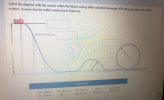 Label the diagram with the correct values for kinetic energy (KE) and potential energy (PE) along the path of the roller coaster. Assume that the roller coaster starts from rest. Answer Bank KE: 6500.0J KEO PE: 6500.0J K E: 4875.0J PE 1625.01 KE: 1625.0J PE: 4875.0J KE: 3250.0J PE: 3250,00 PE0J
The average kinetic energy of an atom in a monatomic ideal gas is given by KE=(3/2)kT,where...
The average kinetic energy of an atom in a monatomic ideal gas is given by KE=(3/2)kT,where k = 1.38
Determine the equation of the momentum of a particle of mass m and kinetic energy KE....
Determine the equation of the momentum of a particle of mass m and kinetic energy KE. Express your answer in terms of the variables KE, m and c. (KE/c) +mc is incorrect p=
Determine the equation of the momentum of a particle of mass m and kinetic energy KE....
Determine the equation of the momentum of a particle of mass m and kinetic energy KE. Express your answer in terms of the variables KE, m and c.
45. What is the matemathical relationship between potential energy (PE) and kinetic energy (KE)? a. They...
 45. What is the matemathical relationship between potential energy (PE) and kinetic energy (KE)? a. They are directly proportional b. They are inversely proportional c. Their sum is equal to the total internal energy of the system (E) d. Both B and C are correct e. None of the above 46. What is a consequence of the 1 Law of Thermodynamics? a. The energy of a system can never change b. The energy of the surroundings can never change c....
 Kinetic Energy- KE-1 a) A 1,500kg car is traveling at 30.0m/s. How many joules of kinetic enorekye energy as the KE-2 a) Two objects with masses m -20.0 have? does the car b) Find the speed in km/hr for a 7.00kg bowling ball to have the same etic energy Find the ratio E/Ex g and my-60.0kg are both traveling with the same speed V. b) Two objects with identical masses m are traveling with speeds V1 20.0m's c) In part...
 Read the description of the motion and decide if the kinetic energy (KE) and the gravitational potential energy (PE) is increasing, decreasing, or remaining constant A box of shingles is dropped from the roof and falls to the ground below. kinetic energy Increases kinetic energy decreases c. kinetic energy remains constant d. gravitational potential energy Increases e gravitational potential energy decreases f gravitational potential energy remains constant
 Given the formula of the kinetic energy of a particle m
with
speed v:
KE = 1⁄2mv2 ,
and the formula of the gravitational potential energy:
PE = -GMEm/R,
where G is gravitational constant and ME and R=6378 km are the
mass and the radius of Earth. Now the particle is shot from Earth
surface to space. Find the minimum required initial speed for this
particle to completely escape the influence of Earth gravity (i.e.
PE=0). Notice that the gravitational...
Given the formula of the kinetic energy of a particle m
with
speed v:
KE = 1⁄2mv2 ,
and the formula of the gravitational potential energy:
PE = -GMEm/R,
where G is gravitational constant and ME and R=6378 km are the
mass and the radius of Earth. Now the particle is shot from Earth
surface to space. Find the minimum required initial speed for this
particle to completely escape the influence of Earth gravity (i.e.
PE=0). Notice that the gravitational...
 Label the diagram with the correct values for kinetic energy (KE) and potential energy (PE) along the path of the roller coaster. Assume that the roller coaster starts from rest. Answer Bank KE: 6500.0J KEO PE: 6500.0J K E: 4875.0J PE 1625.01 KE: 1625.0J PE: 4875.0J KE: 3250.0J PE: 3250,00 PE0J
 45. What is the matemathical relationship between potential energy (PE) and kinetic energy (KE)? a. They are directly proportional b. They are inversely proportional c. Their sum is equal to the total internal energy of the system (E) d. Both B and C are correct e. None of the above 46. What is a consequence of the 1 Law of Thermodynamics? a. The energy of a system can never change b. The energy of the surroundings can never change c....
Most questions answered within 3 hours.
-
Where is the error in this code sequence?
String s1 = "Hello";
String s2 = "ello";...
asked 11 months ago -
Financial data for Joel de Paris, Inc., for last year
follow:
Joel de Paris, Inc.
Balance...
asked 11 months ago -
Consider this reaction:
Al2(SO4)3 (aq)+ BaCl3
(aq) Al2Cl6 (aq)- +
3BaSO4(s) . What is the...
asked 11 months ago -
Suppose that Savneet is considering increasing her
recent random sample from 20 car rentals to 40...
asked 11 months ago -
Trucks arrive at an unloading terminal at an average rate of 120
per hour.
Trucks arrive...
asked 11 months ago -
Why are methanol and ethanol completely soluble in water while
octanol is not very little soluble....
asked 11 months ago -
A facilities manager at a university reads in a research report
that the mean amount of...
asked 11 months ago -
When the CuSO4 is rehydrated by adding water to the anhydrous
compound, is this an endothermic...
asked 11 months ago -
A ray of sunlight is passing from diamond into crown glass; the
angle of incidence is...
asked 11 months ago -
A block of mass 0.249 kg is placed on top of a light, vertical
spring of...
asked 11 months ago -
how do the kidneys compensate in the presences of acidosis
a) trigger hyperventilate
b) reserve acid...
asked 11 months ago -
Question 501 pts
The rental rate of capital to the firm increases. Which of the
following...
asked 11 months ago