
Homework Answers


Add Answer to:
Problem 2. Consider the function plotted below. A) What is the amplitude of this function? B)...
Problem 2. Consider the function plotted below A) What is the amplitude of this function? B)...
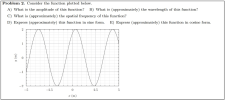 Problem 2. Consider the function plotted below A) What is the amplitude of this function? B) What is (approximately) the wavelength of this function? C) What is (approximately) the spatial frequency of this function? D) Express (approximately) this function in sine form. E) Express (approximately) this function in cosine form -1 -2 -5 -2.5 0 2.5 r (m)
Problem 4 -π/3) in quadrature form. 2π A) Express the function Y1 = (2 m) sin(...
 Problem 4 -π/3) in quadrature form. 2π A) Express the function Y1 = (2 m) sin( 5-x B) Express the function y3=(4m)cos(10-)-(2m) sin( nx) incosine form. 10 in sine form. C) Express the function y3= (4 m) cos(nz)-(2 m) sin(nz) in sine form. C) Express the function y3= (4 m) cos(-x )-(2 m) sin(-x
(1.2) [0.4] Express the function sin(wt + π/6) as a phase-shifted cosine. (1.3) [O.11] An SHO...
 (1.2) [0.4] Express the function sin(wt + π/6) as a phase-shifted cosine. (1.3) [O.11] An SHO trajectory is given by )sin (), where t is in seconds and r is in metres. Determine the (a) equilibrium position, (b) amplitude, (c) angular frequency, (d) cycle frequency, and (e) period. (1.4) [O.14] The trajectory of an oscillating object was carefully measured and is presented on the adjacent graph. The times are in seconds, while the displacement is measured in millimetres From the...
Given The partial graph of the cosine function below has a minimum post -2 nd a...
 Given The partial graph of the cosine function below has a minimum post -2 nd a maximum point at C ) as shown below. The equation of the function can be expressed in the form acos -c))+d. ...c.d w . a) Draw the midline on the graph. b) What is the amplitude of the graph? c) What is the period of the graph? d) What is the value of b in the above equation? e) What is the phase shift...
5. For the previous problem write an equation of its oscillatory motion using a sine or...
 5. For the previous problem write an equation of its oscillatory motion using a sine or cosine function and assuming that the object starts as indicated above. Find the position and velocity of the object at time = 0.26 sec. (You have to determine to use a cosine of sine function and the initial angle based on the initial conditions given in the previous problem). 4. A mass of 1.80 kg is attached to a horizontal spring with a spring...
= Problem #2: The function f(x) sin(4x) on [0:1] is expanded in a Fourier series of...
 = Problem #2: The function f(x) sin(4x) on [0:1] is expanded in a Fourier series of period Which of the following statement is true about the Fourier series of f? (A) The Fourier series of f has only cosine terms. (B) The Fourier series of f has neither sine nor cosine terms. (C) The Fourier series of f has both sine and cosine terms. (D) The Fourier series of f has only sine terms.
(2) Consider the function f(x)- 1 (a) Find the Fourier sine series of f (b) Find...
 (2) Consider the function f(x)- 1 (a) Find the Fourier sine series of f (b) Find the Fourier cosine series of f. (c) Find the odd extension fodd of f. (d) Find the even extension feven of f. (e) Find the Fourier series of fod and compare it with your result -x on 0<a < 1. in (a) (f) Find the Fourier series of feven and compare it with your result in (b)
Problem 5. (20 pts) In this problem, I wil lead you through a procedure that allows...
 Problem 5. (20 pts) In this problem, I wil lead you through a procedure that allows you to write the function f(z) = (2 m) cos(kx-π / 5) + (3 m) sin(kx + π / 4) in cosine form. This method can be extended to write the sum of any frequency as a single cosine function inusoidal f unctions of the same spatia A) Write (2 m) cos(ka-π/5) in quadrature form B) write (3 m) sin(kx+π/4) in quadrature form. C)...
(2 points) Consider the following initial value problem, in which an input of large amplitude and...
 (2 points) Consider the following initial value problem, in which an input of large amplitude and short duration has been idealized as a delta function. yy1+(t-4), y(0)0. a. Find the Laplace transform of the solution. Y(s) = L {y(t)) = b. Obtain the solution y(t) C. Express the solution as a piecewise-defined function and think about what happens to the graph of the solution at t = 4. if 0st<4, y(t) if 4t< o0.
 Problem 2. Consider the function plotted below A) What is the amplitude of this function? B) What is (approximately) the wavelength of this function? C) What is (approximately) the spatial frequency of this function? D) Express (approximately) this function in sine form. E) Express (approximately) this function in cosine form -1 -2 -5 -2.5 0 2.5 r (m)
 Problem 4 -π/3) in quadrature form. 2π A) Express the function Y1 = (2 m) sin( 5-x B) Express the function y3=(4m)cos(10-)-(2m) sin( nx) incosine form. 10 in sine form. C) Express the function y3= (4 m) cos(nz)-(2 m) sin(nz) in sine form. C) Express the function y3= (4 m) cos(-x )-(2 m) sin(-x
 (1.2) [0.4] Express the function sin(wt + π/6) as a phase-shifted cosine. (1.3) [O.11] An SHO trajectory is given by )sin (), where t is in seconds and r is in metres. Determine the (a) equilibrium position, (b) amplitude, (c) angular frequency, (d) cycle frequency, and (e) period. (1.4) [O.14] The trajectory of an oscillating object was carefully measured and is presented on the adjacent graph. The times are in seconds, while the displacement is measured in millimetres From the...
 Given The partial graph of the cosine function below has a minimum post -2 nd a maximum point at C ) as shown below. The equation of the function can be expressed in the form acos -c))+d. ...c.d w . a) Draw the midline on the graph. b) What is the amplitude of the graph? c) What is the period of the graph? d) What is the value of b in the above equation? e) What is the phase shift...
 5. For the previous problem write an equation of its oscillatory motion using a sine or cosine function and assuming that the object starts as indicated above. Find the position and velocity of the object at time = 0.26 sec. (You have to determine to use a cosine of sine function and the initial angle based on the initial conditions given in the previous problem). 4. A mass of 1.80 kg is attached to a horizontal spring with a spring...
 = Problem #2: The function f(x) sin(4x) on [0:1] is expanded in a Fourier series of period Which of the following statement is true about the Fourier series of f? (A) The Fourier series of f has only cosine terms. (B) The Fourier series of f has neither sine nor cosine terms. (C) The Fourier series of f has both sine and cosine terms. (D) The Fourier series of f has only sine terms.
 (2) Consider the function f(x)- 1 (a) Find the Fourier sine series of f (b) Find the Fourier cosine series of f. (c) Find the odd extension fodd of f. (d) Find the even extension feven of f. (e) Find the Fourier series of fod and compare it with your result -x on 0<a < 1. in (a) (f) Find the Fourier series of feven and compare it with your result in (b)
 Problem 5. (20 pts) In this problem, I wil lead you through a procedure that allows you to write the function f(z) = (2 m) cos(kx-π / 5) + (3 m) sin(kx + π / 4) in cosine form. This method can be extended to write the sum of any frequency as a single cosine function inusoidal f unctions of the same spatia A) Write (2 m) cos(ka-π/5) in quadrature form B) write (3 m) sin(kx+π/4) in quadrature form. C)...
 (2 points) Consider the following initial value problem, in which an input of large amplitude and short duration has been idealized as a delta function. yy1+(t-4), y(0)0. a. Find the Laplace transform of the solution. Y(s) = L {y(t)) = b. Obtain the solution y(t) C. Express the solution as a piecewise-defined function and think about what happens to the graph of the solution at t = 4. if 0st<4, y(t) if 4t< o0.
Most questions answered within 3 hours.
-
Where is the error in this code sequence?
String s1 = "Hello";
String s2 = "ello";...
asked 10 months ago -
Financial data for Joel de Paris, Inc., for last year
follow:
Joel de Paris, Inc.
Balance...
asked 10 months ago -
Consider this reaction:
Al2(SO4)3 (aq)+ BaCl3
(aq) Al2Cl6 (aq)- +
3BaSO4(s) . What is the...
asked 10 months ago -
Suppose that Savneet is considering increasing her
recent random sample from 20 car rentals to 40...
asked 10 months ago -
Trucks arrive at an unloading terminal at an average rate of 120
per hour.
Trucks arrive...
asked 10 months ago -
Why are methanol and ethanol completely soluble in water while
octanol is not very little soluble....
asked 10 months ago -
A facilities manager at a university reads in a research report
that the mean amount of...
asked 10 months ago -
When the CuSO4 is rehydrated by adding water to the anhydrous
compound, is this an endothermic...
asked 10 months ago -
A ray of sunlight is passing from diamond into crown glass; the
angle of incidence is...
asked 10 months ago -
A block of mass 0.249 kg is placed on top of a light, vertical
spring of...
asked 10 months ago -
how do the kidneys compensate in the presences of acidosis
a) trigger hyperventilate
b) reserve acid...
asked 10 months ago -
Question 501 pts
The rental rate of capital to the firm increases. Which of the
following...
asked 10 months ago