
Homework Answers
Add Answer to:
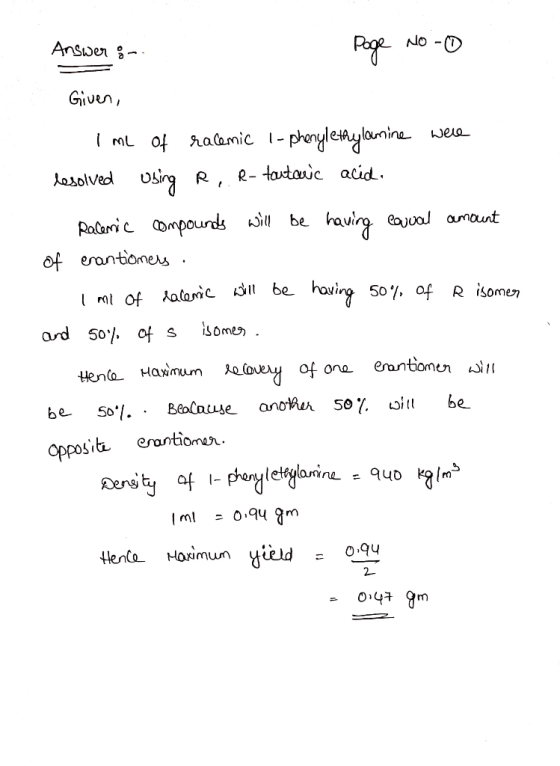
QUESTIONS 1. If 1 mL of racemic 1-phenylethylamine were resolved using R,R-tartaric acid, what is the...
In the resolution of 1-phenylethylamine, would you be able to separate the isomers if you used...
In the resolution of 1-phenylethylamine, would you be able to separate the isomers if you used racemic tartaric acid? explain why yes or no (feel free to incorporate the structures and the R/S designation if it helps to explain your answer)
Please help with pre-lab questions. Pre-Lab Questions: 1. A sample of 2-butanol has a specific rotation...
 Please help with pre-lab questions.
Pre-Lab Questions: 1. A sample of 2-butanol has a specific rotation of +3.25. Determine the optical purity (%ee) and percent composition of this sample (see Mohrig section 17.4). The specific rotation of pure (+)-2-butanol is +13.0°. 2. The equation for the formation of the diastereomeric salts is shown in the background information (performed in Part A of the procedure). Write this chemical equation in your notebook, then ALSO write a balanced equation for the formation...
Please help with pre-lab questions.
Pre-Lab Questions: 1. A sample of 2-butanol has a specific rotation of +3.25. Determine the optical purity (%ee) and percent composition of this sample (see Mohrig section 17.4). The specific rotation of pure (+)-2-butanol is +13.0°. 2. The equation for the formation of the diastereomeric salts is shown in the background information (performed in Part A of the procedure). Write this chemical equation in your notebook, then ALSO write a balanced equation for the formation...
Please help with both questions d and e d. The solubility of salicylic acid in water...
 Please help with both questions d and e
d. The solubility of salicylic acid in water is 0.13 grams per 100 mL water at 10°C What is the maximum amount of salicylic acid that can be recovered if you besin with 2.0 z of salicylic acid and recrystallize it from 50 mL of hot water cooling the water to 10°C e. If you begin with 3.0 mL of methyl salicylate (MS) and isolate 20 g of salicylic acid (SA), what...
Please help with both questions d and e
d. The solubility of salicylic acid in water is 0.13 grams per 100 mL water at 10°C What is the maximum amount of salicylic acid that can be recovered if you besin with 2.0 z of salicylic acid and recrystallize it from 50 mL of hot water cooling the water to 10°C e. If you begin with 3.0 mL of methyl salicylate (MS) and isolate 20 g of salicylic acid (SA), what...
Name Section/CRN POST LABORATORY QUESTIONS 1. A student weighs out 3.52 g. of salicylic acid in...
 Name Section/CRN POST LABORATORY QUESTIONS 1. A student weighs out 3.52 g. of salicylic acid in a 100 ml flask and adds 2.3 mL of acetic anhydride (density 1.080 g/mL). Determine the maximum (theoretical) number of grams of acetylsalicylic acid she can prepare. 2. If the student obtained 4.21 g, of aspirin, calculate the % yield. Briefly, explain why she might have obtained this amount of product. 3. The solubility of Aspirin (acetylsalicylic acid) at 25 °C is 3.0 mg/mL...
1. A sample contains an unknown amount of tartaric acid, H2C4H4O6. If 0.3888 g of the...
1. A sample contains an unknown amount of tartaric acid, H2C4H4O6. If 0.3888 g of the sample requires 37.74 mL of 0.1000 M NaOH to neutralize the H2C4H4O6 completely, what is the percentage of H2C4H4O6 in the sample? The molar mass of H2C4H4O6 is 150.09 g/mol. The balanced equation for the reaction is: H2C4H4O6 + 2 NaOH → 2 H2O + Na2C4H4O6 2. Sodium thiosulfate, Na2S2O3, is an important reagent for titrations. Its solutions can be standardized by titrating the...
A) A student weighed out 3.52 g. of salicylic acid in a 100 mL flask and...
A) A student weighed out 3.52 g. of salicylic acid in a 100 mL flask and adds 2.3 mL of acetic anhydride (density= 1.080 g/mL). Determine the maximum(theoretical) number of grams of acetylsalicylic acid she can prepare. B) If the student obtained 4.21 g. of aspirin, calculate the % yield. Briefly, explain why she might have obtained this amount of product.
Pre-Laboratory Questions: 1. Bromocresol green is chosen as the acid-base indicator. Within what pH range does...
 Pre-Laboratory Questions: 1. Bromocresol green is chosen as the acid-base indicator. Within what pH range does it change color? What color should the indicator be at the endpoint of the titration? 2. Calculate the maximum number of moles of ammonia that can be generated when 1.073 grams of NH SCN reacts with excess Ca(OH)2, using all three possible reactions. 3. Calculate the number of moles of ammonia that must have reacted with boric acid if 21.55 ml of a 0.3143...
I’m not sure what I’ve done wrong since the rest of my calculations were correct, so...
 I’m
not sure what I’ve done wrong since the rest of my calculations
were correct, so will someone please explain to me how to solve
these. I’ve tried everything i can think of and nothing is working.
We were unable to transcribe this imagebalanced chemical equation: Pb(NO), (aq) + 2Cl(aq) - PbCl2(s) + 2KNO3(aq) What is the limiting reactant? lead(II) nitrate O potassium chloride The percent yield for the reaction is 80.6%. How many grams of precipitate is recovered? precipitate...
I’m
not sure what I’ve done wrong since the rest of my calculations
were correct, so will someone please explain to me how to solve
these. I’ve tried everything i can think of and nothing is working.
We were unable to transcribe this imagebalanced chemical equation: Pb(NO), (aq) + 2Cl(aq) - PbCl2(s) + 2KNO3(aq) What is the limiting reactant? lead(II) nitrate O potassium chloride The percent yield for the reaction is 80.6%. How many grams of precipitate is recovered? precipitate...
please help with those questions and clear steps. 1- For the following reaction, 29.7 grams of calcium hydroxide are allowed to react with 26.0 grams of hydrochloric acid. calcium hydroxide (aq) + hy...
 please help with those questions and clear steps.
1- For the following reaction, 29.7 grams of
calcium hydroxide are allowed to react with
26.0 grams of hydrochloric
acid.
calcium hydroxide (aq) +
hydrochloric acid (aq) calcium
chloride (aq) + water
(l)
a) What is the maximum amount of calcium chloride
that can be formed? ________________ grams
b)
What is the FORMULA for the limiting
reagent?
c) What amount of the excess reagent remains after the reaction is
complete? ___________ grams...
please help with those questions and clear steps.
1- For the following reaction, 29.7 grams of
calcium hydroxide are allowed to react with
26.0 grams of hydrochloric
acid.
calcium hydroxide (aq) +
hydrochloric acid (aq) calcium
chloride (aq) + water
(l)
a) What is the maximum amount of calcium chloride
that can be formed? ________________ grams
b)
What is the FORMULA for the limiting
reagent?
c) What amount of the excess reagent remains after the reaction is
complete? ___________ grams...
1.An aqueous solution of hydrobromic acid is standardized by titration with a 0.113 M solution of...
1.An aqueous solution of hydrobromic acid is standardized by titration with a 0.113 M solution of barium hydroxide. If 20.6 mL of base are required to neutralize 19.9 mL of the acid, what is the molarity of the hydrobromic acid solution? ____M hydrobromic acid 2. An aqueous solution of barium hydroxide is standardized by titration with a 0.196 M solution of nitric acid. If 27.0 mL of base are required to neutralize 15.3 mL of the acid, what is the...
 Please help with pre-lab questions.
Pre-Lab Questions: 1. A sample of 2-butanol has a specific rotation of +3.25. Determine the optical purity (%ee) and percent composition of this sample (see Mohrig section 17.4). The specific rotation of pure (+)-2-butanol is +13.0°. 2. The equation for the formation of the diastereomeric salts is shown in the background information (performed in Part A of the procedure). Write this chemical equation in your notebook, then ALSO write a balanced equation for the formation...
Please help with pre-lab questions.
Pre-Lab Questions: 1. A sample of 2-butanol has a specific rotation of +3.25. Determine the optical purity (%ee) and percent composition of this sample (see Mohrig section 17.4). The specific rotation of pure (+)-2-butanol is +13.0°. 2. The equation for the formation of the diastereomeric salts is shown in the background information (performed in Part A of the procedure). Write this chemical equation in your notebook, then ALSO write a balanced equation for the formation...
 Please help with both questions d and e
d. The solubility of salicylic acid in water is 0.13 grams per 100 mL water at 10°C What is the maximum amount of salicylic acid that can be recovered if you besin with 2.0 z of salicylic acid and recrystallize it from 50 mL of hot water cooling the water to 10°C e. If you begin with 3.0 mL of methyl salicylate (MS) and isolate 20 g of salicylic acid (SA), what...
Please help with both questions d and e
d. The solubility of salicylic acid in water is 0.13 grams per 100 mL water at 10°C What is the maximum amount of salicylic acid that can be recovered if you besin with 2.0 z of salicylic acid and recrystallize it from 50 mL of hot water cooling the water to 10°C e. If you begin with 3.0 mL of methyl salicylate (MS) and isolate 20 g of salicylic acid (SA), what...
 Name Section/CRN POST LABORATORY QUESTIONS 1. A student weighs out 3.52 g. of salicylic acid in a 100 ml flask and adds 2.3 mL of acetic anhydride (density 1.080 g/mL). Determine the maximum (theoretical) number of grams of acetylsalicylic acid she can prepare. 2. If the student obtained 4.21 g, of aspirin, calculate the % yield. Briefly, explain why she might have obtained this amount of product. 3. The solubility of Aspirin (acetylsalicylic acid) at 25 °C is 3.0 mg/mL...
 Pre-Laboratory Questions: 1. Bromocresol green is chosen as the acid-base indicator. Within what pH range does it change color? What color should the indicator be at the endpoint of the titration? 2. Calculate the maximum number of moles of ammonia that can be generated when 1.073 grams of NH SCN reacts with excess Ca(OH)2, using all three possible reactions. 3. Calculate the number of moles of ammonia that must have reacted with boric acid if 21.55 ml of a 0.3143...
 I’m
not sure what I’ve done wrong since the rest of my calculations
were correct, so will someone please explain to me how to solve
these. I’ve tried everything i can think of and nothing is working.
We were unable to transcribe this imagebalanced chemical equation: Pb(NO), (aq) + 2Cl(aq) - PbCl2(s) + 2KNO3(aq) What is the limiting reactant? lead(II) nitrate O potassium chloride The percent yield for the reaction is 80.6%. How many grams of precipitate is recovered? precipitate...
I’m
not sure what I’ve done wrong since the rest of my calculations
were correct, so will someone please explain to me how to solve
these. I’ve tried everything i can think of and nothing is working.
We were unable to transcribe this imagebalanced chemical equation: Pb(NO), (aq) + 2Cl(aq) - PbCl2(s) + 2KNO3(aq) What is the limiting reactant? lead(II) nitrate O potassium chloride The percent yield for the reaction is 80.6%. How many grams of precipitate is recovered? precipitate...
 please help with those questions and clear steps.
1- For the following reaction, 29.7 grams of
calcium hydroxide are allowed to react with
26.0 grams of hydrochloric
acid.
calcium hydroxide (aq) +
hydrochloric acid (aq) calcium
chloride (aq) + water
(l)
a) What is the maximum amount of calcium chloride
that can be formed? ________________ grams
b)
What is the FORMULA for the limiting
reagent?
c) What amount of the excess reagent remains after the reaction is
complete? ___________ grams...
please help with those questions and clear steps.
1- For the following reaction, 29.7 grams of
calcium hydroxide are allowed to react with
26.0 grams of hydrochloric
acid.
calcium hydroxide (aq) +
hydrochloric acid (aq) calcium
chloride (aq) + water
(l)
a) What is the maximum amount of calcium chloride
that can be formed? ________________ grams
b)
What is the FORMULA for the limiting
reagent?
c) What amount of the excess reagent remains after the reaction is
complete? ___________ grams...
Most questions answered within 3 hours.
-
Where is the error in this code sequence?
String s1 = "Hello";
String s2 = "ello";...
asked 11 months ago -
Financial data for Joel de Paris, Inc., for last year
follow:
Joel de Paris, Inc.
Balance...
asked 11 months ago -
Consider this reaction:
Al2(SO4)3 (aq)+ BaCl3
(aq) Al2Cl6 (aq)- +
3BaSO4(s) . What is the...
asked 11 months ago -
Suppose that Savneet is considering increasing her
recent random sample from 20 car rentals to 40...
asked 11 months ago -
Trucks arrive at an unloading terminal at an average rate of 120
per hour.
Trucks arrive...
asked 11 months ago -
Why are methanol and ethanol completely soluble in water while
octanol is not very little soluble....
asked 11 months ago -
A facilities manager at a university reads in a research report
that the mean amount of...
asked 11 months ago -
When the CuSO4 is rehydrated by adding water to the anhydrous
compound, is this an endothermic...
asked 11 months ago -
A ray of sunlight is passing from diamond into crown glass; the
angle of incidence is...
asked 11 months ago -
A block of mass 0.249 kg is placed on top of a light, vertical
spring of...
asked 11 months ago -
how do the kidneys compensate in the presences of acidosis
a) trigger hyperventilate
b) reserve acid...
asked 11 months ago -
Question 501 pts
The rental rate of capital to the firm increases. Which of the
following...
asked 11 months ago