there are 3 objects of masses 6kg, 4kg, 2kg respectively. if the 2nd object is 20m...
there are 3 objects of masses 6kg, 4kg, 2kg respectively. if the 2nd object is 20m east if th 1st object and the 3rd object is 10m south of the 1st object what is the magnitude & direction of the gravitational force exerted on the 1st object
Homework Answers
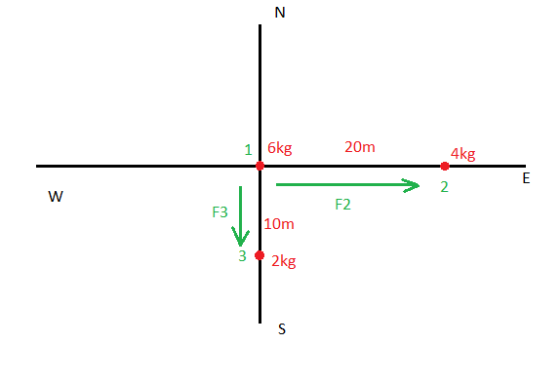
Gravutational Force ,
where
=====================
(downwards)
================
Net Force,
ANSWER:
=====================
Direction
ANSWER:
counter clockwise
========================
Add Answer to:
there are 3 objects of masses 6kg, 4kg, 2kg
respectively. if the 2nd object is 20m...
Blocks with masses of 2kg , 4kg , and 6kg are lined up in a row...
Blocks with masses of 2kg , 4kg , and 6kg are lined up in a row on a frictionless table. All three are pushed forward by a 52N force applied to the 2kg block. 1. How much force does the 4kg block exert on the 6kg block? 2. How much force does the 4kg block exert on the 2kg block?
Objects with masses of 205 kg and a 505 kg are separated by 0.330 m. (a)...
 Objects with masses of 205 kg and a 505 kg are separated by 0.330 m. (a) Find the net gravitational force exerted by these objects on a 46.0 kg object placed midway between them. magnitude direction -Select- N (b) At what position (other than infinitely remote ones) can the 46.0 kg object be placed so as to experience a net force of zero? m from the 505 kg mass
Objects with masses of 145 kg and a 445 kg are separated by 0.300 m. (a)...
 Objects with masses of 145 kg and a 445 kg are separated by 0.300 m. (a) Find the net gravitational force exerted by these objects on a 36.0-kg object placed midway between them. magnitude N direction (b) At what position (other than infinitely remote ones) can the 36.0-kg object be placed so as to experience a net force of zero? m from the 445-kg mass
Objects with masses of 130 kg and a 430 kg are separated by 0.360 m. (a)...
Objects with masses of 130 kg and a 430 kg are separated by 0.360 m. (a) Find the net gravitational force exerted by these objects on a 40.0-kg object placed midway between them. magnitude ____ N What is the Direction: a.toward the 130kg mass b. toward the 430kg mass c. the magnitude is zero (b) At what position (other than infinitely remote ones) can the 40.0-kg object be placed so as to experience a net force of zero? ________ m...
Objects with masses of 225 kg and a 525 kg are separated by 0.500 m. (a)Find...
Objects with masses of 225 kg and a 525 kg are separated by 0.500 m. (a)Find the net gravitational force exerted by these objects on a 70.0 kg object placed midway between them. magnitude __??____ direction: toward the 225 kg mass toward the 525 kg mass The magnitude is zero. (b) At what position (other than infinitely remote ones) can the 70.0 kg object be placed so as to experience a net force of zero? __??____ m from the 525...
Objects with masses of 250 kg and a 550 kg are separated by 0.490 m. (a)...
Objects with masses of 250 kg and a 550 kg are separated by 0.490 m. (a) Find the net gravitational force exerted by these objects on a 63.0 kg object placed midway between them. magnitude .000021 Correct: Your answer is correct. N direction Correct: Your answer is correct. (b) At what position (other than infinitely remote ones) can the 63.0 kg object be placed so as to experience a net force of zero? Just need part B
Question Part Points Submissions Used Objects with masses of 235 kg and a 535 kg are...
Question Part Points Submissions Used Objects with masses of 235 kg and a 535 kg are separated by 0.420 m. (a) Find the net gravitational force exerted by these objects on a 32.0-kg object placed midway between them, and the magnitude in newtons and the direction (b) At what position (other than infinitely remote ones) can the 32.0-kg object be placed so as to experience a net force of zero? m from the 535-kg mass
Objects with masses of 225 kg and a 525 kg are separated by 0.500 m. (a)...
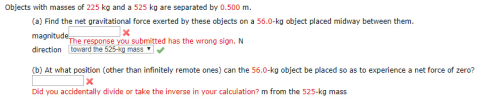 Objects with masses of 225 kg and a 525 kg are separated by 0.500 m. (a) Find the net gravitational force exerted by these objects on a 56.0-kg object placed midway between them. magnitude direction toward the 525-kg mass (b) At what position (other than infinitely remote ones) can the 56.0-kg object be placed so as to experience a net force of zero? Did you accidentally divide or take the inverse in your calculation? m from the 525-kg mass The...
Objects with masses of 140 kg and a 440 kg are separated by 0.330 m. (a)...
Objects with masses of 140 kg and a 440 kg are separated by 0.330 m. (a) Find the net gravitational force exerted by these objects on a 39.0-kg object placed midway between them. magnitude N (b) At what position (other than infinitely remote ones) can the 39.0-kg object be placed so as to experience a net force of zero? m from the 440-kg mass
1) A first point object (M1) is positioned at (x,y) = (0,0). Second and third identical...
1) A first point object (M1) is positioned at (x,y) = (0,0). Second and third identical point objects (M2) are positioned at (-3R,0) and (3R,0), respectively. Determine expressions {G, M1, M2, R} for the following: 1.1) the magnitude of the gravitational force applied by the 2nd and 3rd objects onto the 1st object; 1.2) the potential energy of the system 1.3) the work required to separate the three objects so as to make them infinitely far from each other.
 Objects with masses of 205 kg and a 505 kg are separated by 0.330 m. (a) Find the net gravitational force exerted by these objects on a 46.0 kg object placed midway between them. magnitude direction -Select- N (b) At what position (other than infinitely remote ones) can the 46.0 kg object be placed so as to experience a net force of zero? m from the 505 kg mass
 Objects with masses of 145 kg and a 445 kg are separated by 0.300 m. (a) Find the net gravitational force exerted by these objects on a 36.0-kg object placed midway between them. magnitude N direction (b) At what position (other than infinitely remote ones) can the 36.0-kg object be placed so as to experience a net force of zero? m from the 445-kg mass
 Objects with masses of 225 kg and a 525 kg are separated by 0.500 m. (a) Find the net gravitational force exerted by these objects on a 56.0-kg object placed midway between them. magnitude direction toward the 525-kg mass (b) At what position (other than infinitely remote ones) can the 56.0-kg object be placed so as to experience a net force of zero? Did you accidentally divide or take the inverse in your calculation? m from the 525-kg mass The...
Most questions answered within 3 hours.
-
Where is the error in this code sequence?
String s1 = "Hello";
String s2 = "ello";...
asked 11 months ago -
Financial data for Joel de Paris, Inc., for last year
follow:
Joel de Paris, Inc.
Balance...
asked 11 months ago -
Consider this reaction:
Al2(SO4)3 (aq)+ BaCl3
(aq) Al2Cl6 (aq)- +
3BaSO4(s) . What is the...
asked 11 months ago -
Suppose that Savneet is considering increasing her
recent random sample from 20 car rentals to 40...
asked 11 months ago -
Trucks arrive at an unloading terminal at an average rate of 120
per hour.
Trucks arrive...
asked 11 months ago -
Why are methanol and ethanol completely soluble in water while
octanol is not very little soluble....
asked 11 months ago -
A facilities manager at a university reads in a research report
that the mean amount of...
asked 11 months ago -
When the CuSO4 is rehydrated by adding water to the anhydrous
compound, is this an endothermic...
asked 11 months ago -
A ray of sunlight is passing from diamond into crown glass; the
angle of incidence is...
asked 11 months ago -
A block of mass 0.249 kg is placed on top of a light, vertical
spring of...
asked 11 months ago -
how do the kidneys compensate in the presences of acidosis
a) trigger hyperventilate
b) reserve acid...
asked 11 months ago -
Question 501 pts
The rental rate of capital to the firm increases. Which of the
following...
asked 11 months ago