
Homework Answers
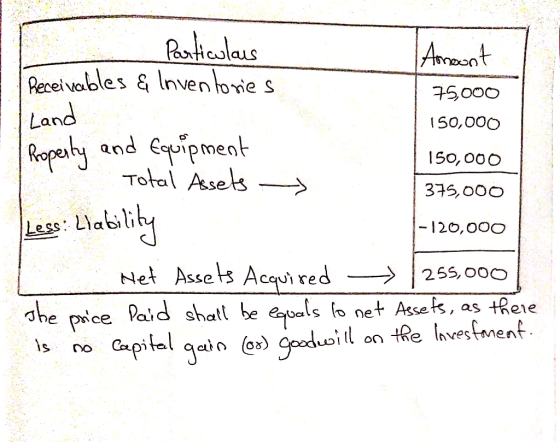
Answer - option B is $255,000
Add Answer to:
Assume that on January 1, 2013, an investor company acquired 100% of the outstanding voting common...
Assume that on January 1, 2013, an investor company acquired 100% of the outstanding voting common...
 Assume that on January 1, 2013, an investor company acquired 100% of the outstanding voting common stock of an investee company. The following financial statement information is for the investor company and the investee company on January 1, 2013, prepared immediately before this transaction. Book Values Investor Investee Receivables & inventories $100,000 $50,000 Land 200,000 100.000 Property & equipment 225.000 100.000 Total assets $525,000 $250,000 Liabilities $150,000 $80,000 Common stock ($2 par) 20,000 10,000 Additional paid-in capital 280.000 150.000 Retained...
Tax effects of business combinations (nontaxable, market value differs from book value) Assume that on January...
 Tax effects of business combinations (nontaxable, market value differs from book value) Assume that on January 1, 2013, an investor company acquired 100% of the outstanding voting common stock of an investee company in exchange for $225,000 worth of investor company common stock. The transaction is a tax-free reorganization under the Internal Revenue Code. The following financial statement information is for the investor company and the investee company on January 1, 2013, prepared immediately before this transaction. Book Values Investor...
Use the following facts for Multiple Choice problems 38 and 39: Assume on January 1, 2019,...
 Use the following facts for Multiple Choice problems 38 and 39: Assume on January 1, 2019, an investor company acquired 100% of the outstanding voting common stock of an investee company. The following financial statement information is for the investor company and the investee company on January 1, 2019, prepared immediately before this transaction. Book Values Investor Investee Receivables & inventories Land.. Property & equipment, net Total assets. $ 100,000 200,000 225,000 $ 525,000 $ 50.000 +10 80,000 - 5...
Tax effects of business combinations (taxable, market value differs from book value) Assume that on January...
 Tax effects of business combinations (taxable, market value differs from book value) Assume that on January 1, 2013, an investor company acquired 100% of the outstanding voting common stock of an investee company in exchange for $300,000. The transaction is a taxable asset acquisition under the Internal Revenue Code. The following financial statement information is for the investor company and the investee company on January 1, 2013, prepared immediately before this transaction. Current assets Noncurrent assets Total assets Liabilities Common...
Consolidating entries (market value differs from book value) Assume that on January 1, 2013, an investor...
 Consolidating entries (market value differs from book value) Assume that on January 1, 2013, an investor company acquired 100% of the outstanding voting common stock of an investee company. The following financial statement information was prepared immediately after the acquisition and presents the acquisition date balance sheet for the pre-consolidation investor company, the investee company and the consolidated financial statements for the investor and investee. Investor Investee Consolidated Cash & receivables $500,000 $62,500 $562,500 Inventory 375,000 156,250 531,250 Property &...
Consolidating entries (market value differs from book value) Assume that on January 1, 2013, an investor...
 Consolidating entries (market value differs from book value) Assume that on January 1, 2013, an investor company acquired 100% of the outstanding voting common stock of an investee company. The following financial statement information was prepared immediately after the acquisition and presents the acquisition-date balance sheet for the pre-consolidation investor company, the investee company and the consolidated financial statements for the investor and investee. Investor Investee Consolidated Cash & receivables $1,500,000 $187,500 $1,687,500 Inventory 1,125,000 468,750 1,593,750 Property & equipment...
On January 1, Year 1. Investor, Inc. acquired 40% of the outstanding common stock of Investee...
 On January 1, Year 1. Investor, Inc. acquired 40% of the outstanding common stock of Investee Co, for $530,000. Investee's net assets on that date totaled $1.2 million. Any excess of cost over book value is attributable to a trade name with a 20-year remaining life. Investee immediately began supplying inventory to Investor as follows: Year Year Year 2 Transfer Price $100,000 $150,000 Cost to Investec $70,000 $96,000 Amount Held by Investor at Year-End (at Transfer Price) $25,000 $45,000 Inventory...
Assume an investee has the following financial statement information for the three years ending December 31,...
 Assume an investee has the following financial statement information for the three years ending December 31, 2013: (At December 31) 2011 2012 2013 Current assets $103,500 $138,850 $142,735 Tangible fixed assets 281,500 287,150 330,865 Intangible assets 25,000 22,500 20,000 Total assets $410,000 $448,500 $493,500 Current liabilities $50,000 $55,000 $60,500 Noncurrent liabilities 110,000 121,000 133, 100 Common stock 50,000 50,000 50,000 Additional paid-in capital 50,000 50,000 50,000 Retained earnings 150,000 172,500 200,000 Total liabilities and equity $410,000 $448,500 $493,500 (At December...
On July 1, 2012, an acquiring company Corp. paid $1,100,000 for 100% of the outstanding common...
 On July 1, 2012, an acquiring company Corp. paid $1,100,000 for 100% of the outstanding common stock of an investee company in a transaction that qualifies as a business combination. Immediately preceding the transaction, the investee company had the following condensed balance sheet: Pre-acquisition amounts reported on investee's balance sheet Current assets $150,000 Property and equipment, net 1,400,000 Liabilities 750,000 Equity 800,000 The acquisition-date fair value of the property and equipment was $220,000 more than its carrying amount. For all...
On January 1, 2018, an investor company acquired 30% of an investee company’s common stock for...
On January 1, 2018, an investor company acquired 30% of an investee company’s common stock for $600,000. As a result of this transaction, the investor can exert significant influence over the investee. During each year ended December 31, 2018 and 2019 the investee reported $120,000 of net income and $50,000 of dividends. On January 1, 2018, the book value of the investee’s net assets was $2,000,000 and all individual net assets had appraised fair values that equaled their reported book...
 Assume that on January 1, 2013, an investor company acquired 100% of the outstanding voting common stock of an investee company. The following financial statement information is for the investor company and the investee company on January 1, 2013, prepared immediately before this transaction. Book Values Investor Investee Receivables & inventories $100,000 $50,000 Land 200,000 100.000 Property & equipment 225.000 100.000 Total assets $525,000 $250,000 Liabilities $150,000 $80,000 Common stock ($2 par) 20,000 10,000 Additional paid-in capital 280.000 150.000 Retained...
 Tax effects of business combinations (nontaxable, market value differs from book value) Assume that on January 1, 2013, an investor company acquired 100% of the outstanding voting common stock of an investee company in exchange for $225,000 worth of investor company common stock. The transaction is a tax-free reorganization under the Internal Revenue Code. The following financial statement information is for the investor company and the investee company on January 1, 2013, prepared immediately before this transaction. Book Values Investor...
 Use the following facts for Multiple Choice problems 38 and 39: Assume on January 1, 2019, an investor company acquired 100% of the outstanding voting common stock of an investee company. The following financial statement information is for the investor company and the investee company on January 1, 2019, prepared immediately before this transaction. Book Values Investor Investee Receivables & inventories Land.. Property & equipment, net Total assets. $ 100,000 200,000 225,000 $ 525,000 $ 50.000 +10 80,000 - 5...
 Tax effects of business combinations (taxable, market value differs from book value) Assume that on January 1, 2013, an investor company acquired 100% of the outstanding voting common stock of an investee company in exchange for $300,000. The transaction is a taxable asset acquisition under the Internal Revenue Code. The following financial statement information is for the investor company and the investee company on January 1, 2013, prepared immediately before this transaction. Current assets Noncurrent assets Total assets Liabilities Common...
 Consolidating entries (market value differs from book value) Assume that on January 1, 2013, an investor company acquired 100% of the outstanding voting common stock of an investee company. The following financial statement information was prepared immediately after the acquisition and presents the acquisition date balance sheet for the pre-consolidation investor company, the investee company and the consolidated financial statements for the investor and investee. Investor Investee Consolidated Cash & receivables $500,000 $62,500 $562,500 Inventory 375,000 156,250 531,250 Property &...
 Consolidating entries (market value differs from book value) Assume that on January 1, 2013, an investor company acquired 100% of the outstanding voting common stock of an investee company. The following financial statement information was prepared immediately after the acquisition and presents the acquisition-date balance sheet for the pre-consolidation investor company, the investee company and the consolidated financial statements for the investor and investee. Investor Investee Consolidated Cash & receivables $1,500,000 $187,500 $1,687,500 Inventory 1,125,000 468,750 1,593,750 Property & equipment...
 On January 1, Year 1. Investor, Inc. acquired 40% of the outstanding common stock of Investee Co, for $530,000. Investee's net assets on that date totaled $1.2 million. Any excess of cost over book value is attributable to a trade name with a 20-year remaining life. Investee immediately began supplying inventory to Investor as follows: Year Year Year 2 Transfer Price $100,000 $150,000 Cost to Investec $70,000 $96,000 Amount Held by Investor at Year-End (at Transfer Price) $25,000 $45,000 Inventory...
 Assume an investee has the following financial statement information for the three years ending December 31, 2013: (At December 31) 2011 2012 2013 Current assets $103,500 $138,850 $142,735 Tangible fixed assets 281,500 287,150 330,865 Intangible assets 25,000 22,500 20,000 Total assets $410,000 $448,500 $493,500 Current liabilities $50,000 $55,000 $60,500 Noncurrent liabilities 110,000 121,000 133, 100 Common stock 50,000 50,000 50,000 Additional paid-in capital 50,000 50,000 50,000 Retained earnings 150,000 172,500 200,000 Total liabilities and equity $410,000 $448,500 $493,500 (At December...
 On July 1, 2012, an acquiring company Corp. paid $1,100,000 for 100% of the outstanding common stock of an investee company in a transaction that qualifies as a business combination. Immediately preceding the transaction, the investee company had the following condensed balance sheet: Pre-acquisition amounts reported on investee's balance sheet Current assets $150,000 Property and equipment, net 1,400,000 Liabilities 750,000 Equity 800,000 The acquisition-date fair value of the property and equipment was $220,000 more than its carrying amount. For all...
Most questions answered within 3 hours.
-
Where is the error in this code sequence?
String s1 = "Hello";
String s2 = "ello";...
asked 11 months ago -
Financial data for Joel de Paris, Inc., for last year
follow:
Joel de Paris, Inc.
Balance...
asked 11 months ago -
Consider this reaction:
Al2(SO4)3 (aq)+ BaCl3
(aq) Al2Cl6 (aq)- +
3BaSO4(s) . What is the...
asked 11 months ago -
Suppose that Savneet is considering increasing her
recent random sample from 20 car rentals to 40...
asked 11 months ago -
Trucks arrive at an unloading terminal at an average rate of 120
per hour.
Trucks arrive...
asked 11 months ago -
Why are methanol and ethanol completely soluble in water while
octanol is not very little soluble....
asked 11 months ago -
A facilities manager at a university reads in a research report
that the mean amount of...
asked 11 months ago -
When the CuSO4 is rehydrated by adding water to the anhydrous
compound, is this an endothermic...
asked 11 months ago -
A ray of sunlight is passing from diamond into crown glass; the
angle of incidence is...
asked 11 months ago -
A block of mass 0.249 kg is placed on top of a light, vertical
spring of...
asked 11 months ago -
how do the kidneys compensate in the presences of acidosis
a) trigger hyperventilate
b) reserve acid...
asked 11 months ago -
Question 501 pts
The rental rate of capital to the firm increases. Which of the
following...
asked 11 months ago