
Homework Answers
| mean μ= | 2.200 |
| standard deviation σ= | 3.800 |
| for 77th percentile critical value of z= | 0.74 | ||
| therefore corresponding value=mean+z*std deviation= | 5.01 | ||
Add Answer to:
Y is a Gaussian RV with Gy(o)= Gy(2.2.3.8). at which value of Y does cumulative probability...
The cumulative probability distribution shows the probability 10 O A. of two or more events occurring at once O...
 The cumulative probability distribution shows the probability 10 O A. of two or more events occurring at once O B. that a random vaniable less than or equal to a particular value. O c. of all possible events occurring O D. that a random variable takes on a particular value given that another event has happened 11. Analyzing the effect of minimum wage changes on teenage employment across the 48 contiguous U.S. states from 1980 to 2004 is an example...
Question 11 (2 marks) Special Attempt 2 I value problem: y'4y+3 Consider the initial value problem: y'-43 Using TWO(2) steps of the following explict third order Runge-Kutta scheme 1hyn 2 obt...
 Question 11 (2 marks) Special Attempt 2 I value problem: y'4y+3 Consider the initial value problem: y'-43 Using TWO(2) steps of the following explict third order Runge-Kutta scheme 1hyn 2 obtain an approximate solution to the initial value problem at x 0.04. Maintain at least eight decimal digit accuracy throughout all your calculations. You may express your answer as a single five decimal digit number, for example 17.18263. YOU DO NOT HAVE TO ROUND YOUR FINAL ESTIMATE. y(0.04) Skipped
Question...
Question 11 (2 marks) Special Attempt 2 I value problem: y'4y+3 Consider the initial value problem: y'-43 Using TWO(2) steps of the following explict third order Runge-Kutta scheme 1hyn 2 obtain an approximate solution to the initial value problem at x 0.04. Maintain at least eight decimal digit accuracy throughout all your calculations. You may express your answer as a single five decimal digit number, for example 17.18263. YOU DO NOT HAVE TO ROUND YOUR FINAL ESTIMATE. y(0.04) Skipped
Question...
674%, y():1 nge- Consider the initial value problem: l- Using TWO(2) steps of the following expli...
 674%, y():1 nge- Consider the initial value problem: l- Using TWO(2) steps of the following explict third order Runge-Kutta scheme k1二hj(sn.yn). obtain an approximate solution to the initial value problem at x 0.04. Maintain at least eight decimal digit accuracy throughout all your calculations. You may express your answer as a single five decimal digit number, for example 17.18263. YOU DO NOT HAVE TO ROUND YOUR FINAL ESTIMATE y(0.04)* Skipped
674%, y():1 nge- Consider the initial value problem: l- Using...
674%, y():1 nge- Consider the initial value problem: l- Using TWO(2) steps of the following explict third order Runge-Kutta scheme k1二hj(sn.yn). obtain an approximate solution to the initial value problem at x 0.04. Maintain at least eight decimal digit accuracy throughout all your calculations. You may express your answer as a single five decimal digit number, for example 17.18263. YOU DO NOT HAVE TO ROUND YOUR FINAL ESTIMATE y(0.04)* Skipped
674%, y():1 nge- Consider the initial value problem: l- Using...
the answer should be as computer answer Consider the initial value problem: y' = 842+ y(0)=5....
 the answer should be as computer answer
Consider the initial value problem: y' = 842+ y(0)=5. (y+5) Using TWO(2) steps of the following explict third order Runge-Kutta scheme ki = hf(nyn), k2 = hf(n+ihgyn+şkı), k3 = hf(en+h,yn+şk2), Yn+1 = yn +4(k1+3k3), obtain an approximate solution to the initial value problem at x = 0.6 Maintain at least eight decimal digit accuracy throughout all your calculations. You may express your answer as a single five decimal digit number, for example 17.18263....
the answer should be as computer answer
Consider the initial value problem: y' = 842+ y(0)=5. (y+5) Using TWO(2) steps of the following explict third order Runge-Kutta scheme ki = hf(nyn), k2 = hf(n+ihgyn+şkı), k3 = hf(en+h,yn+şk2), Yn+1 = yn +4(k1+3k3), obtain an approximate solution to the initial value problem at x = 0.6 Maintain at least eight decimal digit accuracy throughout all your calculations. You may express your answer as a single five decimal digit number, for example 17.18263....
please answer question 2?3?4 A continuous random variable Y has the following probability density function (pdf)...
 please answer question 2?3?4
A continuous random variable Y has the following probability density function (pdf) cer, 01 (? > 0) y ) Determine c as a function of ?. Then, for the case ? 2, evaluate c, calculate the maximum value of f(v), and show this value in a sketch of fo). (b) Determine F), the cumulative distribution function (edf) of Y. Then, for the case ? = 2, calculate the value of F(0) and show this value in...
please answer question 2?3?4
A continuous random variable Y has the following probability density function (pdf) cer, 01 (? > 0) y ) Determine c as a function of ?. Then, for the case ? 2, evaluate c, calculate the maximum value of f(v), and show this value in a sketch of fo). (b) Determine F), the cumulative distribution function (edf) of Y. Then, for the case ? = 2, calculate the value of F(0) and show this value in...
Question Question 9 (2 marks) Attempt 1 Consider the initial value problem: v=2x2+5 y(1) = 3....
 Question Question 9 (2 marks) Attempt 1 Consider the initial value problem: v=2x2+5 y(1) = 3. Using Euler's method: yn+1 =y, thyn n+1 = In th, with step-size h = 0.5, obtain an approximate solution to the initial value problem at x = 2. Maintain at least eight decimal digit accuracy throughout all calculations. You may express your answer as a five decimal digit number, for example 6.27181 YOU DO NOT HAVE TO ROUND YOUR FINAL ESTIMATE. Estimate at x...
Two random variables, X and Y, have joint probability density function f ( x , y...
Two random variables, X and Y, have joint probability density function f ( x , y ) = { c , x < y < x + 1 , 0 < x < 1 0 , o t h e r w i s e Find c value. What's the conditional p.d.f of Y given X = x, i.e., f Y ∣ X = x ( y ) ? Don't forget the support of Y. Find the conditional expectation E [...
Please have a clear hand writing :) Question Question 9 (2 marks) Special Attempt 1 y(0) 3. Consider the initial value p...
 Please have a clear hand
writing :)
Question Question 9 (2 marks) Special Attempt 1 y(0) 3. Consider the initial value problem: l Using Euler's method: yn+1ynthy n+1tn+h, with step-size h 0.05, obtain an approximate solution to the initial value problem at x- 0.1 Maintain at least eight decimal digit accuracy throughout all calculations You may express your answer as a five decimal digit number; for example 6.27181. YOU DO NOT HAVE TO ROUND YOUR FINAL ESTIMATE Estimate at x0.1...
Please have a clear hand
writing :)
Question Question 9 (2 marks) Special Attempt 1 y(0) 3. Consider the initial value problem: l Using Euler's method: yn+1ynthy n+1tn+h, with step-size h 0.05, obtain an approximate solution to the initial value problem at x- 0.1 Maintain at least eight decimal digit accuracy throughout all calculations You may express your answer as a five decimal digit number; for example 6.27181. YOU DO NOT HAVE TO ROUND YOUR FINAL ESTIMATE Estimate at x0.1...
Which of the following is true about a p-value? O It measures the probability of observing...
 Which of the following is true about a p-value? O It measures the probability of observing your test statistic, assuming the null hypothesis is true. O It measures the probability that the alternative hypothesis is true. O It measures the probability of observing your test statistic, assuming the alternative hypothesis is true. It measures the probability that the null hypothesis is true.
Suppose that Y....Y, are i.l.d. random variables with the probability distribution given in the figure below....
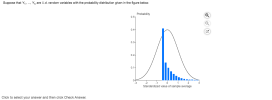 Suppose that Y....Y, are i.l.d. random variables with the probability distribution given in the figure below. Probability Standardized value of sample average Click to select your answer and then click Check Answer. Standardized value of sample average n = 25 Suppose further that you want to calculate Pr (Y30.1) Would it be reasonable to use the normal approximation if n = 25? O A. Yes. OB. No. Click to select your answer and then click Check Answer.
 The cumulative probability distribution shows the probability 10 O A. of two or more events occurring at once O B. that a random vaniable less than or equal to a particular value. O c. of all possible events occurring O D. that a random variable takes on a particular value given that another event has happened 11. Analyzing the effect of minimum wage changes on teenage employment across the 48 contiguous U.S. states from 1980 to 2004 is an example...
 Question 11 (2 marks) Special Attempt 2 I value problem: y'4y+3 Consider the initial value problem: y'-43 Using TWO(2) steps of the following explict third order Runge-Kutta scheme 1hyn 2 obtain an approximate solution to the initial value problem at x 0.04. Maintain at least eight decimal digit accuracy throughout all your calculations. You may express your answer as a single five decimal digit number, for example 17.18263. YOU DO NOT HAVE TO ROUND YOUR FINAL ESTIMATE. y(0.04) Skipped
Question...
Question 11 (2 marks) Special Attempt 2 I value problem: y'4y+3 Consider the initial value problem: y'-43 Using TWO(2) steps of the following explict third order Runge-Kutta scheme 1hyn 2 obtain an approximate solution to the initial value problem at x 0.04. Maintain at least eight decimal digit accuracy throughout all your calculations. You may express your answer as a single five decimal digit number, for example 17.18263. YOU DO NOT HAVE TO ROUND YOUR FINAL ESTIMATE. y(0.04) Skipped
Question...
 674%, y():1 nge- Consider the initial value problem: l- Using TWO(2) steps of the following explict third order Runge-Kutta scheme k1二hj(sn.yn). obtain an approximate solution to the initial value problem at x 0.04. Maintain at least eight decimal digit accuracy throughout all your calculations. You may express your answer as a single five decimal digit number, for example 17.18263. YOU DO NOT HAVE TO ROUND YOUR FINAL ESTIMATE y(0.04)* Skipped
674%, y():1 nge- Consider the initial value problem: l- Using...
674%, y():1 nge- Consider the initial value problem: l- Using TWO(2) steps of the following explict third order Runge-Kutta scheme k1二hj(sn.yn). obtain an approximate solution to the initial value problem at x 0.04. Maintain at least eight decimal digit accuracy throughout all your calculations. You may express your answer as a single five decimal digit number, for example 17.18263. YOU DO NOT HAVE TO ROUND YOUR FINAL ESTIMATE y(0.04)* Skipped
674%, y():1 nge- Consider the initial value problem: l- Using...
 the answer should be as computer answer
Consider the initial value problem: y' = 842+ y(0)=5. (y+5) Using TWO(2) steps of the following explict third order Runge-Kutta scheme ki = hf(nyn), k2 = hf(n+ihgyn+şkı), k3 = hf(en+h,yn+şk2), Yn+1 = yn +4(k1+3k3), obtain an approximate solution to the initial value problem at x = 0.6 Maintain at least eight decimal digit accuracy throughout all your calculations. You may express your answer as a single five decimal digit number, for example 17.18263....
the answer should be as computer answer
Consider the initial value problem: y' = 842+ y(0)=5. (y+5) Using TWO(2) steps of the following explict third order Runge-Kutta scheme ki = hf(nyn), k2 = hf(n+ihgyn+şkı), k3 = hf(en+h,yn+şk2), Yn+1 = yn +4(k1+3k3), obtain an approximate solution to the initial value problem at x = 0.6 Maintain at least eight decimal digit accuracy throughout all your calculations. You may express your answer as a single five decimal digit number, for example 17.18263....
 please answer question 2?3?4
A continuous random variable Y has the following probability density function (pdf) cer, 01 (? > 0) y ) Determine c as a function of ?. Then, for the case ? 2, evaluate c, calculate the maximum value of f(v), and show this value in a sketch of fo). (b) Determine F), the cumulative distribution function (edf) of Y. Then, for the case ? = 2, calculate the value of F(0) and show this value in...
please answer question 2?3?4
A continuous random variable Y has the following probability density function (pdf) cer, 01 (? > 0) y ) Determine c as a function of ?. Then, for the case ? 2, evaluate c, calculate the maximum value of f(v), and show this value in a sketch of fo). (b) Determine F), the cumulative distribution function (edf) of Y. Then, for the case ? = 2, calculate the value of F(0) and show this value in...
 Question Question 9 (2 marks) Attempt 1 Consider the initial value problem: v=2x2+5 y(1) = 3. Using Euler's method: yn+1 =y, thyn n+1 = In th, with step-size h = 0.5, obtain an approximate solution to the initial value problem at x = 2. Maintain at least eight decimal digit accuracy throughout all calculations. You may express your answer as a five decimal digit number, for example 6.27181 YOU DO NOT HAVE TO ROUND YOUR FINAL ESTIMATE. Estimate at x...
 Please have a clear hand
writing :)
Question Question 9 (2 marks) Special Attempt 1 y(0) 3. Consider the initial value problem: l Using Euler's method: yn+1ynthy n+1tn+h, with step-size h 0.05, obtain an approximate solution to the initial value problem at x- 0.1 Maintain at least eight decimal digit accuracy throughout all calculations You may express your answer as a five decimal digit number; for example 6.27181. YOU DO NOT HAVE TO ROUND YOUR FINAL ESTIMATE Estimate at x0.1...
Please have a clear hand
writing :)
Question Question 9 (2 marks) Special Attempt 1 y(0) 3. Consider the initial value problem: l Using Euler's method: yn+1ynthy n+1tn+h, with step-size h 0.05, obtain an approximate solution to the initial value problem at x- 0.1 Maintain at least eight decimal digit accuracy throughout all calculations You may express your answer as a five decimal digit number; for example 6.27181. YOU DO NOT HAVE TO ROUND YOUR FINAL ESTIMATE Estimate at x0.1...
 Which of the following is true about a p-value? O It measures the probability of observing your test statistic, assuming the null hypothesis is true. O It measures the probability that the alternative hypothesis is true. O It measures the probability of observing your test statistic, assuming the alternative hypothesis is true. It measures the probability that the null hypothesis is true.
 Suppose that Y....Y, are i.l.d. random variables with the probability distribution given in the figure below. Probability Standardized value of sample average Click to select your answer and then click Check Answer. Standardized value of sample average n = 25 Suppose further that you want to calculate Pr (Y30.1) Would it be reasonable to use the normal approximation if n = 25? O A. Yes. OB. No. Click to select your answer and then click Check Answer.
Most questions answered within 3 hours.
-
Where is the error in this code sequence?
String s1 = "Hello";
String s2 = "ello";...
asked 11 months ago -
Financial data for Joel de Paris, Inc., for last year
follow:
Joel de Paris, Inc.
Balance...
asked 11 months ago -
Consider this reaction:
Al2(SO4)3 (aq)+ BaCl3
(aq) Al2Cl6 (aq)- +
3BaSO4(s) . What is the...
asked 11 months ago -
Suppose that Savneet is considering increasing her
recent random sample from 20 car rentals to 40...
asked 11 months ago -
Trucks arrive at an unloading terminal at an average rate of 120
per hour.
Trucks arrive...
asked 11 months ago -
Why are methanol and ethanol completely soluble in water while
octanol is not very little soluble....
asked 11 months ago -
A facilities manager at a university reads in a research report
that the mean amount of...
asked 11 months ago -
When the CuSO4 is rehydrated by adding water to the anhydrous
compound, is this an endothermic...
asked 11 months ago -
A ray of sunlight is passing from diamond into crown glass; the
angle of incidence is...
asked 11 months ago -
A block of mass 0.249 kg is placed on top of a light, vertical
spring of...
asked 11 months ago -
how do the kidneys compensate in the presences of acidosis
a) trigger hyperventilate
b) reserve acid...
asked 11 months ago -
Question 501 pts
The rental rate of capital to the firm increases. Which of the
following...
asked 11 months ago