
Homework Answers
Add Answer to:
calculate heat change for .100
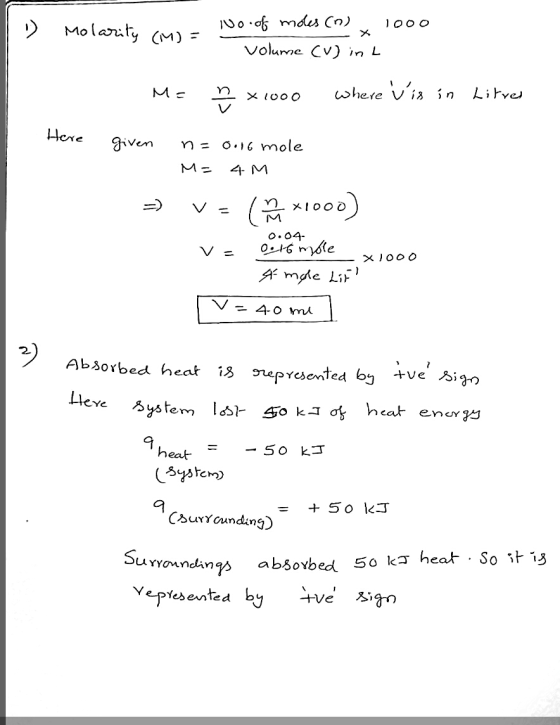
How many mL of 4.0 MH3PO4 would you need to have...
3. If 50.0 kJ of heat are given off by a chemical reaction in aqueous solution and all the heat is absorbed by the...
 3. If 50.0 kJ of heat are given off by a chemical reaction in aqueous solution and all the heat is absorbed by the surrounding water, what are the numerical values of: a) Asystem b) surroundings
please answr three and four thank you 3. If 50.0 kJ of heat are given off by a chemical reaction in aqueous solutio...
 please answr three and four thank
you
3. If 50.0 kJ of heat are given off by a chemical reaction in aqueous solution and all the heat is absorbed by the surrounding water, what are the numerical values of: a) 9system b) surroundings 4. If 100.0 g of water undergo a temperature increase of 5.5°C, what is the heat change (9) of the water? a) in joules b) in kilojoules (contin CHEM& 161 F19
please answr three and four thank
you
3. If 50.0 kJ of heat are given off by a chemical reaction in aqueous solution and all the heat is absorbed by the surrounding water, what are the numerical values of: a) 9system b) surroundings 4. If 100.0 g of water undergo a temperature increase of 5.5°C, what is the heat change (9) of the water? a) in joules b) in kilojoules (contin CHEM& 161 F19
2. How many mL of 4.0 M H3PO4 would you need to have in order to have 0.16 mole?
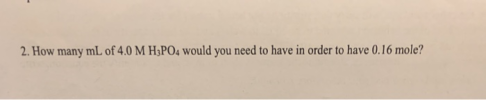 2. How many mL of 4.0 M H3PO4 would you need to have in order to have 0.16 mole?
ReviewI Constants1 Periodic Table Part A A calorimeter is an insulated device in which a chemical reaction is contained By measuring the temperature change. ΔΤ, we can calculate the heat released or...
 ReviewI Constants1 Periodic Table Part A A calorimeter is an insulated device in which a chemical reaction is contained By measuring the temperature change. ΔΤ, we can calculate the heat released or absorbed during the reaction using the following equation: A calorimeter contains 35.0 mL of water at 13.5 °C . when 1.20 g of X (a substance with a molar mass of 61.0 g/mol) is added, it dissolves via the reaction X+20)-X(ag) and the temperature of the solution increases...
4. You mix 50.0 ml. of a weak monoprotic acid with 50.0 mL of NaOH solution...
 4. You mix 50.0 ml. of a weak monoprotic acid with 50.0 mL of NaOH solution in a coffee cup calorimeter. Both solutions and the calorimeter were initially at 23.9°C. The final temperature of the neutralization reaction was determined to be 41.2°C. The calorimeter constant was known to be 110.6J/°C. Density Aqueous Solution = 1.00 g/ml Specific Heat of water = 4.184 J/g °C Hide a. What is the total amount of heat evolved in this reaction? NG 3 b....
How many mL of a 4.0% NaOH solution do you need to have 11.6 g of...
How many mL of a 4.0% NaOH solution do you need to have 11.6 g of NaOH?
Lab 9 Heat of Reaction OBJECTIVE: To experimentally determine the heat of reaction for two exothermic...
 Lab 9 Heat of Reaction
OBJECTIVE:
To experimentally determine the heat of reaction for two
exothermic reactions.
DISCUSSION:
The heat given off or gained in a reaction is called the heat
of reaction (∆?????????).
A reaction that releases heat is known as an exothermic
reaction; an endothermic reaction
is one that absorbs heat.
The heat of the reaction corresponds to one mole of the
reactant and is expressed in
kilocalories per mole of reactant or in kilojoules per mole of...
Lab 9 Heat of Reaction
OBJECTIVE:
To experimentally determine the heat of reaction for two
exothermic reactions.
DISCUSSION:
The heat given off or gained in a reaction is called the heat
of reaction (∆?????????).
A reaction that releases heat is known as an exothermic
reaction; an endothermic reaction
is one that absorbs heat.
The heat of the reaction corresponds to one mole of the
reactant and is expressed in
kilocalories per mole of reactant or in kilojoules per mole of...
If you have 300 grams of water at 100°C. How many kilojoules of heat are required...
 If you have 300 grams of water at 100°C. How many kilojoules of heat are required to evaporate completely all the water? AHvap of water is 40.7 kJ/mole. O A. 678 kJ OB.133 kJ OC.12200 kg D. 0.133 kJ
THERM OCHEMISTRY I1: HESS'S LAW OF CONSTANT HEAT SUMMATION ADVANCED PROBLEM ASSIGNMENT Dare Section Name REA...
 THERM OCHEMISTRY I1: HESS'S LAW OF CONSTANT HEAT SUMMATION ADVANCED PROBLEM ASSIGNMENT Dare Section Name READ THE EXPERIMENTAL DISCUSSION FIRST SHOW CALCULATION SET-UPI SIGNS! SIGNIFICANT FIGUREESi The 1.00 M solutions of HNO, and NaOH used in this experiment are prepared by diluting 6.00 M stock solutions. 1 What volume of 6.00 M stock solurion and whar volume of water is required to prepare 50.0 mL of 1.0 M solution? mL H.O mL 6.00 M Stock Solution How many moles of...
i need help on the second page: "calculate how many mols of HCL you used based...
 i need help on the second page:
"calculate how many mols of HCL you used based on the volume
and molarity of the HCL"
and
"enthalpy of reaction" parts
Part B Heat of Reaction for HCl(aq) + NaOH (aq) NaCl (aq) + so H20 (1) Volume of 1.0 M HCl (ml) so 100 23.3 Volume of 1.0 M NaOH (ml) Mass of Solution (8) use 1.00 g/ml Ti solution (temp of HCl just before reaction) T solution (highest temp obtained)...
i need help on the second page:
"calculate how many mols of HCL you used based on the volume
and molarity of the HCL"
and
"enthalpy of reaction" parts
Part B Heat of Reaction for HCl(aq) + NaOH (aq) NaCl (aq) + so H20 (1) Volume of 1.0 M HCl (ml) so 100 23.3 Volume of 1.0 M NaOH (ml) Mass of Solution (8) use 1.00 g/ml Ti solution (temp of HCl just before reaction) T solution (highest temp obtained)...
 3. If 50.0 kJ of heat are given off by a chemical reaction in aqueous solution and all the heat is absorbed by the surrounding water, what are the numerical values of: a) Asystem b) surroundings
 please answr three and four thank
you
3. If 50.0 kJ of heat are given off by a chemical reaction in aqueous solution and all the heat is absorbed by the surrounding water, what are the numerical values of: a) 9system b) surroundings 4. If 100.0 g of water undergo a temperature increase of 5.5°C, what is the heat change (9) of the water? a) in joules b) in kilojoules (contin CHEM& 161 F19
please answr three and four thank
you
3. If 50.0 kJ of heat are given off by a chemical reaction in aqueous solution and all the heat is absorbed by the surrounding water, what are the numerical values of: a) 9system b) surroundings 4. If 100.0 g of water undergo a temperature increase of 5.5°C, what is the heat change (9) of the water? a) in joules b) in kilojoules (contin CHEM& 161 F19
 2. How many mL of 4.0 M H3PO4 would you need to have in order to have 0.16 mole?
 ReviewI Constants1 Periodic Table Part A A calorimeter is an insulated device in which a chemical reaction is contained By measuring the temperature change. ΔΤ, we can calculate the heat released or absorbed during the reaction using the following equation: A calorimeter contains 35.0 mL of water at 13.5 °C . when 1.20 g of X (a substance with a molar mass of 61.0 g/mol) is added, it dissolves via the reaction X+20)-X(ag) and the temperature of the solution increases...
 4. You mix 50.0 ml. of a weak monoprotic acid with 50.0 mL of NaOH solution in a coffee cup calorimeter. Both solutions and the calorimeter were initially at 23.9°C. The final temperature of the neutralization reaction was determined to be 41.2°C. The calorimeter constant was known to be 110.6J/°C. Density Aqueous Solution = 1.00 g/ml Specific Heat of water = 4.184 J/g °C Hide a. What is the total amount of heat evolved in this reaction? NG 3 b....
 Lab 9 Heat of Reaction
OBJECTIVE:
To experimentally determine the heat of reaction for two
exothermic reactions.
DISCUSSION:
The heat given off or gained in a reaction is called the heat
of reaction (∆?????????).
A reaction that releases heat is known as an exothermic
reaction; an endothermic reaction
is one that absorbs heat.
The heat of the reaction corresponds to one mole of the
reactant and is expressed in
kilocalories per mole of reactant or in kilojoules per mole of...
Lab 9 Heat of Reaction
OBJECTIVE:
To experimentally determine the heat of reaction for two
exothermic reactions.
DISCUSSION:
The heat given off or gained in a reaction is called the heat
of reaction (∆?????????).
A reaction that releases heat is known as an exothermic
reaction; an endothermic reaction
is one that absorbs heat.
The heat of the reaction corresponds to one mole of the
reactant and is expressed in
kilocalories per mole of reactant or in kilojoules per mole of...
 If you have 300 grams of water at 100°C. How many kilojoules of heat are required to evaporate completely all the water? AHvap of water is 40.7 kJ/mole. O A. 678 kJ OB.133 kJ OC.12200 kg D. 0.133 kJ
 THERM OCHEMISTRY I1: HESS'S LAW OF CONSTANT HEAT SUMMATION ADVANCED PROBLEM ASSIGNMENT Dare Section Name READ THE EXPERIMENTAL DISCUSSION FIRST SHOW CALCULATION SET-UPI SIGNS! SIGNIFICANT FIGUREESi The 1.00 M solutions of HNO, and NaOH used in this experiment are prepared by diluting 6.00 M stock solutions. 1 What volume of 6.00 M stock solurion and whar volume of water is required to prepare 50.0 mL of 1.0 M solution? mL H.O mL 6.00 M Stock Solution How many moles of...
 i need help on the second page:
"calculate how many mols of HCL you used based on the volume
and molarity of the HCL"
and
"enthalpy of reaction" parts
Part B Heat of Reaction for HCl(aq) + NaOH (aq) NaCl (aq) + so H20 (1) Volume of 1.0 M HCl (ml) so 100 23.3 Volume of 1.0 M NaOH (ml) Mass of Solution (8) use 1.00 g/ml Ti solution (temp of HCl just before reaction) T solution (highest temp obtained)...
i need help on the second page:
"calculate how many mols of HCL you used based on the volume
and molarity of the HCL"
and
"enthalpy of reaction" parts
Part B Heat of Reaction for HCl(aq) + NaOH (aq) NaCl (aq) + so H20 (1) Volume of 1.0 M HCl (ml) so 100 23.3 Volume of 1.0 M NaOH (ml) Mass of Solution (8) use 1.00 g/ml Ti solution (temp of HCl just before reaction) T solution (highest temp obtained)...
Most questions answered within 3 hours.
-
Where is the error in this code sequence?
String s1 = "Hello";
String s2 = "ello";...
asked 11 months ago -
Financial data for Joel de Paris, Inc., for last year
follow:
Joel de Paris, Inc.
Balance...
asked 11 months ago -
Consider this reaction:
Al2(SO4)3 (aq)+ BaCl3
(aq) Al2Cl6 (aq)- +
3BaSO4(s) . What is the...
asked 11 months ago -
Suppose that Savneet is considering increasing her
recent random sample from 20 car rentals to 40...
asked 11 months ago -
Trucks arrive at an unloading terminal at an average rate of 120
per hour.
Trucks arrive...
asked 11 months ago -
Why are methanol and ethanol completely soluble in water while
octanol is not very little soluble....
asked 11 months ago -
A facilities manager at a university reads in a research report
that the mean amount of...
asked 11 months ago -
When the CuSO4 is rehydrated by adding water to the anhydrous
compound, is this an endothermic...
asked 11 months ago -
A ray of sunlight is passing from diamond into crown glass; the
angle of incidence is...
asked 11 months ago -
A block of mass 0.249 kg is placed on top of a light, vertical
spring of...
asked 11 months ago -
how do the kidneys compensate in the presences of acidosis
a) trigger hyperventilate
b) reserve acid...
asked 11 months ago -
Question 501 pts
The rental rate of capital to the firm increases. Which of the
following...
asked 11 months ago