
Homework Answers
Add Answer to:
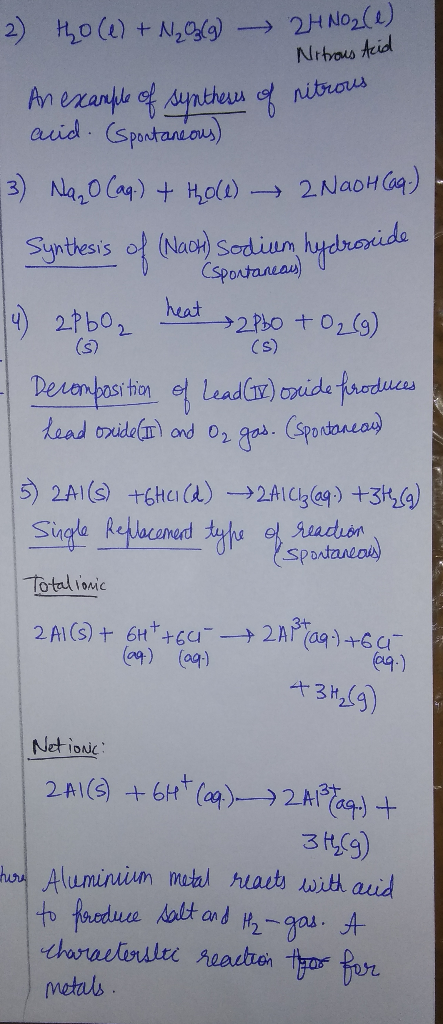
Identify each of the following reactions as synthesis, decomposition, combustion, single replacement, or double replacement. If...
Practice Problem 7. Write a balanced chemical reaction for each of the following double replacement reactions....
 Practice Problem 7. Write a balanced chemical reaction for each of the following double replacement reactions. (a) Silver Nitrate and Hydrochloric Acid (b) Sodium Carbonate and Hydrochloric Acid (c) Sodium Hydroxide and Nitric Acid (d) Calcium Chloride and Sulfuric Acid (e) Sodium Carbonate and Barium Chloride (f) Copper (II) Sulfate and Barium Chloride (8) Iron (III) Chloride and Sodium Hydroxide Write the formula of the following double replacement reactions.
help! Section 1: Balance each of the following reactions. Your instructor may discuss the different types...
 help!
Section 1: Balance each of the following reactions. Your instructor may discuss the different types of reactions present in these examples. Reaction Type Al + O2 +Al:03 Synthesis Synthesis N2 + H2 + NH3 MgCO3 → MgO + CO2 KCIO: → KCI + 02 Cu + AgNO3 → Ag + Cu(NO3)2 Cl2 + Nal → NaCl + 1; HCI + NaOH + H:0 + NaCI BiCl3 + H2S → Bi2S3 + HCI Section II: Balance each of the following...
help!
Section 1: Balance each of the following reactions. Your instructor may discuss the different types of reactions present in these examples. Reaction Type Al + O2 +Al:03 Synthesis Synthesis N2 + H2 + NH3 MgCO3 → MgO + CO2 KCIO: → KCI + 02 Cu + AgNO3 → Ag + Cu(NO3)2 Cl2 + Nal → NaCl + 1; HCI + NaOH + H:0 + NaCI BiCl3 + H2S → Bi2S3 + HCI Section II: Balance each of the following...
Post Laboratory Questions 1. Write the equation for the decomposition of sulfurous acid. Usingl 2. Using...
 Post Laboratory Questions 1. Write the equation for the decomposition of sulfurous acid. Usingl 2. Using the three criteria for double displacement reactions, and the solubility table. predict whether a double displacement reaction will occur for each of the following. If the reaction will occur, balance the reaction write conventional, total ionic and net ionic equations. Box the net ionic equation. Be sure to include the proper phase labels. If no reaction will occur. write "no reaction". All reactants are...
Identify each of the following aqueous reactions as double-displacement or single-displacement. Then write molecular, total ionic,...
 Identify each of the following aqueous reactions as
double-displacement or single-displacement. Then write molecular,
total ionic, and net ionic equations for each.
a. zinc chloride and sodium phosphate
b. tin(II) hydroxide and nitric acid
c. iron(II) iodide and aluminum
d. chromium(III) perchlorate and boric acid
Write answers in provided spaces. Show all work for calculation-based questions, including molar masses. Do your own work. Write your own answers. Use the solubility rules from Appendix J (p. 286) in the lab manual....
Identify each of the following aqueous reactions as
double-displacement or single-displacement. Then write molecular,
total ionic, and net ionic equations for each.
a. zinc chloride and sodium phosphate
b. tin(II) hydroxide and nitric acid
c. iron(II) iodide and aluminum
d. chromium(III) perchlorate and boric acid
Write answers in provided spaces. Show all work for calculation-based questions, including molar masses. Do your own work. Write your own answers. Use the solubility rules from Appendix J (p. 286) in the lab manual....
Experiment 8 Double Replacement Reactions Background: Some reactions have the net effect of causing the cation...
 Experiment 8 Double Replacement Reactions Background: Some reactions have the net effect of causing the cation of each reactant to trade places, forming a compound with the other anion. These reactions are known as double replacement reactions. In the example below (unbalanced equation), the barium and sodium cations switch places so that barium forms a product with sulfate while sodium forms a product with chloride. Note that the formula of each product is determined by the charges of the ions,...
Write formula for compounds wite the correct formula for the following compounds: sodium bromide calcium chloride...
 Write formula for compounds
wite the correct formula for the following compounds: sodium bromide calcium chloride calcium sulfide copper(I) carbonate sulfuric acid diphosphorus pentoxide _ chloric acicd ammonium sulfate hydrochloric acid mercury(II) acetate lead (II) nitrite ammonium sulfite sodium sulfate nitrous acid nitric acid iron(III) sulfate barium fluoride copper(I) sulfite ammonium nitrate iron(III) hydroxide mercury(II) nitrate sulfurous acid hydrosulfuric acid iron(II) hydroxide lead(II) chloride calcium hydrogen carbonate sulfur trioxide phosphoric acid bromine pentafluoride dinitrogen tetroxide carbon monoxide aluminum carbonate ammonium...
Write formula for compounds
wite the correct formula for the following compounds: sodium bromide calcium chloride calcium sulfide copper(I) carbonate sulfuric acid diphosphorus pentoxide _ chloric acicd ammonium sulfate hydrochloric acid mercury(II) acetate lead (II) nitrite ammonium sulfite sodium sulfate nitrous acid nitric acid iron(III) sulfate barium fluoride copper(I) sulfite ammonium nitrate iron(III) hydroxide mercury(II) nitrate sulfurous acid hydrosulfuric acid iron(II) hydroxide lead(II) chloride calcium hydrogen carbonate sulfur trioxide phosphoric acid bromine pentafluoride dinitrogen tetroxide carbon monoxide aluminum carbonate ammonium...
Partner PART A. BALANCING EQUATIONS sulfur plus oxygen yields sulfur trioxide carbon plus oxygen yields carbon...
 Partner PART A. BALANCING EQUATIONS sulfur plus oxygen yields sulfur trioxide carbon plus oxygen yields carbon dioxide Name Date Combination reactions silver plus sulfur yields silver sulfide sulfur dioxide plus water gives sulfuric acid 3 Decomposition reactions sodium carbonate in the presence of heat produces carbon dioxide and sodium oxide carbonic acid produces carbon dioxide and water ammonium hydroxide produces ammonia and water potassium chlorate (KCIO,) plus heat gives potassium chloride and oxygen Single replacement reactions copper plus silver nitrate...
FOR OUESTIONS 25- 34. For all single replacement reactions below predict whether or not the reaction...
 FOR OUESTIONS 25- 34. For all single replacement reactions below predict whether or not the reaction will occur using your activity series of metals. For all double replacement reactions predict the products and predict solubility for the reactants and products. Then, balance all reactions that occur. 25. Zn + Cuso, AB Yes, a reaction will occur. 26. KOH + H,SO, K_250_4+H_20. 2KOH + H_250_4-K_250_4-2H_20 27. Nal + B, AB No reaction 28. Bry + NaCl AB Yes, a reaction will...
Chemical Reactions and Equations Write balanced chemical equations for the following reactions and also identifying them...
 Chemical Reactions and Equations Write balanced chemical equations for the following reactions and also identifying them as formation, decomposition, single replacement, double replacement or combustion reactions. Reaction between sodium carbonate and nitric acid to produce sodium nitrate, carbon dioxide and water a. b. Reaction between silver (1) nitrate and hydrogen sulfide gas. c. Reaction between sodium and water to produce hydrogen gas and sodium hydroxide. d. Reaction between sodium and chlorine to produce sodium chloride. e. Reaction between lead(II) chloride...
Chemical Reactions For each reaction you observed, the names of the reactants and products are given...
 Chemical Reactions For each reaction you observed, the names of the reactants and products are given below. You must: 1. Write the correct formula for each reactant and product. Balance each equation. 2. A. Combination reactions magnesium oxide 1. Magnesium + oxygen (unbalanced) Mg+ O, MgO sulfur dioxide 2. Sulfur + oxygen B. Analysis of the Copper Content of a Penny po zinc chloride + hydrogen zinc + hydrochloric acid HCI ZnCl, 1. (unbalanced) н, Zn + C. Single Replacement...
 Practice Problem 7. Write a balanced chemical reaction for each of the following double replacement reactions. (a) Silver Nitrate and Hydrochloric Acid (b) Sodium Carbonate and Hydrochloric Acid (c) Sodium Hydroxide and Nitric Acid (d) Calcium Chloride and Sulfuric Acid (e) Sodium Carbonate and Barium Chloride (f) Copper (II) Sulfate and Barium Chloride (8) Iron (III) Chloride and Sodium Hydroxide Write the formula of the following double replacement reactions.
 help!
Section 1: Balance each of the following reactions. Your instructor may discuss the different types of reactions present in these examples. Reaction Type Al + O2 +Al:03 Synthesis Synthesis N2 + H2 + NH3 MgCO3 → MgO + CO2 KCIO: → KCI + 02 Cu + AgNO3 → Ag + Cu(NO3)2 Cl2 + Nal → NaCl + 1; HCI + NaOH + H:0 + NaCI BiCl3 + H2S → Bi2S3 + HCI Section II: Balance each of the following...
help!
Section 1: Balance each of the following reactions. Your instructor may discuss the different types of reactions present in these examples. Reaction Type Al + O2 +Al:03 Synthesis Synthesis N2 + H2 + NH3 MgCO3 → MgO + CO2 KCIO: → KCI + 02 Cu + AgNO3 → Ag + Cu(NO3)2 Cl2 + Nal → NaCl + 1; HCI + NaOH + H:0 + NaCI BiCl3 + H2S → Bi2S3 + HCI Section II: Balance each of the following...
 Post Laboratory Questions 1. Write the equation for the decomposition of sulfurous acid. Usingl 2. Using the three criteria for double displacement reactions, and the solubility table. predict whether a double displacement reaction will occur for each of the following. If the reaction will occur, balance the reaction write conventional, total ionic and net ionic equations. Box the net ionic equation. Be sure to include the proper phase labels. If no reaction will occur. write "no reaction". All reactants are...
 Identify each of the following aqueous reactions as
double-displacement or single-displacement. Then write molecular,
total ionic, and net ionic equations for each.
a. zinc chloride and sodium phosphate
b. tin(II) hydroxide and nitric acid
c. iron(II) iodide and aluminum
d. chromium(III) perchlorate and boric acid
Write answers in provided spaces. Show all work for calculation-based questions, including molar masses. Do your own work. Write your own answers. Use the solubility rules from Appendix J (p. 286) in the lab manual....
Identify each of the following aqueous reactions as
double-displacement or single-displacement. Then write molecular,
total ionic, and net ionic equations for each.
a. zinc chloride and sodium phosphate
b. tin(II) hydroxide and nitric acid
c. iron(II) iodide and aluminum
d. chromium(III) perchlorate and boric acid
Write answers in provided spaces. Show all work for calculation-based questions, including molar masses. Do your own work. Write your own answers. Use the solubility rules from Appendix J (p. 286) in the lab manual....
 Experiment 8 Double Replacement Reactions Background: Some reactions have the net effect of causing the cation of each reactant to trade places, forming a compound with the other anion. These reactions are known as double replacement reactions. In the example below (unbalanced equation), the barium and sodium cations switch places so that barium forms a product with sulfate while sodium forms a product with chloride. Note that the formula of each product is determined by the charges of the ions,...
 Write formula for compounds
wite the correct formula for the following compounds: sodium bromide calcium chloride calcium sulfide copper(I) carbonate sulfuric acid diphosphorus pentoxide _ chloric acicd ammonium sulfate hydrochloric acid mercury(II) acetate lead (II) nitrite ammonium sulfite sodium sulfate nitrous acid nitric acid iron(III) sulfate barium fluoride copper(I) sulfite ammonium nitrate iron(III) hydroxide mercury(II) nitrate sulfurous acid hydrosulfuric acid iron(II) hydroxide lead(II) chloride calcium hydrogen carbonate sulfur trioxide phosphoric acid bromine pentafluoride dinitrogen tetroxide carbon monoxide aluminum carbonate ammonium...
Write formula for compounds
wite the correct formula for the following compounds: sodium bromide calcium chloride calcium sulfide copper(I) carbonate sulfuric acid diphosphorus pentoxide _ chloric acicd ammonium sulfate hydrochloric acid mercury(II) acetate lead (II) nitrite ammonium sulfite sodium sulfate nitrous acid nitric acid iron(III) sulfate barium fluoride copper(I) sulfite ammonium nitrate iron(III) hydroxide mercury(II) nitrate sulfurous acid hydrosulfuric acid iron(II) hydroxide lead(II) chloride calcium hydrogen carbonate sulfur trioxide phosphoric acid bromine pentafluoride dinitrogen tetroxide carbon monoxide aluminum carbonate ammonium...
 Partner PART A. BALANCING EQUATIONS sulfur plus oxygen yields sulfur trioxide carbon plus oxygen yields carbon dioxide Name Date Combination reactions silver plus sulfur yields silver sulfide sulfur dioxide plus water gives sulfuric acid 3 Decomposition reactions sodium carbonate in the presence of heat produces carbon dioxide and sodium oxide carbonic acid produces carbon dioxide and water ammonium hydroxide produces ammonia and water potassium chlorate (KCIO,) plus heat gives potassium chloride and oxygen Single replacement reactions copper plus silver nitrate...
 FOR OUESTIONS 25- 34. For all single replacement reactions below predict whether or not the reaction will occur using your activity series of metals. For all double replacement reactions predict the products and predict solubility for the reactants and products. Then, balance all reactions that occur. 25. Zn + Cuso, AB Yes, a reaction will occur. 26. KOH + H,SO, K_250_4+H_20. 2KOH + H_250_4-K_250_4-2H_20 27. Nal + B, AB No reaction 28. Bry + NaCl AB Yes, a reaction will...
 Chemical Reactions and Equations Write balanced chemical equations for the following reactions and also identifying them as formation, decomposition, single replacement, double replacement or combustion reactions. Reaction between sodium carbonate and nitric acid to produce sodium nitrate, carbon dioxide and water a. b. Reaction between silver (1) nitrate and hydrogen sulfide gas. c. Reaction between sodium and water to produce hydrogen gas and sodium hydroxide. d. Reaction between sodium and chlorine to produce sodium chloride. e. Reaction between lead(II) chloride...
 Chemical Reactions For each reaction you observed, the names of the reactants and products are given below. You must: 1. Write the correct formula for each reactant and product. Balance each equation. 2. A. Combination reactions magnesium oxide 1. Magnesium + oxygen (unbalanced) Mg+ O, MgO sulfur dioxide 2. Sulfur + oxygen B. Analysis of the Copper Content of a Penny po zinc chloride + hydrogen zinc + hydrochloric acid HCI ZnCl, 1. (unbalanced) н, Zn + C. Single Replacement...
Most questions answered within 3 hours.
-
Where is the error in this code sequence?
String s1 = "Hello";
String s2 = "ello";...
asked 11 months ago -
Financial data for Joel de Paris, Inc., for last year
follow:
Joel de Paris, Inc.
Balance...
asked 11 months ago -
Consider this reaction:
Al2(SO4)3 (aq)+ BaCl3
(aq) Al2Cl6 (aq)- +
3BaSO4(s) . What is the...
asked 11 months ago -
Suppose that Savneet is considering increasing her
recent random sample from 20 car rentals to 40...
asked 11 months ago -
Trucks arrive at an unloading terminal at an average rate of 120
per hour.
Trucks arrive...
asked 11 months ago -
Why are methanol and ethanol completely soluble in water while
octanol is not very little soluble....
asked 11 months ago -
A facilities manager at a university reads in a research report
that the mean amount of...
asked 11 months ago -
When the CuSO4 is rehydrated by adding water to the anhydrous
compound, is this an endothermic...
asked 11 months ago -
A ray of sunlight is passing from diamond into crown glass; the
angle of incidence is...
asked 11 months ago -
A block of mass 0.249 kg is placed on top of a light, vertical
spring of...
asked 11 months ago -
how do the kidneys compensate in the presences of acidosis
a) trigger hyperventilate
b) reserve acid...
asked 11 months ago -
Question 501 pts
The rental rate of capital to the firm increases. Which of the
following...
asked 11 months ago