
Homework Answers
2) 1) Business cycle refers to the fluctuations in economic activities which keeps recurring. There are 5 phases of business cycle:
boom,
recession,
slump/ trough,
recovery/ expansion,
recession
2)
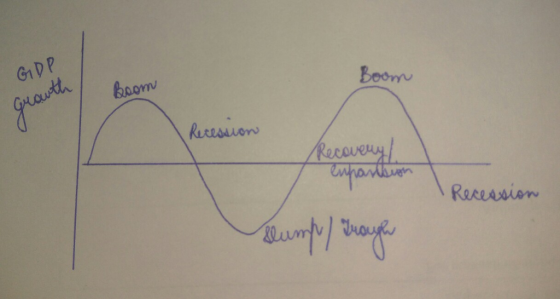
The phases of business cycle are marked on the diagram.
3) a)Demand for bond increases
During expansion of business cycle the income and wealth increases and demand for bonds rises shifting the demand curve to right. So demand for bonds rises during expansion.
b) Demand for bonds decreases.
During recession the demand for bonds reduces because the income and wealth od individuals is reducing. This leads to demand curve shifting to left.
c) Supply of bonds increases
During expansion the demand increases and the output is also increasing. Investors find this phase favorable for good investment opportunities and hence the supply of bonds increases shifting the supply curve to right.
d) Supply of bonds decreases
During recession the opportunities for investors reduces as the demand and overall output is falling. This shifts the supply curve to left and the supply of bonds is decreasing.
(You can comment for doubts)
Add Answer to:
Question 2 1. What is the "business cycle"? 2. Provide a visual representation of the business...
QUESTION 9 "Microsoft Excel ____ provide a visual representation of quantitative information, giving the viewer an...
QUESTION 9 "Microsoft Excel ____ provide a visual representation of quantitative information, giving the viewer an overall picture of a set of data." charts spreadsheets tables worksheets QUESTION 10 Information systems can give a business a competitive advantage by Decreasing costs and improving efficiency Improving quality and customer service Providing more features that customers want than competitors offer All of the above QUESTION 11 Consider the market for portable air conditioners in equilibrium. When a heat wave strikes the equilibrium...
7. The business cycle What Is a Business Cycle and How Does It Affect You? The term business cycle, or economic cycle,...
 7. The business cycle What Is a Business Cycle and How Does It Affect You? The term business cycle, or economic cycle, describes the pattern of expanding and contracting business activity that an economy exhibits over a period of time. In this context, increasing production and consumption are generally referred to as economic growth, and declining production and consumption are usually called economic contraction. What are the phases of a business cycle? Which of the following statements accurately describe the...
1. What is the business cycle? How does unemployment and inflation vary over the business cycle? 2. What...
1. What is the business cycle? How does unemployment and inflation vary over the business cycle? 2. What is NAIRU and why is it important. What problems will the economy face if there is a large output gap? 3. Explain the impact of government expenditures on the equilibrium level of income. How does this differ from the effect of changes in taxation? What is the multiplier? 4 . Explain the impact of the time lags associated with discretionary fiscal policy. Which do you think is...
1) Thinking back to the business cycle discussion, how would Keynesian economists explain the performance of...
1) Thinking back to the business cycle discussion, how would Keynesian economists explain the performance of the economy during the last few years? What has happened to aggregate demand? 2) Next, how would neoclassical economists explain the performance of the economy during the last few years? What has happened to aggregate supply?
Question 1: A business cycle refers to: the short-run fluctuations in real GDP. the life-cycle of...
Question 1: A business cycle refers to: the short-run fluctuations in real GDP. the life-cycle of firms from infancy to maturity. the flow of goods and services and factors of production through the economy. the long-run trend of increasing real GDP. Question 2: Which of the following industries would experience the greatest increase in demand during an expansion? Accounting services. Baby supply industry. Hair care industry. The furniture industry.
6) Suppose that currently nominal interest rates, inflation, and expected inflation are all 2% right now...
 6) Suppose that currently nominal interest rates, inflation, and expected inflation are all 2% right now a)Suppose the Federal Reserve increases interest rates in the economy. Draw a well labeled supply 2 and demand diagram that shows how they typically would do that and how it affects the supply & demand in the money market and bond market. Suppose that when the Federal Reserve takes this action and expected inflation decreases from 2% to 1%. Show the effect of this...
Suppose that currently nominal interest rates, inflation, and expected inflation are all 2% right now. a)...
Suppose that currently nominal interest rates, inflation, and expected inflation are all 2% right now. a) Suppose the Federal Reserve increases interest rates in the economy. Draw a well labeled supply and demand diagram that shows how they typically would do that and how it affects the supply & demand in the money market and bond market. b) Suppose that when the Federal Reserve takes this action and expected inflation decreases from 2% to 1%. Show the effect of this...
Suppose that currently nominal interest rates, inflation, and expected inflation are all 2% right now Suppose...
 Suppose that currently nominal interest rates, inflation, and expected inflation are all 2% right now Suppose the Federal Reserve increases interest rates in the economy. Draw a well labeled supply and demand diagram that shows how they typically would do that and how it affects the supply & demand in the money market and bond market. Suppose that when the Federal Reserve takes this action and expected inflation decreases from 2% to 1%. Show the effect of this change in...
6) Suppose that currently nominal interest rates, inflation, and expected inflation are all 2% right now....
6) Suppose that currently nominal interest rates, inflation, and expected inflation are all 2% right now. a) Suppose the Federal Reserve increases interest rates in the economy. Draw a well labeled supply and demand diagram that shows how they typically would do that and how it affects the supply & demand in the money market and bond market. b) Suppose that when the Federal Reserve takes this action and expected inflation decreases from 2% to 1%. Show the effect of...
6) Suppose that currently nominal interest rates, inflation, and expected inflation are all 2% right now....
 6) Suppose that currently nominal interest rates, inflation, and expected inflation are all 2% right now. Suppose the Federal Reserve increases interest rates in the economy. Draw a well labeled supply and demand diagram that shows how they typically would do that and how it affects the supply & demand in the money market and bond market. a) b)Suppose that when the Federal Reserve takes this action and expected inflation decreases from 2% to 1%. Show the effect of this...
 7. The business cycle What Is a Business Cycle and How Does It Affect You? The term business cycle, or economic cycle, describes the pattern of expanding and contracting business activity that an economy exhibits over a period of time. In this context, increasing production and consumption are generally referred to as economic growth, and declining production and consumption are usually called economic contraction. What are the phases of a business cycle? Which of the following statements accurately describe the...
 6) Suppose that currently nominal interest rates, inflation, and expected inflation are all 2% right now a)Suppose the Federal Reserve increases interest rates in the economy. Draw a well labeled supply 2 and demand diagram that shows how they typically would do that and how it affects the supply & demand in the money market and bond market. Suppose that when the Federal Reserve takes this action and expected inflation decreases from 2% to 1%. Show the effect of this...
 Suppose that currently nominal interest rates, inflation, and expected inflation are all 2% right now Suppose the Federal Reserve increases interest rates in the economy. Draw a well labeled supply and demand diagram that shows how they typically would do that and how it affects the supply & demand in the money market and bond market. Suppose that when the Federal Reserve takes this action and expected inflation decreases from 2% to 1%. Show the effect of this change in...
 6) Suppose that currently nominal interest rates, inflation, and expected inflation are all 2% right now. Suppose the Federal Reserve increases interest rates in the economy. Draw a well labeled supply and demand diagram that shows how they typically would do that and how it affects the supply & demand in the money market and bond market. a) b)Suppose that when the Federal Reserve takes this action and expected inflation decreases from 2% to 1%. Show the effect of this...
Most questions answered within 3 hours.
-
Where is the error in this code sequence?
String s1 = "Hello";
String s2 = "ello";...
asked 10 months ago -
Financial data for Joel de Paris, Inc., for last year
follow:
Joel de Paris, Inc.
Balance...
asked 10 months ago -
Consider this reaction:
Al2(SO4)3 (aq)+ BaCl3
(aq) Al2Cl6 (aq)- +
3BaSO4(s) . What is the...
asked 10 months ago -
Suppose that Savneet is considering increasing her
recent random sample from 20 car rentals to 40...
asked 10 months ago -
Trucks arrive at an unloading terminal at an average rate of 120
per hour.
Trucks arrive...
asked 10 months ago -
Why are methanol and ethanol completely soluble in water while
octanol is not very little soluble....
asked 10 months ago -
A facilities manager at a university reads in a research report
that the mean amount of...
asked 10 months ago -
When the CuSO4 is rehydrated by adding water to the anhydrous
compound, is this an endothermic...
asked 10 months ago -
A ray of sunlight is passing from diamond into crown glass; the
angle of incidence is...
asked 10 months ago -
A block of mass 0.249 kg is placed on top of a light, vertical
spring of...
asked 10 months ago -
how do the kidneys compensate in the presences of acidosis
a) trigger hyperventilate
b) reserve acid...
asked 10 months ago -
Question 501 pts
The rental rate of capital to the firm increases. Which of the
following...
asked 10 months ago