
Homework Answers
Please Check the value of alpha from your reference book, as it can be different in different books.
Relation between change in length and temperature is given by:
dL = L0*alpha*dT
L0 = original length of concrete slabs = 375 cm = 3.75 m
alpha = thermal expansion coefficient of concrete slabs = 12*10^-6 /C
dT = change in temperature = Tf - Ti
Tf = 0 F = -17.78 C
Ti = 115 F = 46.11 C
So, Using these values:
dL = 3.75*12*10^-6*(-17.78 - 46.11)
dL = -2.87*10^-3 m
dL = -2.87 mm
So gap at 0 F will be 2.87 mm
Please Upvote.
Add Answer to:
A concrete bridge is built of 375-cm-long concrete slabs with an expansion joint between them. The...
A concrete bridge is built of 375-cm-long concrete slabs with an expansion joint between them. The...
 A concrete bridge is built of 375-cm-long concrete slabs with an expansion joint between them. The slabs just touch on a 115° F day the hottest day for which the bridge is designed. PartA What is the gap between the slabs when the temperature is O°F? Express your answer with the appropriate units AL- Value Units Submit Provide Feedback
A concrete highway is built of slabs 14 m long (15 ∘C). Part A How wide...
A concrete highway is built of slabs 14 m long (15 ∘C). Part A How wide should the expansion cracks between the slabs be (at 15 ∘C) to prevent buckling if the range of temperature is -30∘C to +47 ∘C? Express your answer to two significant figures and include the appropriate units. ΔL ΔL = nothingnothing SubmitRequest Answer
FQ4 Two concrete slabs of a 250m bridge are assembled without any space between them, as...
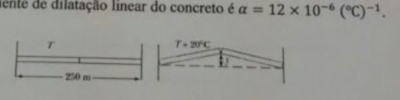 FQ4 Two concrete slabs of a 250m bridge are assembled without
any space between them, as in the figure below the left. After a
rise in the ambient temperature of 20 ° C, the contact region
between the plates rises to a height y, as indicated in the figure
below, to the right. Calculate the value of y. The linear expansion
coefficient of the concrete is 12E-6
de dilatação linear do concreto é α = 12 × 10-6 (°C)-1.
FQ4 Two concrete slabs of a 250m bridge are assembled without
any space between them, as in the figure below the left. After a
rise in the ambient temperature of 20 ° C, the contact region
between the plates rises to a height y, as indicated in the figure
below, to the right. Calculate the value of y. The linear expansion
coefficient of the concrete is 12E-6
de dilatação linear do concreto é α = 12 × 10-6 (°C)-1.
A concrete highway is built of slabs 10 m long (20 degree C). How wide should...
 A concrete highway is built of slabs 10 m long (20 degree C). How wide should the expansion cracks between the slabs be (at 15 degree C) to prevent buckling if the range of temperature is -30 degree C to 47 degree C? Express your answer using two significant figures. Delta t = 3.240. middot 10^-3
A concrete highway is built of slabs 20 m long (20 degree C). How wide should...
 A concrete highway is built of slabs 20 m long (20 degree C). How wide should the expansion cracks between the slabs be (at 20 degree C) to prevent buckling if the range of temperature is -30 degree C to +55 degree C?
Expansion joints are used to allow for thermal expansion bridges. A steel bridge with a single...
Expansion joints are used to allow for thermal expansion bridges. A steel bridge with a single expansion joint must operate between temperature extremes -50 F and 150 F, the gap in the joint is fully closed and the bridge is 100 m long. The linear expansion coefficient of steel is 12 x 10^-6 (Celcius). What is the gap at -50 F? Express your answer in centimeters.
A bridge is made with segments of concrete 50 m long. If the linear expansion coefficient...
A bridge is made with segments of concrete 50 m long. If the linear expansion coefficient is 12 X 10–6 (°C)–1 , how much spacing (in cm) is needed to allow for expansion during an extreme temperature change of 150°F? ANSWER. 5.0 cm PLEASE EXPLAIN YOUR CONVERSIONS AND STEPS
Question 3 A 11 m x15m house is built on a 14 cm -thick concrete slab....
 Question 3 A 11 m x15m house is built on a 14 cm -thick concrete slab. Part A What is the heat-loss rate through the slab if the ground temperature is 5 ° while the interior of the house is 24 Express your answer using two significant figures. ? kW At Submit Request Answer
Full solution thank The 12-m-long A-36 steel rails on a train track are laid with a...
 Full solution thank
The 12-m-long A-36 steel rails on a train track are laid with a small gap between them to allow for thermal expansion. The CROSS-sectional area of each railis 3100 mm . (Figure 1) - Part A Determine the required gap & so that the rails just touch one another when the temperature is increased from Ti -30°C to 30°C Express your answer to three significant figures and include the appropriate units. :MAO ? Value Units Fiqure 1...
Full solution thank
The 12-m-long A-36 steel rails on a train track are laid with a small gap between them to allow for thermal expansion. The CROSS-sectional area of each railis 3100 mm . (Figure 1) - Part A Determine the required gap & so that the rails just touch one another when the temperature is increased from Ti -30°C to 30°C Express your answer to three significant figures and include the appropriate units. :MAO ? Value Units Fiqure 1...
ll Review PartA A 5.00 m -tall, 90.0 cm -diameter concrete column supports a 5.00x10⁵ kg...
 ll Review PartA A 5.00 m -tall, 90.0 cm -diameter concrete column supports a 5.00x10⁵ kg load. By how much is the column compressed? Express your answer with the appropriate units. alue Units Submit Request Answer
 A concrete bridge is built of 375-cm-long concrete slabs with an expansion joint between them. The slabs just touch on a 115° F day the hottest day for which the bridge is designed. PartA What is the gap between the slabs when the temperature is O°F? Express your answer with the appropriate units AL- Value Units Submit Provide Feedback
 FQ4 Two concrete slabs of a 250m bridge are assembled without
any space between them, as in the figure below the left. After a
rise in the ambient temperature of 20 ° C, the contact region
between the plates rises to a height y, as indicated in the figure
below, to the right. Calculate the value of y. The linear expansion
coefficient of the concrete is 12E-6
de dilatação linear do concreto é α = 12 × 10-6 (°C)-1.
FQ4 Two concrete slabs of a 250m bridge are assembled without
any space between them, as in the figure below the left. After a
rise in the ambient temperature of 20 ° C, the contact region
between the plates rises to a height y, as indicated in the figure
below, to the right. Calculate the value of y. The linear expansion
coefficient of the concrete is 12E-6
de dilatação linear do concreto é α = 12 × 10-6 (°C)-1.
 A concrete highway is built of slabs 10 m long (20 degree C). How wide should the expansion cracks between the slabs be (at 15 degree C) to prevent buckling if the range of temperature is -30 degree C to 47 degree C? Express your answer using two significant figures. Delta t = 3.240. middot 10^-3
 A concrete highway is built of slabs 20 m long (20 degree C). How wide should the expansion cracks between the slabs be (at 20 degree C) to prevent buckling if the range of temperature is -30 degree C to +55 degree C?
 Question 3 A 11 m x15m house is built on a 14 cm -thick concrete slab. Part A What is the heat-loss rate through the slab if the ground temperature is 5 ° while the interior of the house is 24 Express your answer using two significant figures. ? kW At Submit Request Answer
 Full solution thank
The 12-m-long A-36 steel rails on a train track are laid with a small gap between them to allow for thermal expansion. The CROSS-sectional area of each railis 3100 mm . (Figure 1) - Part A Determine the required gap & so that the rails just touch one another when the temperature is increased from Ti -30°C to 30°C Express your answer to three significant figures and include the appropriate units. :MAO ? Value Units Fiqure 1...
Full solution thank
The 12-m-long A-36 steel rails on a train track are laid with a small gap between them to allow for thermal expansion. The CROSS-sectional area of each railis 3100 mm . (Figure 1) - Part A Determine the required gap & so that the rails just touch one another when the temperature is increased from Ti -30°C to 30°C Express your answer to three significant figures and include the appropriate units. :MAO ? Value Units Fiqure 1...
 ll Review PartA A 5.00 m -tall, 90.0 cm -diameter concrete column supports a 5.00x10⁵ kg load. By how much is the column compressed? Express your answer with the appropriate units. alue Units Submit Request Answer
Most questions answered within 3 hours.
-
Where is the error in this code sequence?
String s1 = "Hello";
String s2 = "ello";...
asked 10 months ago -
Financial data for Joel de Paris, Inc., for last year
follow:
Joel de Paris, Inc.
Balance...
asked 10 months ago -
Consider this reaction:
Al2(SO4)3 (aq)+ BaCl3
(aq) Al2Cl6 (aq)- +
3BaSO4(s) . What is the...
asked 10 months ago -
Suppose that Savneet is considering increasing her
recent random sample from 20 car rentals to 40...
asked 10 months ago -
Trucks arrive at an unloading terminal at an average rate of 120
per hour.
Trucks arrive...
asked 10 months ago -
Why are methanol and ethanol completely soluble in water while
octanol is not very little soluble....
asked 10 months ago -
A facilities manager at a university reads in a research report
that the mean amount of...
asked 10 months ago -
When the CuSO4 is rehydrated by adding water to the anhydrous
compound, is this an endothermic...
asked 10 months ago -
A ray of sunlight is passing from diamond into crown glass; the
angle of incidence is...
asked 10 months ago -
A block of mass 0.249 kg is placed on top of a light, vertical
spring of...
asked 10 months ago -
how do the kidneys compensate in the presences of acidosis
a) trigger hyperventilate
b) reserve acid...
asked 10 months ago -
Question 501 pts
The rental rate of capital to the firm increases. Which of the
following...
asked 10 months ago