
Homework Answers
Qd = 10 - 5P
Qs = 6 + 3P
At equilibrium, Qd = Qs
10 - 5 P = 6 + 3P
4 = 8P
P = 0.5
Put P in either Qd or Qs,
Q = 10 - 5 * 0.5 = 7.5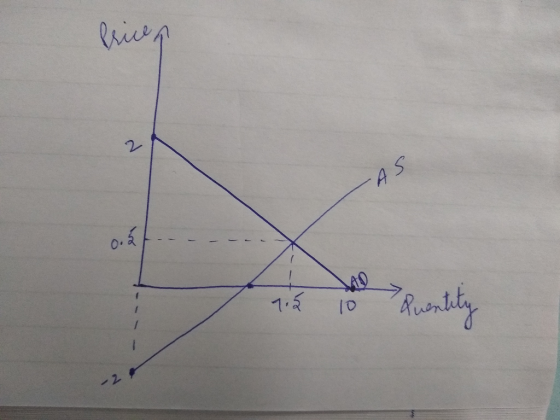
Add Answer to:
q=10-5p
q=6+3p
Q = 10-5P Demano! Q=6+3P supply 1o-SP=643P -SP-3p=6-10 - 8p=-4 P= I (05) pt...
Given Q-10-Sp Demand Q-6+3P Solved for P and Q 0-5p-6+3P 4-8P QElo-5 Q-p Q75 a 75 Draw the graph for the two functi...
 Given Q-10-Sp Demand Q-6+3P Solved for P and Q 0-5p-6+3P 4-8P QElo-5 Q-p Q75 a 75 Draw the graph for the two functions G-6-3P9P &6+ 3 G1o-5 a2-P O10-5 P22 C-613p O-622 3 3 39-2-P
In a small country, the demand curve is given as: Q=100-5P, supply curve: Q=3P-12, and the world price is $10. I. Wha...
In a small country, the demand curve is given as: Q=100-5P, supply curve: Q=3P-12, and the world price is $10. I. What is the social surplus under free trade? (5%) II. If the government impose a $2/unit tariff on the good, what is the deadweight loss? (10%) III. Show the change in equilibrium and deadweight loss on a graph. (10%)
Question 1: In a perfectly competitive market, the demand curve is given as: Q=100-5P, the supply curve is given as Q=3P...
Question 1: In a perfectly competitive market, the demand curve is given as: Q=100-5P, the supply curve is given as Q=3P-12. Compute the total social surplus of this market. If the government impose a tax on the producers, and the tax rate is $2 per unit produced. What is the deadweight loss? If the government impose a tax on the consumers, and the tax rate is $2 per unit purchased, graphically show the change in the market equilibrium and the...
2. Let the demand and supply functions be as follows: (a) Qd-51 – 3P (6) Qd...
 2. Let the demand and supply functions be as follows: (a) Qd-51 – 3P (6) Qd = 30 – 2P Qs = 6P - 10 Qs = -6 +5P find P* and Q* by elimination of variables. (Use fractions rather than decimals.) 3. According to (3.5), for Q* to be positive, it is necessary that the expression (ad – bc) have the same algebraic sign as (b+d). Verify that this condition is indeed satisfied in the models of Probs. 1...
Q(p) = 10 + 3p Q(p) = 15 - 2p^2 (2)The following equations describe the market...
 Q(p) = 10 + 3p
Q(p) = 15 - 2p^2
(2)The following equations describe the market for commodity X. Q(p) = 10 + 3P.. Q(p) = 15 - 2P .....(2) (a)Which of the two equations is the demand equation and which is the supply equation? Explain. (b) Find the equilibrium price and the equilibrium quantity transacted in this market. (C)Find the price elasticity of demand at equilibrium and comment on how the firm could use this information if it considers...
Q(p) = 10 + 3p
Q(p) = 15 - 2p^2
(2)The following equations describe the market for commodity X. Q(p) = 10 + 3P.. Q(p) = 15 - 2P .....(2) (a)Which of the two equations is the demand equation and which is the supply equation? Explain. (b) Find the equilibrium price and the equilibrium quantity transacted in this market. (C)Find the price elasticity of demand at equilibrium and comment on how the firm could use this information if it considers...
3. The demand and supply for wine are given by Q-20-P and Q-3P, respectively. P is...
 3. The demand and supply for wine are given by Q-20-P and Q-3P, respectively. P is the dollar price of wine per bottle, and Q is the number of bottles (unit: thousand bottles). (1) What is the equilibrium price and quantity? (2) Suppose now the government imposes a per-unit tax of $4 on the sellers. Solve for the nevw equilibrium price and quantity, the price sellers received, and the price consumers paid. (3) Calculate the government tax revenue. (4) What...
1. Simple Supply and Demand. Q = 60-10P+2Y Q = 100+5P-15Pc P= Price of pizza Y...
 1. Simple Supply and Demand. Q = 60-10P+2Y Q = 100+5P-15Pc P= Price of pizza Y = Aggregate income P = Price of fresh mozzarella a. Identify the exogenous and endogenous variables: b. Solve for p in terms of the exogenous variable. c. Let Y = 10 and Pc = 2. Solve for the equilibrium P and Q d. Suppose Y increases to 12: i. Present a graph showing the impact of the increase in Y(which curve moves which way)....
Question 1 (45%): In a perfectly competitive market, the demand curve is given as: Q=100-5P, the supply curve is given...
Question 1 (45%): In a perfectly competitive market, the demand curve is given as: Q=100-5P, the supply curve is given as Q=3P-12. I. Compute the total social surplus of this market. (10%) II. If the government impose a tax on the producers, and the tax rate is $2 per unit produced. What is the deadweight loss? (10%) III. If the government impose a tax on the consumers, and the tax rate is $2 per unit purchased, graphically show the change...
What is the equilibrium price and quantity? P=10, Q=0 P=6,Q=4
 What is the equilibrium price and quantity?
P=10,
Q=0
P=6,Q=4
P=5,Q=5
P=0,Q=10
Use the image above. What happens when the market price is
$4?
Shortage
Nothing
Surplus
Equilibrium
Using the same image. What happens if the price is
$10?
Shortage
Nothing
Surplus
Equilibrium
Demand and Supply Price $10 Quantity Demanded Quantity Supplied 0 1 2 3 4 5 6 7 8 9 10 Quantity
What is the equilibrium price and quantity?
P=10,
Q=0
P=6,Q=4
P=5,Q=5
P=0,Q=10
Use the image above. What happens when the market price is
$4?
Shortage
Nothing
Surplus
Equilibrium
Using the same image. What happens if the price is
$10?
Shortage
Nothing
Surplus
Equilibrium
Demand and Supply Price $10 Quantity Demanded Quantity Supplied 0 1 2 3 4 5 6 7 8 9 10 Quantity
(10 marks) Suppose the market for apples is represented by: Supply: Demand: -p Q-36-3p Find the...
 (10 marks) Suppose the market for apples is represented by: Supply: Demand: -p Q-36-3p Find the market equilibrium price and quantity. (2 marks) b. Find the price elasticity of demand at the equilibrium. (3 marks) Suppose bad weather results in a poor harvest of apples. Using the price elasticity calculated in (b), explain its effect on the total revenue of the apple farmers (5 marks)
 Given Q-10-Sp Demand Q-6+3P Solved for P and Q 0-5p-6+3P 4-8P QElo-5 Q-p Q75 a 75 Draw the graph for the two functions G-6-3P9P &6+ 3 G1o-5 a2-P O10-5 P22 C-613p O-622 3 3 39-2-P
 2. Let the demand and supply functions be as follows: (a) Qd-51 – 3P (6) Qd = 30 – 2P Qs = 6P - 10 Qs = -6 +5P find P* and Q* by elimination of variables. (Use fractions rather than decimals.) 3. According to (3.5), for Q* to be positive, it is necessary that the expression (ad – bc) have the same algebraic sign as (b+d). Verify that this condition is indeed satisfied in the models of Probs. 1...
 Q(p) = 10 + 3p
Q(p) = 15 - 2p^2
(2)The following equations describe the market for commodity X. Q(p) = 10 + 3P.. Q(p) = 15 - 2P .....(2) (a)Which of the two equations is the demand equation and which is the supply equation? Explain. (b) Find the equilibrium price and the equilibrium quantity transacted in this market. (C)Find the price elasticity of demand at equilibrium and comment on how the firm could use this information if it considers...
Q(p) = 10 + 3p
Q(p) = 15 - 2p^2
(2)The following equations describe the market for commodity X. Q(p) = 10 + 3P.. Q(p) = 15 - 2P .....(2) (a)Which of the two equations is the demand equation and which is the supply equation? Explain. (b) Find the equilibrium price and the equilibrium quantity transacted in this market. (C)Find the price elasticity of demand at equilibrium and comment on how the firm could use this information if it considers...
 3. The demand and supply for wine are given by Q-20-P and Q-3P, respectively. P is the dollar price of wine per bottle, and Q is the number of bottles (unit: thousand bottles). (1) What is the equilibrium price and quantity? (2) Suppose now the government imposes a per-unit tax of $4 on the sellers. Solve for the nevw equilibrium price and quantity, the price sellers received, and the price consumers paid. (3) Calculate the government tax revenue. (4) What...
 1. Simple Supply and Demand. Q = 60-10P+2Y Q = 100+5P-15Pc P= Price of pizza Y = Aggregate income P = Price of fresh mozzarella a. Identify the exogenous and endogenous variables: b. Solve for p in terms of the exogenous variable. c. Let Y = 10 and Pc = 2. Solve for the equilibrium P and Q d. Suppose Y increases to 12: i. Present a graph showing the impact of the increase in Y(which curve moves which way)....
 What is the equilibrium price and quantity?
P=10,
Q=0
P=6,Q=4
P=5,Q=5
P=0,Q=10
Use the image above. What happens when the market price is
$4?
Shortage
Nothing
Surplus
Equilibrium
Using the same image. What happens if the price is
$10?
Shortage
Nothing
Surplus
Equilibrium
Demand and Supply Price $10 Quantity Demanded Quantity Supplied 0 1 2 3 4 5 6 7 8 9 10 Quantity
What is the equilibrium price and quantity?
P=10,
Q=0
P=6,Q=4
P=5,Q=5
P=0,Q=10
Use the image above. What happens when the market price is
$4?
Shortage
Nothing
Surplus
Equilibrium
Using the same image. What happens if the price is
$10?
Shortage
Nothing
Surplus
Equilibrium
Demand and Supply Price $10 Quantity Demanded Quantity Supplied 0 1 2 3 4 5 6 7 8 9 10 Quantity
 (10 marks) Suppose the market for apples is represented by: Supply: Demand: -p Q-36-3p Find the market equilibrium price and quantity. (2 marks) b. Find the price elasticity of demand at the equilibrium. (3 marks) Suppose bad weather results in a poor harvest of apples. Using the price elasticity calculated in (b), explain its effect on the total revenue of the apple farmers (5 marks)
Most questions answered within 3 hours.
-
Where is the error in this code sequence?
String s1 = "Hello";
String s2 = "ello";...
asked 11 months ago -
Financial data for Joel de Paris, Inc., for last year
follow:
Joel de Paris, Inc.
Balance...
asked 11 months ago -
Consider this reaction:
Al2(SO4)3 (aq)+ BaCl3
(aq) Al2Cl6 (aq)- +
3BaSO4(s) . What is the...
asked 11 months ago -
Suppose that Savneet is considering increasing her
recent random sample from 20 car rentals to 40...
asked 11 months ago -
Trucks arrive at an unloading terminal at an average rate of 120
per hour.
Trucks arrive...
asked 11 months ago -
Why are methanol and ethanol completely soluble in water while
octanol is not very little soluble....
asked 11 months ago -
A facilities manager at a university reads in a research report
that the mean amount of...
asked 11 months ago -
When the CuSO4 is rehydrated by adding water to the anhydrous
compound, is this an endothermic...
asked 11 months ago -
A ray of sunlight is passing from diamond into crown glass; the
angle of incidence is...
asked 11 months ago -
A block of mass 0.249 kg is placed on top of a light, vertical
spring of...
asked 11 months ago -
how do the kidneys compensate in the presences of acidosis
a) trigger hyperventilate
b) reserve acid...
asked 11 months ago -
Question 501 pts
The rental rate of capital to the firm increases. Which of the
following...
asked 11 months ago