
Homework Answers
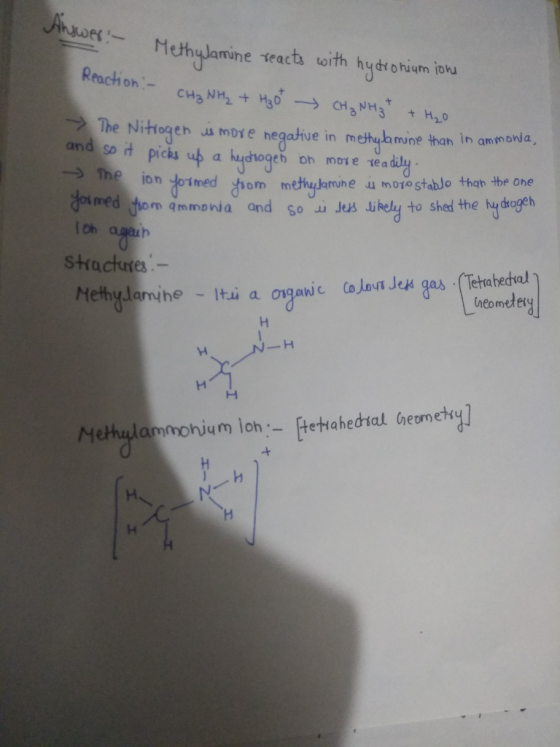
Answer- The methylamine and methylammonium ion molecular structure is tetrahedral.
1) In this react the nitrogen is more negative in methylamine thain in ammonia.
2) The ion formed from methylamine is more stable than the one formed from ammonia.
Add Answer to:
Methylamine, CH3NH2, reacts with hydronium ions in very much the same manner as ammonia. CH3NH2(aq) +...
1) Which one of the following is a Bronsted-Lowry acid? A) (CH3)3NH+ B) CH3COOH C) HNO2...
1) Which one of the following is a Bronsted-Lowry acid? A) (CH3)3NH+ B) CH3COOH C) HNO2 D) all of the above 2) Which one of the following statements regarding Kw is false? A) pKw is 14.00 at 25 °C. B) The value of Kw is always 1.0 × 10⁻¹⁴. C) Kw changes with temperature. D) The value of Kw shows that water is a weak acid. 3) The Ka of benzoic acid is 6.30 × 10⁻⁵. The pH of a...
2. If the reaction between iron(III) ion and thiocyanate ion yielded an equilibrium concentration of 0.30...
 2. If the reaction between iron(III) ion and thiocyanate ion yielded an equilibrium concentration of 0.30 M for each of these ions, what is the equilibrium concentration of the red iron(III)-thiocyanate complex? (Hint: The equilibrium constant for the reaction is in the Background section.) Show your work 3. In the reaction below, NH3(g) + H2O(1) - NH; +H30+ the equilibrium constant is 10-34. Is this reaction likely to take place? Explain your answer. iron(III) and thiocyanate ions, the equilibrium expression...
What is the general class of each test reaction in the introduction? Precipitation? Acid-Base? Oxidation eduction?...
 What is the general class of each test reaction in the introduction? Precipitation? Acid-Base? Oxidation eduction? anoina to aizy ona svidstils Reaction Class 1 2 iliw 15 TO15192do art sshommua bns nosgol rond dass 101 12575 gbubnium oY noi de lo enor Som 10 910 w II woy Xd on abian aningstid on naloga uzib 3 OOH 4 5 DHET 6 7 SET adus 00 9 Complex ion formation 10 11 No reaction 12 13 14 Combination 15 16 17...
please answer as many questions with detail. 1. Evaluate how much "weight" (mass, strictly speaking) an average huma...
 please answer as many questions with detail.
1. Evaluate how much "weight" (mass, strictly speaking) an average human loses daily due to gas exchange while breathing. Find all necessary data, indicate your sources, and present a detailed calculation. 2. 10.00 g of a Mg-Al alloy completely dissolved in hydrochloric acid. The volume of hydrogen gas given off in the chemical reaction is 12.29 L Find the mass composition (in mass %) of the alloy. Assume that the volume of 1...
please answer as many questions with detail.
1. Evaluate how much "weight" (mass, strictly speaking) an average human loses daily due to gas exchange while breathing. Find all necessary data, indicate your sources, and present a detailed calculation. 2. 10.00 g of a Mg-Al alloy completely dissolved in hydrochloric acid. The volume of hydrogen gas given off in the chemical reaction is 12.29 L Find the mass composition (in mass %) of the alloy. Assume that the volume of 1...
please help me type my introduction for my lab report. thank you!! INTRODUCTION In this section,...
 please help me type my
introduction for my lab report. thank you!!
INTRODUCTION In this section, you will introduce the experiment by explaining generally what you did and why you did it. This section usually starts with an examination of the literature through a library search to inform the reader about work already done on this topic. If you have never done a bibliographic database search for scientific journal articles, then you are not yet a biological sciences major (note:...
please help me type my
introduction for my lab report. thank you!!
INTRODUCTION In this section, you will introduce the experiment by explaining generally what you did and why you did it. This section usually starts with an examination of the literature through a library search to inform the reader about work already done on this topic. If you have never done a bibliographic database search for scientific journal articles, then you are not yet a biological sciences major (note:...
Titration: Acids and Bases 2. How can you determine which acid is diprotic? 3. using the...
 Titration: Acids and Bases
2. How can you determine which acid is diprotic?
3. using the answers to questions one and two, which acid is
diprotic?
4. Which base has more hydroxide ions per molecule?
Acid Volume Base Base Initial Volume (mL) Base Final Volume (mL) Volume of Base Used (mL) Acid: Base Ratio Acid 1 20 mL Base 1 50 mL 34.5 15.5 4:3 Acid 2 20 mL Base 1 Acid 1 20 mL Base 2 Acid 2 20...
Titration: Acids and Bases
2. How can you determine which acid is diprotic?
3. using the answers to questions one and two, which acid is
diprotic?
4. Which base has more hydroxide ions per molecule?
Acid Volume Base Base Initial Volume (mL) Base Final Volume (mL) Volume of Base Used (mL) Acid: Base Ratio Acid 1 20 mL Base 1 50 mL 34.5 15.5 4:3 Acid 2 20 mL Base 1 Acid 1 20 mL Base 2 Acid 2 20...
The first two pages are the background of the lab. I would appreciate any help with...
 The first two pages are the background of the lab. I would
appreciate any help with the pre-lab questions, even if you cannot
answer them all, so I could continue to the post-lab on my own.
Experiment Thermodynamics: Entropy vs. Enthalpy OH, Background The formation of a Lewis Acid-Base complex occurs when you have a lone pair of electrons being donated to an electropositive ion or atom. Common examples are the Lewis Acid-Base complexes that most metal ions form in...
The first two pages are the background of the lab. I would
appreciate any help with the pre-lab questions, even if you cannot
answer them all, so I could continue to the post-lab on my own.
Experiment Thermodynamics: Entropy vs. Enthalpy OH, Background The formation of a Lewis Acid-Base complex occurs when you have a lone pair of electrons being donated to an electropositive ion or atom. Common examples are the Lewis Acid-Base complexes that most metal ions form in...
The first two pages are a background of the lab and there is a page with...
 The first two pages are a background of the lab and there is a
page with the results. I would appreciate any help with this. If
needed I have the pre-lab questions as well. I added in the pre-lab
questions I will get them answered and updated again if that is
what is needed.
Report Sheet Name Pre-Lab Questions [Ni(H0) ] + + 6 NHỮ[Ni(NH] + + H2O 1. Given the spontaneous chemical reaction shown above and the fact that...
The first two pages are a background of the lab and there is a
page with the results. I would appreciate any help with this. If
needed I have the pre-lab questions as well. I added in the pre-lab
questions I will get them answered and updated again if that is
what is needed.
Report Sheet Name Pre-Lab Questions [Ni(H0) ] + + 6 NHỮ[Ni(NH] + + H2O 1. Given the spontaneous chemical reaction shown above and the fact that...
just one example/demonstration! Data needed to be calculated is in highlighted in green boxes. And I...
 just one example/demonstration!
Data needed to be calculated is in highlighted in green boxes.
And I highlighted in red an equation (not sure if thats what you
use to calculate it) And ignore the lab instructions on completeing
a graph!! I already know how to do that in excel, just curious how
Ln (relative rate) and 1/T in K^-1 is calculated by hand*
here is the rest of that lab leading up to the question as I
know its typically...
just one example/demonstration!
Data needed to be calculated is in highlighted in green boxes.
And I highlighted in red an equation (not sure if thats what you
use to calculate it) And ignore the lab instructions on completeing
a graph!! I already know how to do that in excel, just curious how
Ln (relative rate) and 1/T in K^-1 is calculated by hand*
here is the rest of that lab leading up to the question as I
know its typically...
For the preparation and standardization of NaOH with KHP im supposed to boil water for 1hr and 30 min to remove CO2
For the preparation and standardization of NaOH with KHP im supposed to boil water for 1hr and 30 min to remove CO2....the problem is that if I don't boil it for that long and (30 min) b/c of not enough time but I put the water I boiled for 1/2 hr aproximately into a NaOH bottle with a CO2 absorber and stored it there for a few days. I would assume that I would have to boil the water again...but...
 2. If the reaction between iron(III) ion and thiocyanate ion yielded an equilibrium concentration of 0.30 M for each of these ions, what is the equilibrium concentration of the red iron(III)-thiocyanate complex? (Hint: The equilibrium constant for the reaction is in the Background section.) Show your work 3. In the reaction below, NH3(g) + H2O(1) - NH; +H30+ the equilibrium constant is 10-34. Is this reaction likely to take place? Explain your answer. iron(III) and thiocyanate ions, the equilibrium expression...
 What is the general class of each test reaction in the introduction? Precipitation? Acid-Base? Oxidation eduction? anoina to aizy ona svidstils Reaction Class 1 2 iliw 15 TO15192do art sshommua bns nosgol rond dass 101 12575 gbubnium oY noi de lo enor Som 10 910 w II woy Xd on abian aningstid on naloga uzib 3 OOH 4 5 DHET 6 7 SET adus 00 9 Complex ion formation 10 11 No reaction 12 13 14 Combination 15 16 17...
 please answer as many questions with detail.
1. Evaluate how much "weight" (mass, strictly speaking) an average human loses daily due to gas exchange while breathing. Find all necessary data, indicate your sources, and present a detailed calculation. 2. 10.00 g of a Mg-Al alloy completely dissolved in hydrochloric acid. The volume of hydrogen gas given off in the chemical reaction is 12.29 L Find the mass composition (in mass %) of the alloy. Assume that the volume of 1...
please answer as many questions with detail.
1. Evaluate how much "weight" (mass, strictly speaking) an average human loses daily due to gas exchange while breathing. Find all necessary data, indicate your sources, and present a detailed calculation. 2. 10.00 g of a Mg-Al alloy completely dissolved in hydrochloric acid. The volume of hydrogen gas given off in the chemical reaction is 12.29 L Find the mass composition (in mass %) of the alloy. Assume that the volume of 1...
 please help me type my
introduction for my lab report. thank you!!
INTRODUCTION In this section, you will introduce the experiment by explaining generally what you did and why you did it. This section usually starts with an examination of the literature through a library search to inform the reader about work already done on this topic. If you have never done a bibliographic database search for scientific journal articles, then you are not yet a biological sciences major (note:...
please help me type my
introduction for my lab report. thank you!!
INTRODUCTION In this section, you will introduce the experiment by explaining generally what you did and why you did it. This section usually starts with an examination of the literature through a library search to inform the reader about work already done on this topic. If you have never done a bibliographic database search for scientific journal articles, then you are not yet a biological sciences major (note:...
 Titration: Acids and Bases
2. How can you determine which acid is diprotic?
3. using the answers to questions one and two, which acid is
diprotic?
4. Which base has more hydroxide ions per molecule?
Acid Volume Base Base Initial Volume (mL) Base Final Volume (mL) Volume of Base Used (mL) Acid: Base Ratio Acid 1 20 mL Base 1 50 mL 34.5 15.5 4:3 Acid 2 20 mL Base 1 Acid 1 20 mL Base 2 Acid 2 20...
Titration: Acids and Bases
2. How can you determine which acid is diprotic?
3. using the answers to questions one and two, which acid is
diprotic?
4. Which base has more hydroxide ions per molecule?
Acid Volume Base Base Initial Volume (mL) Base Final Volume (mL) Volume of Base Used (mL) Acid: Base Ratio Acid 1 20 mL Base 1 50 mL 34.5 15.5 4:3 Acid 2 20 mL Base 1 Acid 1 20 mL Base 2 Acid 2 20...
 The first two pages are the background of the lab. I would
appreciate any help with the pre-lab questions, even if you cannot
answer them all, so I could continue to the post-lab on my own.
Experiment Thermodynamics: Entropy vs. Enthalpy OH, Background The formation of a Lewis Acid-Base complex occurs when you have a lone pair of electrons being donated to an electropositive ion or atom. Common examples are the Lewis Acid-Base complexes that most metal ions form in...
The first two pages are the background of the lab. I would
appreciate any help with the pre-lab questions, even if you cannot
answer them all, so I could continue to the post-lab on my own.
Experiment Thermodynamics: Entropy vs. Enthalpy OH, Background The formation of a Lewis Acid-Base complex occurs when you have a lone pair of electrons being donated to an electropositive ion or atom. Common examples are the Lewis Acid-Base complexes that most metal ions form in...
 The first two pages are a background of the lab and there is a
page with the results. I would appreciate any help with this. If
needed I have the pre-lab questions as well. I added in the pre-lab
questions I will get them answered and updated again if that is
what is needed.
Report Sheet Name Pre-Lab Questions [Ni(H0) ] + + 6 NHỮ[Ni(NH] + + H2O 1. Given the spontaneous chemical reaction shown above and the fact that...
The first two pages are a background of the lab and there is a
page with the results. I would appreciate any help with this. If
needed I have the pre-lab questions as well. I added in the pre-lab
questions I will get them answered and updated again if that is
what is needed.
Report Sheet Name Pre-Lab Questions [Ni(H0) ] + + 6 NHỮ[Ni(NH] + + H2O 1. Given the spontaneous chemical reaction shown above and the fact that...
 just one example/demonstration!
Data needed to be calculated is in highlighted in green boxes.
And I highlighted in red an equation (not sure if thats what you
use to calculate it) And ignore the lab instructions on completeing
a graph!! I already know how to do that in excel, just curious how
Ln (relative rate) and 1/T in K^-1 is calculated by hand*
here is the rest of that lab leading up to the question as I
know its typically...
just one example/demonstration!
Data needed to be calculated is in highlighted in green boxes.
And I highlighted in red an equation (not sure if thats what you
use to calculate it) And ignore the lab instructions on completeing
a graph!! I already know how to do that in excel, just curious how
Ln (relative rate) and 1/T in K^-1 is calculated by hand*
here is the rest of that lab leading up to the question as I
know its typically...
Most questions answered within 3 hours.
-
Where is the error in this code sequence?
String s1 = "Hello";
String s2 = "ello";...
asked 11 months ago -
Financial data for Joel de Paris, Inc., for last year
follow:
Joel de Paris, Inc.
Balance...
asked 11 months ago -
Consider this reaction:
Al2(SO4)3 (aq)+ BaCl3
(aq) Al2Cl6 (aq)- +
3BaSO4(s) . What is the...
asked 11 months ago -
Suppose that Savneet is considering increasing her
recent random sample from 20 car rentals to 40...
asked 11 months ago -
Trucks arrive at an unloading terminal at an average rate of 120
per hour.
Trucks arrive...
asked 11 months ago -
Why are methanol and ethanol completely soluble in water while
octanol is not very little soluble....
asked 11 months ago -
A facilities manager at a university reads in a research report
that the mean amount of...
asked 11 months ago -
When the CuSO4 is rehydrated by adding water to the anhydrous
compound, is this an endothermic...
asked 11 months ago -
A ray of sunlight is passing from diamond into crown glass; the
angle of incidence is...
asked 11 months ago -
A block of mass 0.249 kg is placed on top of a light, vertical
spring of...
asked 11 months ago -
how do the kidneys compensate in the presences of acidosis
a) trigger hyperventilate
b) reserve acid...
asked 11 months ago -
Question 501 pts
The rental rate of capital to the firm increases. Which of the
following...
asked 11 months ago