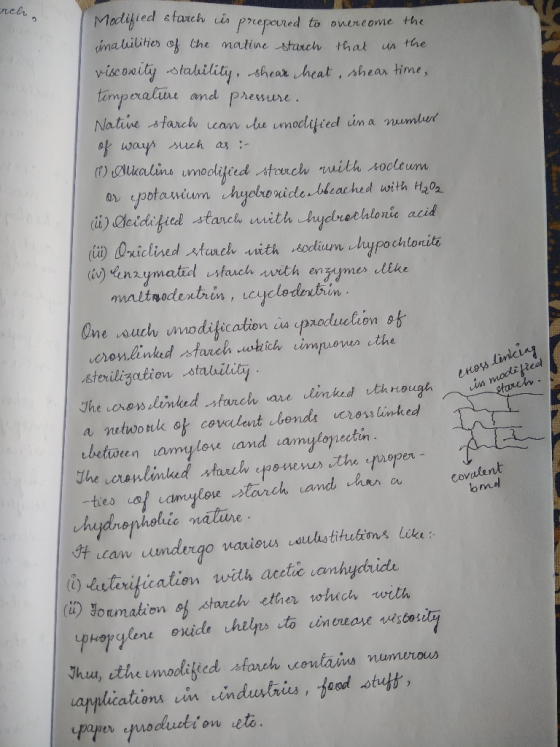
explain substitution and cross linking in modified starch and reference the reactive groups
explain substitution and cross linking in modified starch and reference the reactive groups
Homework Answers
Add Answer to:
explain substitution and cross linking in modified
starch and reference the reactive groups
Compare chemical cross-linking and physical cross-linking between polymer strands in terms of thermal reversibility and rigidity/strength....
Compare chemical cross-linking and physical cross-linking between polymer strands in terms of thermal reversibility and rigidity/strength. Explain these differences by comparing the types of interactions between polymer strands (chemical bonds vs. intermolecular interactions).
Place the following in order from least reactive to most reactive, in reference to reactivity towards...
 Place the following in order from least reactive to most reactive, in reference to reactivity towards electrophilic aromatic substitution a.) Group 1 b.) Group 2 or or of
Arrange the following groups of compounds in order from most reactive to least reactive toward electrophilic...
Arrange the following groups of compounds in order from most reactive to least reactive toward electrophilic aromatic substitution. 1. Benzene, ethylbenzene, chlorobenzene, nitrobenzene, anisole. 2. Toluene, p-cresol, benzene, p-xylene. 3. Benzene, benzoic acid, phenol, propylbenzene. 4. p-Methylnitrobenzene, 2-chloro-1-methyl-4-nitrobenzene, 1-methyl-2,4-dinitrobenzene, p-chloromethylbenzene.
(7 points) Explain why esters are more reactive towards nucleophilic acyl substitution compared to amides. Your...
 (7 points) Explain why esters are more reactive towards nucleophilic acyl substitution compared to amides. Your answer should be clear and concise. Writing more than necessary only increases the odds of writing an incorrect statement, which could result in points off. nucleophilic acyl substitution Nu R X R Nu - - - - - - - - - - O RO R NO Ester Amide
Can someone explain how I am supposed to know which is least reactive compared to most reactive? I know that the benzen...
 Can someone explain how I am supposed to know which is least
reactive compared to most reactive? I know that the benzene with
the NO2 group on it is least reactive because it's an EWG (electron
withdrawing group) so a deactivator but how do I compare the
others? Thanks!!!
Rank the following compounds in order of their reactivity toward electrophilic aromatic substitution NO2 CH least reactive (slowest) most reactive (fastest) b
Rank the following compounds in order of their reactivity...
Can someone explain how I am supposed to know which is least
reactive compared to most reactive? I know that the benzene with
the NO2 group on it is least reactive because it's an EWG (electron
withdrawing group) so a deactivator but how do I compare the
others? Thanks!!!
Rank the following compounds in order of their reactivity toward electrophilic aromatic substitution NO2 CH least reactive (slowest) most reactive (fastest) b
Rank the following compounds in order of their reactivity...
_15. The class least reactive towards acyl substitution is a. carboxylates b. esters c. acid anhydrides...
 _15. The class least reactive towards acyl substitution is a. carboxylates b. esters c. acid anhydrides d. carboxylic acids e. acid halides f. amides _ 16. Acetals protect aldehyde carbonyl groups from all of the following except: a. acidic conditions b. nucleophiles c. organometallics H h O d. basic conditions are. hydride reduction
Although carboxylic acids are readily available compounds, they are not very reactive towards nucleophilic acyl substitution...
Although carboxylic acids are readily available compounds, they are not very reactive towards nucleophilic acyl substitution because of their poor leaving group (hydroxide ion, a strong base). Thus, a variety of methods in the lab and in nature have been utilized to activate carboxylic acids, converting them into compounds with better leaving groups. Which of the following reagents/conditions could be used to activate a carboxylic acid? A. SOCl2 B. DIBAL-H C. ATP D. Both A and B E. Both A...
What are your reference groups? List and discuss at least 4 groups that influence your purchases....
What are your reference groups? List and discuss at least 4 groups that influence your purchases. For each group, indicate whether it's influence is comparative or normative (or both) and explain your answers. Please some references also
3. (11 marks) Answer with reference to the following article. Genetically Modified Foods A gentetically modified...
 3. (11 marks) Answer with reference to the following article. Genetically Modified Foods A gentetically modified (GM) food has had its DNA altered through genetic engineer rather than through conventional breeding. The first commercial GM food was Calgene's Flavr Savr tomato that resisted rotting, which the company claimed would enable it to stay on the vine longer to ripen. It was first marketed in 1994 without any special labeling. Other common GM crops include canola, cotton, rice and sugar cane....
Cross Cultural Management Explain “all” of the following topics: -What diversity encompasses in the United States...
Cross Cultural Management Explain “all” of the following topics: -What diversity encompasses in the United States -The historical background for the study of diversity - Key diversity terms, including types of discrimination - Minority groups and non-dominant groups - Stereotyping, prejudice, and discrimination theories.
 Place the following in order from least reactive to most reactive, in reference to reactivity towards electrophilic aromatic substitution a.) Group 1 b.) Group 2 or or of
 (7 points) Explain why esters are more reactive towards nucleophilic acyl substitution compared to amides. Your answer should be clear and concise. Writing more than necessary only increases the odds of writing an incorrect statement, which could result in points off. nucleophilic acyl substitution Nu R X R Nu - - - - - - - - - - O RO R NO Ester Amide
 Can someone explain how I am supposed to know which is least
reactive compared to most reactive? I know that the benzene with
the NO2 group on it is least reactive because it's an EWG (electron
withdrawing group) so a deactivator but how do I compare the
others? Thanks!!!
Rank the following compounds in order of their reactivity toward electrophilic aromatic substitution NO2 CH least reactive (slowest) most reactive (fastest) b
Rank the following compounds in order of their reactivity...
Can someone explain how I am supposed to know which is least
reactive compared to most reactive? I know that the benzene with
the NO2 group on it is least reactive because it's an EWG (electron
withdrawing group) so a deactivator but how do I compare the
others? Thanks!!!
Rank the following compounds in order of their reactivity toward electrophilic aromatic substitution NO2 CH least reactive (slowest) most reactive (fastest) b
Rank the following compounds in order of their reactivity...
 _15. The class least reactive towards acyl substitution is a. carboxylates b. esters c. acid anhydrides d. carboxylic acids e. acid halides f. amides _ 16. Acetals protect aldehyde carbonyl groups from all of the following except: a. acidic conditions b. nucleophiles c. organometallics H h O d. basic conditions are. hydride reduction
 3. (11 marks) Answer with reference to the following article. Genetically Modified Foods A gentetically modified (GM) food has had its DNA altered through genetic engineer rather than through conventional breeding. The first commercial GM food was Calgene's Flavr Savr tomato that resisted rotting, which the company claimed would enable it to stay on the vine longer to ripen. It was first marketed in 1994 without any special labeling. Other common GM crops include canola, cotton, rice and sugar cane....
Most questions answered within 3 hours.
-
Where is the error in this code sequence?
String s1 = "Hello";
String s2 = "ello";...
asked 10 months ago -
Financial data for Joel de Paris, Inc., for last year
follow:
Joel de Paris, Inc.
Balance...
asked 10 months ago -
Consider this reaction:
Al2(SO4)3 (aq)+ BaCl3
(aq) Al2Cl6 (aq)- +
3BaSO4(s) . What is the...
asked 10 months ago -
Suppose that Savneet is considering increasing her
recent random sample from 20 car rentals to 40...
asked 10 months ago -
Trucks arrive at an unloading terminal at an average rate of 120
per hour.
Trucks arrive...
asked 10 months ago -
Why are methanol and ethanol completely soluble in water while
octanol is not very little soluble....
asked 10 months ago -
A facilities manager at a university reads in a research report
that the mean amount of...
asked 10 months ago -
When the CuSO4 is rehydrated by adding water to the anhydrous
compound, is this an endothermic...
asked 10 months ago -
A ray of sunlight is passing from diamond into crown glass; the
angle of incidence is...
asked 10 months ago -
A block of mass 0.249 kg is placed on top of a light, vertical
spring of...
asked 10 months ago -
how do the kidneys compensate in the presences of acidosis
a) trigger hyperventilate
b) reserve acid...
asked 10 months ago -
Question 501 pts
The rental rate of capital to the firm increases. Which of the
following...
asked 10 months ago