
Homework Answers
Add Answer to:
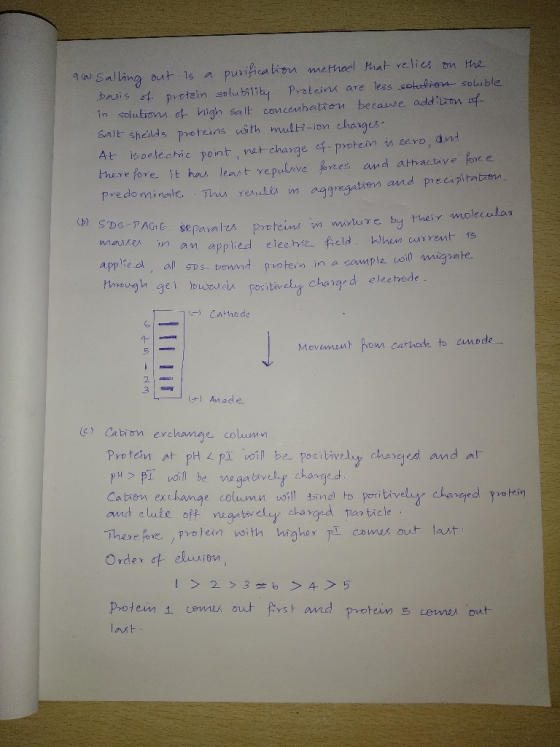
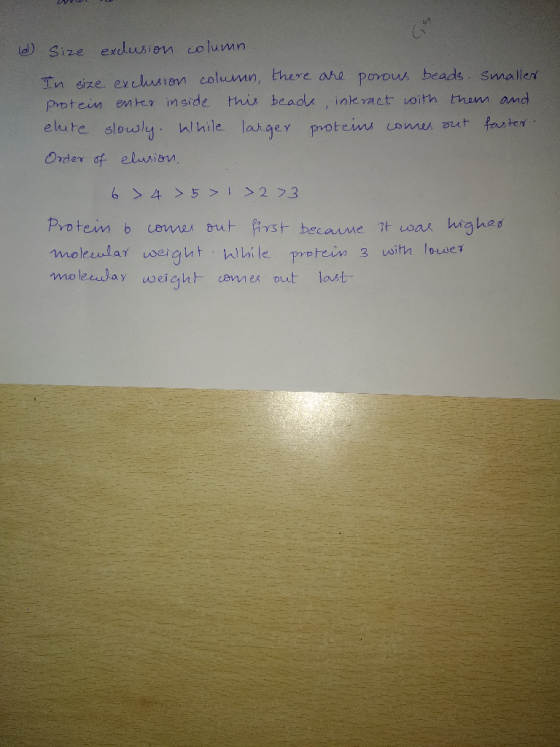
9. The following proteins were identified in a mixture. protein te precipitate MW (kDa) 4.8 22...
Work out 9C and 9D using info given please. No additional info is needed. Workout all parts of number 9. Explain in...
 Work out 9C and 9D using info given please. No additional info
is needed.
Workout all parts of number 9. Explain in clear details on how to draw a gel, why and how to determine where the bands will be formed. 9. The following proteins were identified in a mixture. protein MW (kDa) 38 4.8 [MgSO.) resured to precious 45% 80% 65% 20% 30% 45% 6.8 9.50 5.3 115 a) What is meant by "salting out a protein using MgSO:?...
Work out 9C and 9D using info given please. No additional info
is needed.
Workout all parts of number 9. Explain in clear details on how to draw a gel, why and how to determine where the bands will be formed. 9. The following proteins were identified in a mixture. protein MW (kDa) 38 4.8 [MgSO.) resured to precious 45% 80% 65% 20% 30% 45% 6.8 9.50 5.3 115 a) What is meant by "salting out a protein using MgSO:?...
You have a mixture of three proteins: Protein X, MW 15 kDa, pI 4.5 Protein Y, MW 25 kDa, pI 8.5 Protein Z, MW 75 kDa,...
 You have a mixture of three proteins: Protein X, MW 15 kDa, pI 4.5 Protein Y, MW 25 kDa, pI 8.5 Protein Z, MW 75 kDa, pl 5.0 2) You have a cation exchange (acidic) column, low salt (100 mM NaCl) and high salt (1 M NaCI) buffer at pH 7.0. If you loaded the above mixture of proteins on the column in low salt buffer, which proteins would most likely be retained on the column? If you loaded the...
You have a mixture of the proteins listed below. Protein pI Molecular Weight (kDa) A 3.1...
You have a mixture of the proteins listed below. Protein pI Molecular Weight (kDa) A 3.1 265 B 6.9 93 C 10.3 96 D 7.1 43 E 8.6 189 1. You load the protein mix onto a cation exchange column at pH 5. Next, you apply a "washing" step by passing through buffer at pH 5. Finally, for your elution step, you apply a pH gradient starting from pH 2.0 to pH 13.0. (A gradient buffer system allows you to...
NOTES: To separate on a size-exclusion column, differences in MW need to be greater than 10%....
NOTES: To separate on a size-exclusion column, differences in MW need to be greater than 10%. To separate proteins by charge, the difference in pI must be at least 0.5 pH unit. Consider the table of four proteins below: Protein Size pI Size exclusion Charge at pH 7.4 DEAE-elution 1 49 kDa 6.8 2 51 kDa 8.1 3 53 kDa 6.4 4 99 kDa 8.3 5 106 kDa 3.8 6 143 kDa 7.9 (a) In what order would the proteins...
 Work out 9C and 9D using info given please. No additional info
is needed.
Workout all parts of number 9. Explain in clear details on how to draw a gel, why and how to determine where the bands will be formed. 9. The following proteins were identified in a mixture. protein MW (kDa) 38 4.8 [MgSO.) resured to precious 45% 80% 65% 20% 30% 45% 6.8 9.50 5.3 115 a) What is meant by "salting out a protein using MgSO:?...
Work out 9C and 9D using info given please. No additional info
is needed.
Workout all parts of number 9. Explain in clear details on how to draw a gel, why and how to determine where the bands will be formed. 9. The following proteins were identified in a mixture. protein MW (kDa) 38 4.8 [MgSO.) resured to precious 45% 80% 65% 20% 30% 45% 6.8 9.50 5.3 115 a) What is meant by "salting out a protein using MgSO:?...
 You have a mixture of three proteins: Protein X, MW 15 kDa, pI 4.5 Protein Y, MW 25 kDa, pI 8.5 Protein Z, MW 75 kDa, pl 5.0 2) You have a cation exchange (acidic) column, low salt (100 mM NaCl) and high salt (1 M NaCI) buffer at pH 7.0. If you loaded the above mixture of proteins on the column in low salt buffer, which proteins would most likely be retained on the column? If you loaded the...
Most questions answered within 3 hours.
-
Where is the error in this code sequence?
String s1 = "Hello";
String s2 = "ello";...
asked 11 months ago -
Financial data for Joel de Paris, Inc., for last year
follow:
Joel de Paris, Inc.
Balance...
asked 11 months ago -
Consider this reaction:
Al2(SO4)3 (aq)+ BaCl3
(aq) Al2Cl6 (aq)- +
3BaSO4(s) . What is the...
asked 11 months ago -
Suppose that Savneet is considering increasing her
recent random sample from 20 car rentals to 40...
asked 11 months ago -
Trucks arrive at an unloading terminal at an average rate of 120
per hour.
Trucks arrive...
asked 11 months ago -
Why are methanol and ethanol completely soluble in water while
octanol is not very little soluble....
asked 11 months ago -
A facilities manager at a university reads in a research report
that the mean amount of...
asked 11 months ago -
When the CuSO4 is rehydrated by adding water to the anhydrous
compound, is this an endothermic...
asked 11 months ago -
A ray of sunlight is passing from diamond into crown glass; the
angle of incidence is...
asked 11 months ago -
A block of mass 0.249 kg is placed on top of a light, vertical
spring of...
asked 11 months ago -
how do the kidneys compensate in the presences of acidosis
a) trigger hyperventilate
b) reserve acid...
asked 11 months ago -
Question 501 pts
The rental rate of capital to the firm increases. Which of the
following...
asked 11 months ago