
Homework Answers
Plastic has the ability to grab hold of electrons. so when a rubber rod is rubbed with plastic, electrons get transferred to plastic, making the rubber positively charged. On the other hand, rubbing a glass rod with hair makes the hair to lose electrons because materials like hair or fur can lose electrons easily. These electrons get transferred to the glass rod, making it negatively charged. When both these rods are brought close to each other, they attract.
Add Answer to:
A rubber rod is rubbed with plastic, and a glass rod is rubbed with human hair....
A glass rod is rubbed on a nylon cloth. The glass rod and nylon cloth are then...
A glass rod is rubbed on a nylon cloth. The glass rod and nylon cloth are then each touched to a different pith ball. The pith ball touched by the glass rod becomes _______________ charged and the pith ball touched by the nylon cloth becomes ______________ charged. These pith balls then ______________each other because _________________ charges attract and ______________ charges repel. Options: Attract Like Negatively Positively Repel Unlike
1. a) What will happen to one glass rod near another one after being both charged?...
1. a) What will happen to one glass rod near another one after being both charged? Attract, Repel, or Neither b) Based on the result for part a, do the two glass rods have the same charge or opposite charges? Explain. 2) A rubber to another rubber repel each other, bases on that, do the two rubber rods have the same charge or opposite charges? Explain. 3) A glass and a rubber attract each other, based on that, do...
1) A plastic comb is pulled through initially neutral hair. The comb accumulates 1 μC of...
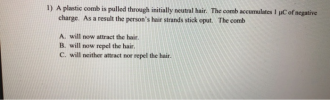 1) A plastic comb is pulled through initially neutral hair. The comb accumulates 1 μC of negative charge. As a result the person's hair strands stick oput. The comb A. will now attract the hair. B. will now repel the hair. C. will neither attract nor repel the hair.
UDSTTUNZ A rod of glass is rubbed with a piece of silk, the rod and the...
 UDSTTUNZ A rod of glass is rubbed with a piece of silk, the rod and the silk were initially neutral. After rubbing, the galss rod becomes positively charged. What happens to the silk? The silk remains neutral. The silk becomes negatively charged. The silk becomes positively charged. Not enough information.
An electrostatically charged object (e.g. plastic rod that was vigorously rubbed with wool/fur) is put in...
An electrostatically charged object (e.g. plastic rod that was vigorously rubbed with wool/fur) is put in contact with a neural metallic soda can. Consequently, charges are transferred from the plastic rod to the soda can. On which surface the charges will stay on the soda can (inside, outside, both inside and outside, …). EXPLAIN WHY
1) You have a glass rod that has been rubbed with silk, and a small neutrally-charged...
1) You have a glass rod that has been rubbed with silk, and a small neutrally-charged aluminum foil ball attached to a thread. You slowly approach the ball with the rod and then make contact between the ball and the rod. Glass tends to acquire a positive charged when rubbed with silk. Based on this information sketch a picture of the final excess charge distributions on the glass rod and aluminum foil ball.
A glass rod is rubbed with silk, giving it a total charge of +10nC. How many...
 A glass rod is rubbed with silk, giving it a total charge of +10nC. How many electrons or protons were added or removed? How much does the rod's mass change, in kilograms, when rubbed by the silk.
-12 points KatzPSE1 23.P007. A glass rod is initially neutral. After it is rubbed with silk,...
 -12 points KatzPSE1 23.P007. A glass rod is initially neutral. After it is rubbed with silk, its charge is 89.5 HC (a) Has the rod gained or lost mass? Explain. O The rod has gained mass. Electrons have been added to the rod. The rod has lost mass. Electrons have been stripped from the rod (b) How much mass has the rod gained or lost? kg Need Help? Read It -/2 points KatzPSE1 23.P.008 . Estimate the fractional increase or...
1) An electrostatically charged object (e.g. plastic rod that was vigorously rubbed with wool/fur) is put...
1) An electrostatically charged object (e.g. plastic rod that was vigorously rubbed with wool/fur) is put in contact with a neural metallic soda can. Consequently, charges are transferred from the plastic rod to the soda can. On which surface the charges will stay on the soda can (inside, outside, both inside and outside, …). EXPLAIN WHY. (2 points) 2) Describe in a few words a method to generate an electric field, in which the field lines are straight, parallel, and...
After an initially neutral glass rod is rubbed with an initially neutral silk scarf, the rod...
 After an initially neutral glass rod is rubbed with an initially neutral silk scarf, the rod has a charge of 16.8 pC. Estimate the fractional increase or decrease in the scarf's mass. (Assume the scarf had a mass of 100 g) AM Would this change in mass be easily noticed? (Assume that this change is noticeable if it is more than 1 mg.) O Yes O No
 1) A plastic comb is pulled through initially neutral hair. The comb accumulates 1 μC of negative charge. As a result the person's hair strands stick oput. The comb A. will now attract the hair. B. will now repel the hair. C. will neither attract nor repel the hair.
 UDSTTUNZ A rod of glass is rubbed with a piece of silk, the rod and the silk were initially neutral. After rubbing, the galss rod becomes positively charged. What happens to the silk? The silk remains neutral. The silk becomes negatively charged. The silk becomes positively charged. Not enough information.
 A glass rod is rubbed with silk, giving it a total charge of +10nC. How many electrons or protons were added or removed? How much does the rod's mass change, in kilograms, when rubbed by the silk.
 -12 points KatzPSE1 23.P007. A glass rod is initially neutral. After it is rubbed with silk, its charge is 89.5 HC (a) Has the rod gained or lost mass? Explain. O The rod has gained mass. Electrons have been added to the rod. The rod has lost mass. Electrons have been stripped from the rod (b) How much mass has the rod gained or lost? kg Need Help? Read It -/2 points KatzPSE1 23.P.008 . Estimate the fractional increase or...
 After an initially neutral glass rod is rubbed with an initially neutral silk scarf, the rod has a charge of 16.8 pC. Estimate the fractional increase or decrease in the scarf's mass. (Assume the scarf had a mass of 100 g) AM Would this change in mass be easily noticed? (Assume that this change is noticeable if it is more than 1 mg.) O Yes O No
Most questions answered within 3 hours.
-
Where is the error in this code sequence?
String s1 = "Hello";
String s2 = "ello";...
asked 11 months ago -
Financial data for Joel de Paris, Inc., for last year
follow:
Joel de Paris, Inc.
Balance...
asked 11 months ago -
Consider this reaction:
Al2(SO4)3 (aq)+ BaCl3
(aq) Al2Cl6 (aq)- +
3BaSO4(s) . What is the...
asked 11 months ago -
Suppose that Savneet is considering increasing her
recent random sample from 20 car rentals to 40...
asked 11 months ago -
Trucks arrive at an unloading terminal at an average rate of 120
per hour.
Trucks arrive...
asked 11 months ago -
Why are methanol and ethanol completely soluble in water while
octanol is not very little soluble....
asked 11 months ago -
A facilities manager at a university reads in a research report
that the mean amount of...
asked 11 months ago -
When the CuSO4 is rehydrated by adding water to the anhydrous
compound, is this an endothermic...
asked 11 months ago -
A ray of sunlight is passing from diamond into crown glass; the
angle of incidence is...
asked 11 months ago -
A block of mass 0.249 kg is placed on top of a light, vertical
spring of...
asked 11 months ago -
how do the kidneys compensate in the presences of acidosis
a) trigger hyperventilate
b) reserve acid...
asked 11 months ago -
Question 501 pts
The rental rate of capital to the firm increases. Which of the
following...
asked 11 months ago