FIFO, LIFO, WEIGHTED AVERAGE
- Determine cost of beginning inventory and each purchase, each sale, ending inventory
Beginning inventory 100 units at 150
Purchases
January 3: 100 units at 50
February 10: 150 units at 45
June 3: 90 units at 60
August 2: 200 units at 40
October 10: 210 units at 40
Sales:
January 4: 40 units
March 11: 30 units
June 31: 50 units
September 10: 80 units
November 2: 50 units
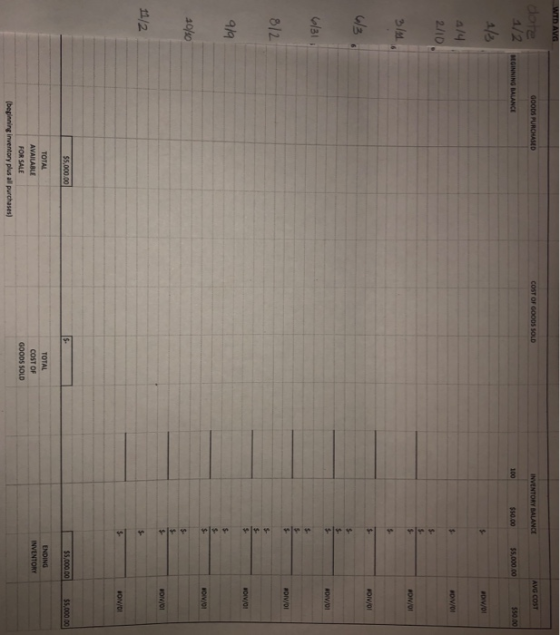
After determining the cost of beginning inventory and each purchase, each sale, ending inventory fill in the spreadsheet.
Homework Answers
1) FIFO Method:-
Calculation of Cost of Goods Sold and Ending Inventory (Amounts in $)
| Date | Purchases | Cost of Goods Sold | Ending balance | ||||||
| Qty (a) | Unit Cost (b) | Total Cost (a*b) | Qty (c) | Unit Cost (d) | Total Cost (c*d) | Qty (e) | Unit Cost (f) | Total Cost (e*f) | |
| Beg Inv | 100 | 150 | 15,000 | ||||||
| Jan 3 | 100 | 50 | 5,000 | 100 | 150 | 15,000 | |||
| 100 | 50 | 5,000 | |||||||
| Jan 4 | 40 | 150 | 6,000 | 60 | 150 | 9,000 | |||
| 100 | 50 | 5,000 | |||||||
| Feb 10 | 150 | 45 | 6,750 | 60 | 150 | 9,000 | |||
| 100 | 50 | 5,000 | |||||||
| 150 | 45 | 6,750 | |||||||
| Mar 11 | 30 | 150 | 4,500 | 30 | 150 | 4,500 | |||
| 100 | 50 | 5,000 | |||||||
| 150 | 45 | 6,750 | |||||||
| Jun 3 | 90 | 60 | 5,400 | 30 | 150 | 4,500 | |||
| 100 | 50 | 5,000 | |||||||
| 150 | 45 | 6,750 | |||||||
| 90 | 60 | 5,400 | |||||||
| Jun 30 | 30 | 150 | 4,500 | 80 | 50 | 4,000 | |||
| 20 | 50 | 1,000 | 150 | 45 | 6,750 | ||||
| 90 | 60 | 5,400 | |||||||
| Aug 2 | 200 | 40 | 8,000 | 80 | 50 | 4,000 | |||
| 150 | 45 | 6,750 | |||||||
| 90 | 60 | 5,400 | |||||||
| 200 | 40 | 8,000 | |||||||
| Sep 10 | 80 | 50 | 4,000 | 150 | 45 | 6,750 | |||
| 90 | 60 | 5,400 | |||||||
| 200 | 40 | 8,000 | |||||||
| Oct 10 | 210 | 40 | 8,400 | 150 | 45 | 6,750 | |||
| 90 | 60 | 5,400 | |||||||
| 200 | 40 | 8,000 | |||||||
| 210 | 40 | 8,400 | |||||||
| Nov 2 | 50 | 45 | 2,250 | 100 | 45 | 4,500 | |||
| 90 | 60 | 5,400 | |||||||
| 200 | 40 | 8,000 | |||||||
| 210 | 40 | 8,400 | |||||||
| Total | 750 | 33,550 | 250 | 22,250 | 600 | 26,300 | |||
Therefore cost of goods sold is $22,250 and cost of ending inventory is $26,300 under FIFO.
2) LIFO Method:-
Calculation of Cost of Goods Sold and Ending Inventory (Amounts in $)
| Date | Purchases | Cost of Goods Sold | Ending balance | ||||||
| Qty (a) | Unit Cost (b) | Total Cost (a*b) | Qty (c) | Unit Cost (d) | Total Cost (c*d) | Qty (e) | Unit Cost (f) | Total Cost (e*f) | |
| Beg Inv | 100 | 150 | 15,000 | ||||||
| Jan 3 | 100 | 50 | 5,000 | 100 | 150 | 15,000 | |||
| 100 | 50 | 5,000 | |||||||
| Jan 4 | 40 | 50 | 2,000 | 100 | 150 | 15,000 | |||
| 60 | 50 | 3,000 | |||||||
| Feb 10 | 150 | 45 | 6,750 | 100 | 150 | 15,000 | |||
| 60 | 50 | 3,000 | |||||||
| 150 | 45 | 6,750 | |||||||
| Mar 11 | 30 | 45 | 1,350 | 100 | 150 | 15,000 | |||
| 60 | 50 | 3,000 | |||||||
| 120 | 45 | 5,400 | |||||||
| Jun 3 | 90 | 60 | 5,400 | 100 | 150 | 15,000 | |||
| 60 | 50 | 3,000 | |||||||
| 120 | 45 | 5,400 | |||||||
| 90 | 60 | 5,400 | |||||||
| Jun 30 | 50 | 60 | 3,000 | 100 | 150 | 15,000 | |||
| 60 | 50 | 3,000 | |||||||
| 120 | 45 | 5,400 | |||||||
| 40 | 60 | 2,400 | |||||||
| Aug 2 | 200 | 40 | 8,000 | 100 | 150 | 15,000 | |||
| 60 | 50 | 3,000 | |||||||
| 120 | 45 | 5,400 | |||||||
| 40 | 60 | 2,400 | |||||||
| 200 | 40 | 8,000 | |||||||
| Sep 10 | 80 | 40 | 3,200 | 100 | 150 | 15,000 | |||
| 60 | 50 | 3,000 | |||||||
| 120 | 45 | 5,400 | |||||||
| 40 | 60 | 2,400 | |||||||
| 120 | 40 | 4,800 | |||||||
| Oct 10 | 210 | 40 | 8,400 | 100 | 150 | 15,000 | |||
| 60 | 50 | 3,000 | |||||||
| 120 | 45 | 5,400 | |||||||
| 40 | 60 | 2,400 | |||||||
| 120 | 40 | 4,800 | |||||||
| 210 | 40 | 8,400 | |||||||
| Nov 2 | 50 | 40 | 2,000 | 100 | 150 | 15,000 | |||
| 60 | 50 | 3,000 | |||||||
| 120 | 45 | 5,400 | |||||||
| 40 | 60 | 2,400 | |||||||
| 120 | 40 | 4,800 | |||||||
| 160 | 40 | 6,400 | |||||||
| Total | 750 | 33,550 | 250 | 11,550 | 600 | 37,000 | |||
Therefore cost of goods sold is $11,550 and cost of ending inventory is $37,000 under LIFO.
3) Weighted Average Method:-
Calculation of Cost of Goods Sold and Ending Inventory (Amounts in $)
| Date | Purchases | Cost of Goods Sold | Ending balance | ||||||
| Qty (a) | Unit Cost (b) | Total Cost (a*b) | Qty (c) | Unit Cost (d) | Total Cost (c*d) | Qty (e) | Unit Cost (f) | Total Cost (g = e*f) | |
| Beg Inv | 100 | 150 | 15,000 | ||||||
| Jan 3 | 100 | 50 | 5,000 | 100 | 150 | 15,000 | |||
| 100 | 50 | 5,000 | |||||||
| Average (g/e) | 200 | 100 | 20,000 | ||||||
| Jan 4 | 40 | 100 | 4,000 | 160 | 100 | 16,000 | |||
| Feb 10 | 150 | 45 | 6,750 | 160 | 100 | 16,000 | |||
| 150 | 45 | 6,750 | |||||||
| Average (g/e) | 310 | 73.3871 | 22,750 | ||||||
| Mar 11 | 30 | 73.3871 | 2,202 | 280 | 73.3871 | 20,548 | |||
| Jun 3 | 90 | 60 | 5,400 | 280 | 73.3871 | 20,548 | |||
| 90 | 60 | 5,400 | |||||||
| Average (g/e) | 370 | 70.12973 | 25,948 | ||||||
| Jun 30 | 50 | 70.12973 | 3,506 | 320 | 70.12973 | 22,442 | |||
| Aug 2 | 200 | 40 | 8,000 | 320 | 70.12973 | 22,442 | |||
| 200 | 40 | 8,000 | |||||||
| Average (g/e) | 520 | 58.54231 | 30,442 | ||||||
| Sep 10 | 80 | 58.54231 | 4,683 | 440 | 58.54231 | 25,759 | |||
| Oct 10 | 210 | 40 | 8,400 | 440 | 58.54231 | 25,759 | |||
| 210 | 40 | 8,400 | |||||||
| Average (g/e) | 650 | 52.55231 | 34,159 | ||||||
| Nov 2 | 50 | 52.55231 | 2,628 | 600 | 52.55231 | 31,531 | |||
| Total | 750 | 33,550 | 250 | 17,019 | 600 | 31,531 | |||
Therefore cost of goods sold is $17,019 and cost of ending inventory is $31,531 under weighted average method.
(Under this method average cost is calculated after each purchase by dividing total cost of goods available for sale by total units available for sale).
Add Answer to:
FIFO, LIFO, WEIGHTED AVERAGE
- Determine cost of beginning inventory and each purchase, each
sale, ending...
FIFO, LIFO, WEIGHTED AVERAGE - Determine cost of beginning inventory and each purchase, each sale, ending...
 FIFO, LIFO, WEIGHTED AVERAGE
- Determine cost of beginning inventory and each purchase,
each sale, ending inventory
Beginning inventory 100 units at 150
Purchases
January 3: 100 units at 50
February 10: 150 units at 45
June 3: 90 units at 60
August 2: 200 units at 40
October 10: 210 units at 40
Sales:
January 4: 40 units
March 11: 30 units
June 31: 50 units
September 10: 80 units
November 2: 50 units
After determining the cost of...
FIFO, LIFO, WEIGHTED AVERAGE
- Determine cost of beginning inventory and each purchase,
each sale, ending inventory
Beginning inventory 100 units at 150
Purchases
January 3: 100 units at 50
February 10: 150 units at 45
June 3: 90 units at 60
August 2: 200 units at 40
October 10: 210 units at 40
Sales:
January 4: 40 units
March 11: 30 units
June 31: 50 units
September 10: 80 units
November 2: 50 units
After determining the cost of...
Compute the cost assigned to ending inventory using (a) FIFO, (b) LIFO, (c) weighted average, and...
 Compute the cost assigned to ending inventory using (a) FIFO,
(b) LIFO, (c) weighted average, and (d) specific identification.
For specific identification, units sold consist of 600 units from
beginning inventory, 380 from the February 10 purchase, 120 from
the March 13 purchase, 130 from the August 21 purchase, and 205
from the September 5 purchase. (Round your average cost per unit to
2 decimal places.)
Montoure Company uses a perpetual inventory system. It entered into the following calendar-year purchases...
Compute the cost assigned to ending inventory using (a) FIFO,
(b) LIFO, (c) weighted average, and (d) specific identification.
For specific identification, units sold consist of 600 units from
beginning inventory, 380 from the February 10 purchase, 120 from
the March 13 purchase, 130 from the August 21 purchase, and 205
from the September 5 purchase. (Round your average cost per unit to
2 decimal places.)
Montoure Company uses a perpetual inventory system. It entered into the following calendar-year purchases...
Weighted average method cost LIFO Perpetual Inventory The beginning inventory for Dunne Co. and data on purchases...
 Weighted average method cost
LIFO Perpetual Inventory The beginning inventory for Dunne Co. and data on purchases and sales for a Number of Units Date Transaction Per Unit Total Apr. 3 Inventory $1,200 8 Purchase 1,240 $30,000 93,000 80,000 60,000 11 Sale 2,000 30 Sale May 8 10 2,000 1,260 2,000 Sale 19 28 June 5 Sale Purchase Sale 2,000 1,260 75,600 100,000 40,000 100,800 90,000 16 Sale 56,250 2,250 252,250 1,264 2,250 21 Purchase 44,240 28 Sale 99,000 Legg...
Weighted average method cost
LIFO Perpetual Inventory The beginning inventory for Dunne Co. and data on purchases and sales for a Number of Units Date Transaction Per Unit Total Apr. 3 Inventory $1,200 8 Purchase 1,240 $30,000 93,000 80,000 60,000 11 Sale 2,000 30 Sale May 8 10 2,000 1,260 2,000 Sale 19 28 June 5 Sale Purchase Sale 2,000 1,260 75,600 100,000 40,000 100,800 90,000 16 Sale 56,250 2,250 252,250 1,264 2,250 21 Purchase 44,240 28 Sale 99,000 Legg...
Weighted Average Cost Method with Perpetual Inventory The beginning inventory for Dunne Co. and data on...
Weighted Average Cost Method with Perpetual Inventory The beginning inventory for Dunne Co. and data on purchases and sales for a three-month period are as follows: Date Transaction Number of Units Per Unit Total Apr. 3 Inventory 25 $1,200 $30,000 8 Purchase 75 1,240 93,000 11 Sale 40 2,000 80,000 30 Sale 30 2,000 60,000 May 8 Purchase 60 1,260 75,600 10 Sale 50 2,000 100,000 19 Sale 20 2,000 40,000 28 Purchase 80 1,260 100,800 June 5 Sale 40...
Calculate ending inventory and cost of goods sold using Specific Identification, FIFO, LIFO, and Weighted Average....
 Calculate ending inventory and cost of
goods sold using Specific Identification, FIFO, LIFO, and Weighted
Average.
Required information Problem 6-2B Calculate ending inventory, cost of goods sold, sales revenue, and gross profit for four inventory methods (LO6-3, 6-4, 6-5) (The following information applies to the questions displayed below.] Pete's Tennis Shop has the following transactions related to its top-selling Wilson tennis racket for the month of August. Pete's Tennis Shop uses a periodic inventory system. Date Units Unit Cost Total...
Calculate ending inventory and cost of
goods sold using Specific Identification, FIFO, LIFO, and Weighted
Average.
Required information Problem 6-2B Calculate ending inventory, cost of goods sold, sales revenue, and gross profit for four inventory methods (LO6-3, 6-4, 6-5) (The following information applies to the questions displayed below.] Pete's Tennis Shop has the following transactions related to its top-selling Wilson tennis racket for the month of August. Pete's Tennis Shop uses a periodic inventory system. Date Units Unit Cost Total...
Find cost goods sold & ending inventory for FIFO, LIFO, Average Cost DATE ACTIVITY es and...
 Find cost goods sold & ending inventory for FIFO, LIFO, Average
Cost
DATE ACTIVITY es and sale s Aibor Red is one of its most popular les of Arbor Red for the month of January, Redwyne Jan. 01 Beginning Inventory UNS ACOUIREDCOSTUNITS SOLD RETAIL UNITS ACOL 56.00 Jan. 10 Sales Jan. 20 Purchase Jan. 25 Sales Jan. 30 Purchase 60 55.00 100 $15.00 Instructions: 180 @ $4.50 80 @ $15.00
Find cost goods sold & ending inventory for FIFO, LIFO, Average
Cost
DATE ACTIVITY es and sale s Aibor Red is one of its most popular les of Arbor Red for the month of January, Redwyne Jan. 01 Beginning Inventory UNS ACOUIREDCOSTUNITS SOLD RETAIL UNITS ACOL 56.00 Jan. 10 Sales Jan. 20 Purchase Jan. 25 Sales Jan. 30 Purchase 60 55.00 100 $15.00 Instructions: 180 @ $4.50 80 @ $15.00
.............. Weighted Average Cost Method with Perpetual Inventory The beginning inventory for Dunne Co. and data...
 ..............
Weighted Average Cost Method with Perpetual Inventory The beginning inventory for Dunne Co. and data on purchases and sales for a three-month period are as follows: Number of Units Date Transaction Per Unit Total Apr. 3 8 Inventory Purchase $1,200 1,240 $30,000 93,000 80,000 11 Sale 2,000 30 Sale 2,000 60,000 May 8 Purchase 1,260 75,600 10 Sale 2,000 100,000 40,000 Sale 2,000 28 Purchase 1,260 100,800 June 5 Sale 2,250 2,250 16 21 Sale Purchase 90,000 56,250 44,240...
..............
Weighted Average Cost Method with Perpetual Inventory The beginning inventory for Dunne Co. and data on purchases and sales for a three-month period are as follows: Number of Units Date Transaction Per Unit Total Apr. 3 8 Inventory Purchase $1,200 1,240 $30,000 93,000 80,000 11 Sale 2,000 30 Sale 2,000 60,000 May 8 Purchase 1,260 75,600 10 Sale 2,000 100,000 40,000 Sale 2,000 28 Purchase 1,260 100,800 June 5 Sale 2,250 2,250 16 21 Sale Purchase 90,000 56,250 44,240...
Compute the cost assigned to ending inventory using (a) FIFO, (b) LIFO, (c) weighted average, and...
Compute the cost assigned to ending inventory using (a) FIFO, (b) LIFO, (c) weighted average, and (d) specific identification. Warnerwoods Company uses a perpetual inventory system. It entered into the following purchases and sales transactions for March. Date Activities Units Acquired at Cost Units Sold at Retail Mar. 1 Beginning inventory 210 units @ $53.20 per unit Mar. 5 Purchase 280 units @ $58.20 per unit Mar. 9 Sales 370 units @ $88.20 per unit Mar. 18 Purchase 140 units...
Computing Cost of Goods Sold and Ending Inventory Under FIFO, LIFO, and Average Cost Assume that...
 Computing Cost of Goods Sold and Ending Inventory Under FIFO, LIFO, and Average Cost Assume that Gode Company reports the following initial balance and subsequent purchase of inventory: Beginning inventory, 2017 1,000 units @ $100 each $100,000 Inventory purchased in 2017 2.000 units $150 each 300,000 Cost of goods available for sale in 2017 3.000 units $400,000 Assume that 1,600 units are sold during 2017. Compute the cost of goods sold for 2017 and the balance reported as ending inventory...
Determine cost of goods sold and ending inventory using FIFO, LIFO, and average-cost with analysis. ...
 Determine cost of goods sold and ending inventory using FIFO,
LIFO, and average-cost with analysis.
Financial Accounting, 8th Edition by Weygandt, Kieso, and
Kimmel
Primer on Using Microsoft Excel in Accounting by Rex A
Schildhouse
Problem: Doom's Day Distribution markets CDs of the performing
artist Marilynn. At...
Determine cost of goods sold and ending inventory using FIFO,
LIFO, and average-cost with analysis.
Financial Accounting, 8th Edition by Weygandt, Kieso, and
Kimmel
Primer on Using Microsoft Excel in Accounting by Rex A
Schildhouse
Problem: Doom's Day Distribution markets CDs of the performing
artist Marilynn. At...
 FIFO, LIFO, WEIGHTED AVERAGE
- Determine cost of beginning inventory and each purchase,
each sale, ending inventory
Beginning inventory 100 units at 150
Purchases
January 3: 100 units at 50
February 10: 150 units at 45
June 3: 90 units at 60
August 2: 200 units at 40
October 10: 210 units at 40
Sales:
January 4: 40 units
March 11: 30 units
June 31: 50 units
September 10: 80 units
November 2: 50 units
After determining the cost of...
FIFO, LIFO, WEIGHTED AVERAGE
- Determine cost of beginning inventory and each purchase,
each sale, ending inventory
Beginning inventory 100 units at 150
Purchases
January 3: 100 units at 50
February 10: 150 units at 45
June 3: 90 units at 60
August 2: 200 units at 40
October 10: 210 units at 40
Sales:
January 4: 40 units
March 11: 30 units
June 31: 50 units
September 10: 80 units
November 2: 50 units
After determining the cost of...
 Compute the cost assigned to ending inventory using (a) FIFO,
(b) LIFO, (c) weighted average, and (d) specific identification.
For specific identification, units sold consist of 600 units from
beginning inventory, 380 from the February 10 purchase, 120 from
the March 13 purchase, 130 from the August 21 purchase, and 205
from the September 5 purchase. (Round your average cost per unit to
2 decimal places.)
Montoure Company uses a perpetual inventory system. It entered into the following calendar-year purchases...
Compute the cost assigned to ending inventory using (a) FIFO,
(b) LIFO, (c) weighted average, and (d) specific identification.
For specific identification, units sold consist of 600 units from
beginning inventory, 380 from the February 10 purchase, 120 from
the March 13 purchase, 130 from the August 21 purchase, and 205
from the September 5 purchase. (Round your average cost per unit to
2 decimal places.)
Montoure Company uses a perpetual inventory system. It entered into the following calendar-year purchases...
 Weighted average method cost
LIFO Perpetual Inventory The beginning inventory for Dunne Co. and data on purchases and sales for a Number of Units Date Transaction Per Unit Total Apr. 3 Inventory $1,200 8 Purchase 1,240 $30,000 93,000 80,000 60,000 11 Sale 2,000 30 Sale May 8 10 2,000 1,260 2,000 Sale 19 28 June 5 Sale Purchase Sale 2,000 1,260 75,600 100,000 40,000 100,800 90,000 16 Sale 56,250 2,250 252,250 1,264 2,250 21 Purchase 44,240 28 Sale 99,000 Legg...
Weighted average method cost
LIFO Perpetual Inventory The beginning inventory for Dunne Co. and data on purchases and sales for a Number of Units Date Transaction Per Unit Total Apr. 3 Inventory $1,200 8 Purchase 1,240 $30,000 93,000 80,000 60,000 11 Sale 2,000 30 Sale May 8 10 2,000 1,260 2,000 Sale 19 28 June 5 Sale Purchase Sale 2,000 1,260 75,600 100,000 40,000 100,800 90,000 16 Sale 56,250 2,250 252,250 1,264 2,250 21 Purchase 44,240 28 Sale 99,000 Legg...
 Calculate ending inventory and cost of
goods sold using Specific Identification, FIFO, LIFO, and Weighted
Average.
Required information Problem 6-2B Calculate ending inventory, cost of goods sold, sales revenue, and gross profit for four inventory methods (LO6-3, 6-4, 6-5) (The following information applies to the questions displayed below.] Pete's Tennis Shop has the following transactions related to its top-selling Wilson tennis racket for the month of August. Pete's Tennis Shop uses a periodic inventory system. Date Units Unit Cost Total...
Calculate ending inventory and cost of
goods sold using Specific Identification, FIFO, LIFO, and Weighted
Average.
Required information Problem 6-2B Calculate ending inventory, cost of goods sold, sales revenue, and gross profit for four inventory methods (LO6-3, 6-4, 6-5) (The following information applies to the questions displayed below.] Pete's Tennis Shop has the following transactions related to its top-selling Wilson tennis racket for the month of August. Pete's Tennis Shop uses a periodic inventory system. Date Units Unit Cost Total...
 Find cost goods sold & ending inventory for FIFO, LIFO, Average
Cost
DATE ACTIVITY es and sale s Aibor Red is one of its most popular les of Arbor Red for the month of January, Redwyne Jan. 01 Beginning Inventory UNS ACOUIREDCOSTUNITS SOLD RETAIL UNITS ACOL 56.00 Jan. 10 Sales Jan. 20 Purchase Jan. 25 Sales Jan. 30 Purchase 60 55.00 100 $15.00 Instructions: 180 @ $4.50 80 @ $15.00
Find cost goods sold & ending inventory for FIFO, LIFO, Average
Cost
DATE ACTIVITY es and sale s Aibor Red is one of its most popular les of Arbor Red for the month of January, Redwyne Jan. 01 Beginning Inventory UNS ACOUIREDCOSTUNITS SOLD RETAIL UNITS ACOL 56.00 Jan. 10 Sales Jan. 20 Purchase Jan. 25 Sales Jan. 30 Purchase 60 55.00 100 $15.00 Instructions: 180 @ $4.50 80 @ $15.00
 ..............
Weighted Average Cost Method with Perpetual Inventory The beginning inventory for Dunne Co. and data on purchases and sales for a three-month period are as follows: Number of Units Date Transaction Per Unit Total Apr. 3 8 Inventory Purchase $1,200 1,240 $30,000 93,000 80,000 11 Sale 2,000 30 Sale 2,000 60,000 May 8 Purchase 1,260 75,600 10 Sale 2,000 100,000 40,000 Sale 2,000 28 Purchase 1,260 100,800 June 5 Sale 2,250 2,250 16 21 Sale Purchase 90,000 56,250 44,240...
..............
Weighted Average Cost Method with Perpetual Inventory The beginning inventory for Dunne Co. and data on purchases and sales for a three-month period are as follows: Number of Units Date Transaction Per Unit Total Apr. 3 8 Inventory Purchase $1,200 1,240 $30,000 93,000 80,000 11 Sale 2,000 30 Sale 2,000 60,000 May 8 Purchase 1,260 75,600 10 Sale 2,000 100,000 40,000 Sale 2,000 28 Purchase 1,260 100,800 June 5 Sale 2,250 2,250 16 21 Sale Purchase 90,000 56,250 44,240...
 Computing Cost of Goods Sold and Ending Inventory Under FIFO, LIFO, and Average Cost Assume that Gode Company reports the following initial balance and subsequent purchase of inventory: Beginning inventory, 2017 1,000 units @ $100 each $100,000 Inventory purchased in 2017 2.000 units $150 each 300,000 Cost of goods available for sale in 2017 3.000 units $400,000 Assume that 1,600 units are sold during 2017. Compute the cost of goods sold for 2017 and the balance reported as ending inventory...
 Determine cost of goods sold and ending inventory using FIFO,
LIFO, and average-cost with analysis.
Financial Accounting, 8th Edition by Weygandt, Kieso, and
Kimmel
Primer on Using Microsoft Excel in Accounting by Rex A
Schildhouse
Problem: Doom's Day Distribution markets CDs of the performing
artist Marilynn. At...
Determine cost of goods sold and ending inventory using FIFO,
LIFO, and average-cost with analysis.
Financial Accounting, 8th Edition by Weygandt, Kieso, and
Kimmel
Primer on Using Microsoft Excel in Accounting by Rex A
Schildhouse
Problem: Doom's Day Distribution markets CDs of the performing
artist Marilynn. At...
Most questions answered within 3 hours.
-
Where is the error in this code sequence?
String s1 = "Hello";
String s2 = "ello";...
asked 10 months ago -
Financial data for Joel de Paris, Inc., for last year
follow:
Joel de Paris, Inc.
Balance...
asked 10 months ago -
Consider this reaction:
Al2(SO4)3 (aq)+ BaCl3
(aq) Al2Cl6 (aq)- +
3BaSO4(s) . What is the...
asked 10 months ago -
Suppose that Savneet is considering increasing her
recent random sample from 20 car rentals to 40...
asked 10 months ago -
Trucks arrive at an unloading terminal at an average rate of 120
per hour.
Trucks arrive...
asked 10 months ago -
Why are methanol and ethanol completely soluble in water while
octanol is not very little soluble....
asked 10 months ago -
A facilities manager at a university reads in a research report
that the mean amount of...
asked 10 months ago -
When the CuSO4 is rehydrated by adding water to the anhydrous
compound, is this an endothermic...
asked 10 months ago -
A ray of sunlight is passing from diamond into crown glass; the
angle of incidence is...
asked 10 months ago -
A block of mass 0.249 kg is placed on top of a light, vertical
spring of...
asked 10 months ago -
how do the kidneys compensate in the presences of acidosis
a) trigger hyperventilate
b) reserve acid...
asked 10 months ago -
Question 501 pts
The rental rate of capital to the firm increases. Which of the
following...
asked 10 months ago