
Homework Answers
Add Answer to:
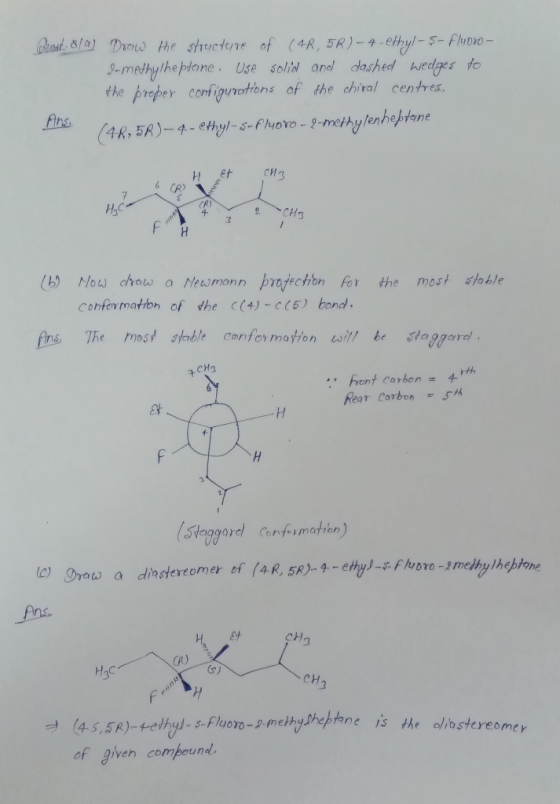
(a) Draw the structure of (4R,5R)-4-ethyl-5-luoro-2-methytheptane. Use solid and dashed wedges to show the proper configurations...
8. (a) Draw the structure of (4R,5R)-4-ethyl-5-fluoro-2-methyl heptane. Use solid and dashed wedges to show the...
 8. (a) Draw the structure of (4R,5R)-4-ethyl-5-fluoro-2-methyl heptane. Use solid and dashed wedges to show the proper configurations of the chiral centers. (0.4 pts) (b) Now draw a Newman projection for the most stable conformation of the C(4)-C(5) bond. (0.4 pts) H (c) Draw a diastereomer of (4R,5R)-4-ethyl-5-fluoro-2-methyl heptane (0.2 pts)
5. (a) Draw the structure of (1 S,2S,5R)-5-ethyl-2-isobutylcyclohexanol. Use solid and dashed wedges to show the...
 5. (a) Draw the structure of (1 S,2S,5R)-5-ethyl-2-isobutylcyclohexanol. Use solid and dashed wedges to show the proper configurations of the chiral centers. (0.4 pts) io noto gos owenA.msxo bnoooe orlt lo veb odt no oub al toomngla batgoo ( 0)emmyalo onelo a of bup (b) Draw both chair conformations for this structure. (0.4 pts) (c) Draw a box around the most stable chair conformation. (0.2 pts)
6. (a) Draw the structure of (18,25,5R)-5-ethyl-2-isobutylcyclohexanol. Use solid and dashed wedges to show the proper...
 6. (a) Draw the structure of (18,25,5R)-5-ethyl-2-isobutylcyclohexanol. Use solid and dashed wedges to show the proper configurations of the chiral centers. (0.4 pts) (b) Draw both chair conformations for this structure. (0.4 pts) OG (c) Draw a box around the most stable chair conformation. (0.2 pts)
5. (a) Draw the structure of (15.25,5R)-5-ethyl-2-isobutylcyclohexanol. Use solid and dashed wedges to show the proper...
 5. (a) Draw the structure of (15.25,5R)-5-ethyl-2-isobutylcyclohexanol. Use solid and dashed wedges to show the proper configurations of the chiral centers. (0.4 pts) (b) Draw both chair conformations for this structure (0.4 pts) (c) Draw a box around the most stable chair conformation (0.2 pts) 6. Compounds A, B, and C are stereoisomers of 1,3-dimethylcyclopentane. Characterize the following solutions as optically active or optically inactive: (1) an equal mixture of B and C and (2) an equal mixture of A...
Redraw (4S, 5R)-4-ethyl-5-propylnonane using wedges and dashes to show the correct stereochemistry
 Redraw (4S, 5R)-4-ethyl-5-propylnonane using wedges and dashes to show the correct stereochemistry
3. Draw all possible stereoisomers of 2-bromo-3-methoxypentane. Use solid and dashed wedges, where appropriate. (2 pts)...
 3. Draw all possible stereoisomers of 2-bromo-3-methoxypentane. Use solid and dashed wedges, where appropriate. (2 pts) осна 2-bromo-3-methoxypentane 4. Provide (RS)-designations for the four starred (*) chiral (stereogenic) centers. (2 pts) H
please answer all questions. 3. Draw all possible stereoisomers of 2-isopropylcyclobutanamine. Use solid and dashed wedges,...
 please answer all
questions.
3. Draw all possible stereoisomers of 2-isopropylcyclobutanamine. Use solid and dashed wedges, where appropriate. (2 pts) NH2 2-isopropylcyclobutanamine Provide (RS)-designations for the four starred (*) chiral (stereogenic) centers. (2 pts) 4. II . I I NT CH3
please answer all
questions.
3. Draw all possible stereoisomers of 2-isopropylcyclobutanamine. Use solid and dashed wedges, where appropriate. (2 pts) NH2 2-isopropylcyclobutanamine Provide (RS)-designations for the four starred (*) chiral (stereogenic) centers. (2 pts) 4. II . I I NT CH3
4) Draw the following compounds a. (2S,5R)-5-chloro-2-ethylhexanoic acid b. (1R,2R,4R)-4-ethylcyclohexane-1,2-diol c. (2S
4) Draw the following compounds a. (2S,5R)-5-chloro-2-ethylhexanoic acid b. (1R,2R,4R)-4-ethylcyclohexane-1,2-diol c. (2S,3R)-3-amino-2-phenylbutanal d. (1S,2S,3R)-2-fluoro-3-propylcyclobutanol e. (2E, 7Z)-5-bromo-2,7-nonadiene
4. Draw the most stable and most unstable Newman Projection for the following molecules using the...
 4. Draw the most stable and most unstable Newman Projection for the following molecules using the rotation around the C3-C4 bond (use the IUPAC rules to number the chain) 5. Draw the two chair conformations for each of the following cyclohexane derivatives and then choose the conformation that is the most stable. Br BA 3 3 3 $ 2879 So ya 6. For the following compounds, identify the chiral carbons with an asterisk (*) and for those that are not...
6. Draw the two chair conformations for cis-1-sec-butyl-2-ethylcyclohexane. Predict the most stable conformer and draw the...
 6. Draw the two chair conformations for cis-1-sec-butyl-2-ethylcyclohexane. Predict the most stable conformer and draw the corresponding Newman projection (4 pts) 7. Convert the following compounds from their 3D structure to their Fisher projection and vice-versa (4 pts) НО Br HO co₂me HN CI CO2Me НО -СІ НЕОН СН2ОН 5| Page 8. The specific rotation for (R)-methyl 2-chloro-2,3-dihydroxypropanoate is -126.7. A student prepare a sample of methyl 2-chloro-2,3-dihydroxypropanoate enantiomers that shows a specific rotation of +89.6, (a) Calculate the percent...
 8. (a) Draw the structure of (4R,5R)-4-ethyl-5-fluoro-2-methyl heptane. Use solid and dashed wedges to show the proper configurations of the chiral centers. (0.4 pts) (b) Now draw a Newman projection for the most stable conformation of the C(4)-C(5) bond. (0.4 pts) H (c) Draw a diastereomer of (4R,5R)-4-ethyl-5-fluoro-2-methyl heptane (0.2 pts)
 5. (a) Draw the structure of (1 S,2S,5R)-5-ethyl-2-isobutylcyclohexanol. Use solid and dashed wedges to show the proper configurations of the chiral centers. (0.4 pts) io noto gos owenA.msxo bnoooe orlt lo veb odt no oub al toomngla batgoo ( 0)emmyalo onelo a of bup (b) Draw both chair conformations for this structure. (0.4 pts) (c) Draw a box around the most stable chair conformation. (0.2 pts)
 6. (a) Draw the structure of (18,25,5R)-5-ethyl-2-isobutylcyclohexanol. Use solid and dashed wedges to show the proper configurations of the chiral centers. (0.4 pts) (b) Draw both chair conformations for this structure. (0.4 pts) OG (c) Draw a box around the most stable chair conformation. (0.2 pts)
 5. (a) Draw the structure of (15.25,5R)-5-ethyl-2-isobutylcyclohexanol. Use solid and dashed wedges to show the proper configurations of the chiral centers. (0.4 pts) (b) Draw both chair conformations for this structure (0.4 pts) (c) Draw a box around the most stable chair conformation (0.2 pts) 6. Compounds A, B, and C are stereoisomers of 1,3-dimethylcyclopentane. Characterize the following solutions as optically active or optically inactive: (1) an equal mixture of B and C and (2) an equal mixture of A...
 Redraw (4S, 5R)-4-ethyl-5-propylnonane using wedges and dashes to show the correct stereochemistry
 3. Draw all possible stereoisomers of 2-bromo-3-methoxypentane. Use solid and dashed wedges, where appropriate. (2 pts) осна 2-bromo-3-methoxypentane 4. Provide (RS)-designations for the four starred (*) chiral (stereogenic) centers. (2 pts) H
 please answer all
questions.
3. Draw all possible stereoisomers of 2-isopropylcyclobutanamine. Use solid and dashed wedges, where appropriate. (2 pts) NH2 2-isopropylcyclobutanamine Provide (RS)-designations for the four starred (*) chiral (stereogenic) centers. (2 pts) 4. II . I I NT CH3
please answer all
questions.
3. Draw all possible stereoisomers of 2-isopropylcyclobutanamine. Use solid and dashed wedges, where appropriate. (2 pts) NH2 2-isopropylcyclobutanamine Provide (RS)-designations for the four starred (*) chiral (stereogenic) centers. (2 pts) 4. II . I I NT CH3
 4. Draw the most stable and most unstable Newman Projection for the following molecules using the rotation around the C3-C4 bond (use the IUPAC rules to number the chain) 5. Draw the two chair conformations for each of the following cyclohexane derivatives and then choose the conformation that is the most stable. Br BA 3 3 3 $ 2879 So ya 6. For the following compounds, identify the chiral carbons with an asterisk (*) and for those that are not...
 6. Draw the two chair conformations for cis-1-sec-butyl-2-ethylcyclohexane. Predict the most stable conformer and draw the corresponding Newman projection (4 pts) 7. Convert the following compounds from their 3D structure to their Fisher projection and vice-versa (4 pts) НО Br HO co₂me HN CI CO2Me НО -СІ НЕОН СН2ОН 5| Page 8. The specific rotation for (R)-methyl 2-chloro-2,3-dihydroxypropanoate is -126.7. A student prepare a sample of methyl 2-chloro-2,3-dihydroxypropanoate enantiomers that shows a specific rotation of +89.6, (a) Calculate the percent...
Most questions answered within 3 hours.
-
Where is the error in this code sequence?
String s1 = "Hello";
String s2 = "ello";...
asked 11 months ago -
Financial data for Joel de Paris, Inc., for last year
follow:
Joel de Paris, Inc.
Balance...
asked 11 months ago -
Consider this reaction:
Al2(SO4)3 (aq)+ BaCl3
(aq) Al2Cl6 (aq)- +
3BaSO4(s) . What is the...
asked 11 months ago -
Suppose that Savneet is considering increasing her
recent random sample from 20 car rentals to 40...
asked 11 months ago -
Trucks arrive at an unloading terminal at an average rate of 120
per hour.
Trucks arrive...
asked 11 months ago -
Why are methanol and ethanol completely soluble in water while
octanol is not very little soluble....
asked 11 months ago -
A facilities manager at a university reads in a research report
that the mean amount of...
asked 11 months ago -
When the CuSO4 is rehydrated by adding water to the anhydrous
compound, is this an endothermic...
asked 11 months ago -
A ray of sunlight is passing from diamond into crown glass; the
angle of incidence is...
asked 11 months ago -
A block of mass 0.249 kg is placed on top of a light, vertical
spring of...
asked 11 months ago -
how do the kidneys compensate in the presences of acidosis
a) trigger hyperventilate
b) reserve acid...
asked 11 months ago -
Question 501 pts
The rental rate of capital to the firm increases. Which of the
following...
asked 11 months ago